
Hindu & Vedic Pantheon
The Remaining Gods
Heroes · Cosmic Beings · Sages · Asuras · Folk Deities
the pantheon beyond the great gods
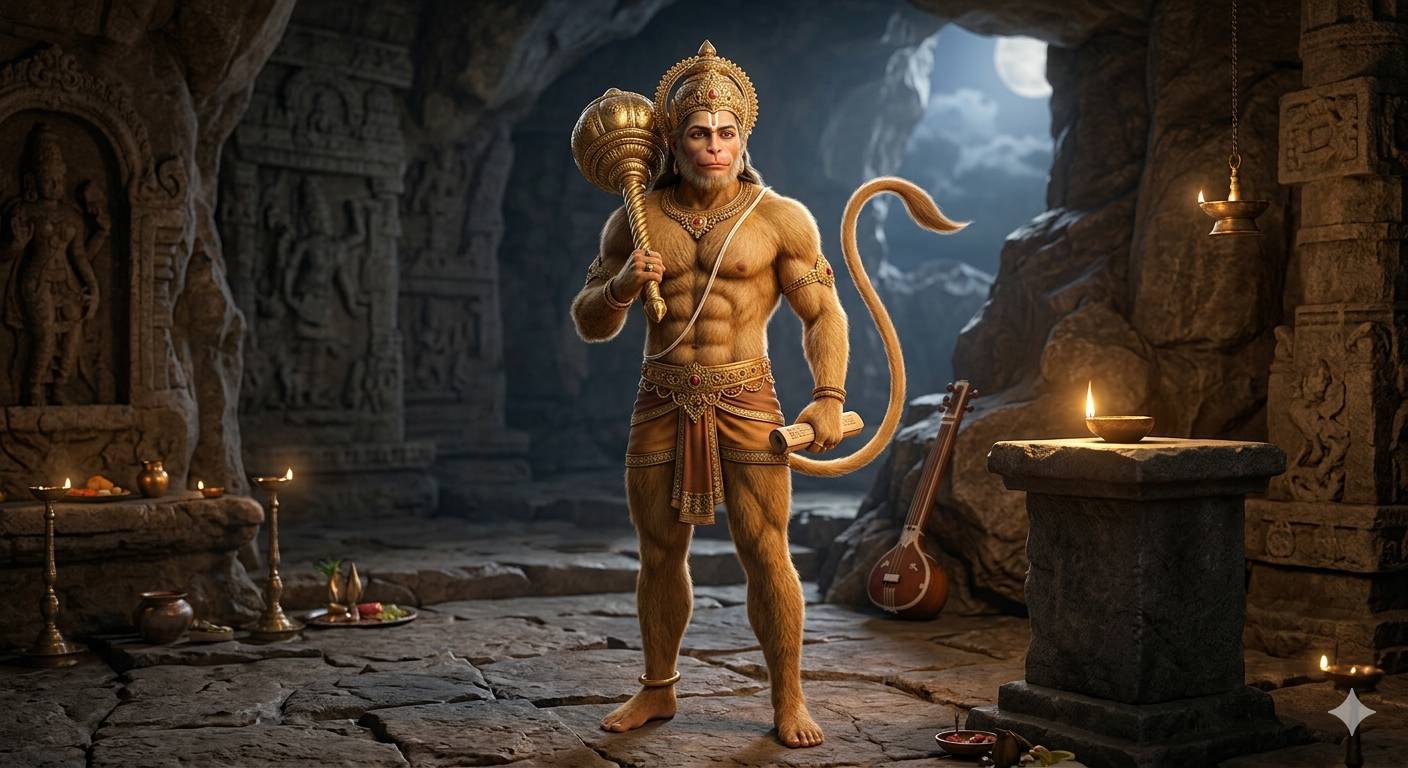
Hanuman is the son of Vayu (the wind god) and the most beloved devotee of Rama. He is the ideal of selfless service, devotion, strength, and courage. He is a Chiranjivi — an immortal being still alive on earth — and is considered by many traditions to be present wherever the Ramayana is recited. He is worshipped as the remover of obstacles, the protector of devotees, and the god of strength, courage, and knowledge. Also known as Anjaneya (son of Anjana), Pavanputra (son of the wind), Mahavira (the great hero), and Bajrang Bali.
Symbols & Iconography
Birth & Origin
Born to Anjana — a female vanara (monkey-being) who was actually an Apsara cursed to life in monkey form — and Kesari, the vanara king. Vayu, the wind god, carried the divine energy that led to his conception: when Anjana was performing austerities and the wind carried a portion of divine pudding (prepared for King Dasharatha's yagna) to her, she consumed it and Hanuman was born.
Family
Father: Vayu (divine) and Kesari (earthly). Mother: Anjana. He is celibate, and considered a devotee-son of Rama. Son: Makardhwaja, born without union from a drop of Hanuman's sweat — a regional tradition distinct from his vow of celibacy.
Scriptures
Hanuman is a central figure of the Valmiki Ramayana and the Ramcharitmanas of Tulsidas. He appears in the Mahabharata, the Skanda Purana, and numerous Puranic texts. The Hanuman Chalisa — a 40-verse devotional hymn composed by Tulsidas — is among the most widely recited religious texts in India today. The Makardhwaja narrative does not appear in Valmiki's original Ramayana; it is preserved in regional traditions, most notably Krittibas Ojha's Bangla Ramayana and Madhava Kandali's Assamese Ramayana.
Worship & Legacy
Hanuman is among the most actively worshipped deities in all of India — with more temples dedicated to him than almost any other deity. He is worshipped on Tuesdays and Saturdays, and Hanuman Jayanti (his birthday) is a major festival. The Sankat Mochan Hanuman Temple in Varanasi and the Mahavir Mandir in Patna are among the most significant, and every Ram temple in India includes Hanuman's shrine. He is the patron of Indian wrestling (Kushti), and many Akhadas (traditional gyms) maintain his shrines. Father and son are worshipped together at temples in Gujarat and Odisha, including the Balaji Makaradhwaja temple at Beawar, Rajasthan.
Key Stories
1. The Infant Who Leapt at the Sun
As an infant, Hanuman saw the sun and mistook it for a ripe fruit. He leapt toward it with great speed. Indra struck him with his thunderbolt to stop the assault, injuring his jaw (Hanu — hence his name Hanuman, "one with a broken jaw"). Vayu, furious at his son's injury, withdrew from all living beings — and life began to suffocate without wind. The gods, panicking, restored Hanuman with boons: Brahma made him invulnerable to the Brahmastra, Indra made his body harder than his own Vajra, Surya gave him mastery of learning, Kubera gave him protection from weapons in battle. He woke and forgot all his powers through a subsequent curse.
2. The Discovery of Sita
When Sita was abducted by Ravana, Rama sent Hanuman to search for her. Hanuman grew to an enormous size and leapt across the ocean to Lanka — a feat of such magnitude that it remains the most celebrated act in his mythology. In Lanka, he found Sita in the Ashoka grove, gave her Rama's ring as proof of his identity, and offered to carry her back. She refused — insisting that Rama himself must come and defeat Ravana to restore her honor. Hanuman then allowed himself to be captured by Ravana's forces, had his tail set on fire, and used his burning tail to set Lanka ablaze before escaping.
3. The Mountain of Herbs
During the battle at Lanka, Lakshmana was struck down by Indrajit's weapon and fell unconscious, near death. The physician Sushena declared that only the Sanjivani herb from the Dronagiri mountain could revive him, and that it must arrive before sunrise. Hanuman flew to the Himalayas but could not identify the specific herb in the dark. He lifted the entire mountain and carried it back to Lanka before sunrise. Lakshmana was revived. After the herb was used, Hanuman flew the mountain back.
4. The Opening of the Chest
After Rama's coronation, Sita gave Hanuman a necklace of pearls. He broke each pearl open and threw it away, saying there was no value in anything that did not contain Rama within it. When asked what did contain Rama, he tore open his own chest — and inside, carved on his heart, were the figures of Rama and Sita. This image — Hanuman with his chest open — is one of the most widely depicted scenes in Hindu devotional art.
5. Makardhwaja — The Son Born of Sweat
After burning Lanka, Hanuman dove into the ocean to cool himself. A drop of his sweat fell into the water and was swallowed by a Makara (a mythical sea creature), which conceived and gave birth to a being — half-vanara, half-aquatic — later named Makardhwaja. Raised by Ahiravana (a son of Ravana ruling the netherworld), Makardhwaja grew into a powerful warrior and was made guardian of Patala's gates. Years later, when Ahiravana abducted Rama and Lakshmana to Patala, Hanuman pursued them and was confronted at the gate by Makardhwaja, who refused him entry out of loyalty to his master. Neither recognized the other. They fought; Hanuman won. Only then did the truth emerge — Hanuman, bound by his vow of celibacy, was startled to learn he had a son, born without union, through his own sweat alone. Impressed by Makardhwaja's strength and unwavering loyalty, Hanuman installed him as the ruler of Patala.
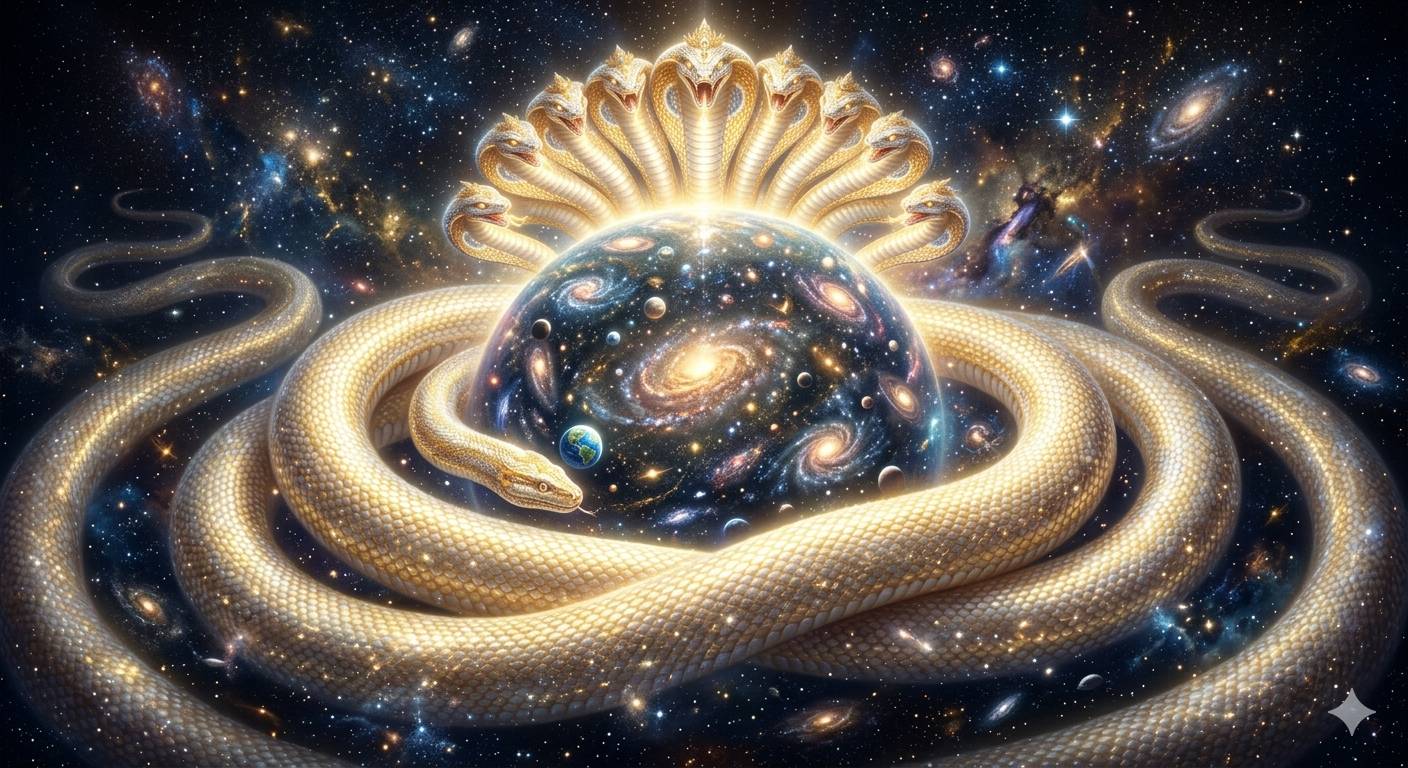
Shesha (also called Ananta — the infinite) is the cosmic serpent upon whose coils Vishnu rests in Yoga Nidra (cosmic sleep) on the primordial ocean between creation cycles. He is the king of all Nagas (serpent beings), a being of infinite size whose coils support the entire universe. Also known as Ananta Shesha and Sheshanaga.
Symbols & Iconography
Scriptures
Shesha appears in the Bhagavata Purana, Vishnu Purana, Mahabharata, and Ramayana.
Worship & Legacy
The most celebrated image of Shesha in worship is at the Anantapadmanabhaswamy Temple in Thiruvananthapuram, Kerala — where Vishnu is depicted reclining on Shesha in a massive 18-foot-long form. The temple is one of the wealthiest in the world and one of the four Vishnu Dhams (sacred abodes). The Naga Panchami festival — on which snakes are worshipped — honors Shesha and the Naga tradition.
Key Stories
1. The Support of the Universe
In the Bhagavata Purana, Shesha supports the earth on his hoods in the underworld (Patala). When he yawns, the earth trembles — the mythological explanation for earthquakes. He is the living foundation of the cosmos.
2. Shesha and Balarama
Balarama is considered Shesha's avatar on earth — which is why he is depicted with a serpent hood, is associated with ploughing (turning the earth), and ultimately exits the world not through death but by a white serpent emerging from his mouth and returning to the sea — Shesha receding from his earthly form.
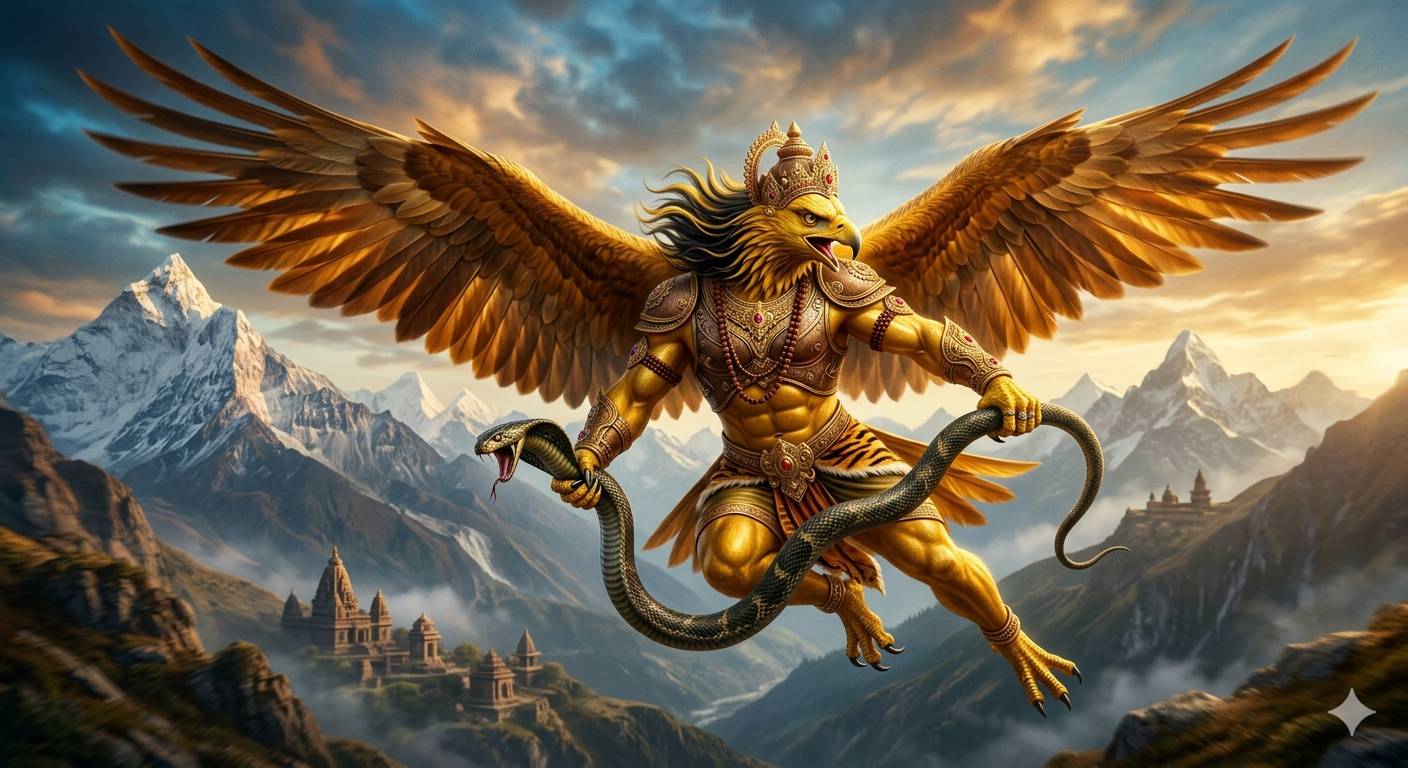
Garuda is the divine eagle — half man, half eagle — who is the vahana (mount) of Vishnu. He is the king of all birds, the sworn enemy of all serpents (Nagas), and himself a deity of considerable mythological depth. He is the symbol of the Indian national emblem and of speed, strength, and loyalty. Also known as Suparna (beautiful wings), Vainateya (son of Vinata), and Khageshvara (lord of birds).
Symbols & Iconography
Birth & Origin
Son of the sage Kashyapa and Vinata (one of Kashyapa's wives). His mother Vinata and her sister Kadru (mother of all serpents) made a wager over the color of the divine horse Uchchaihshravas's tail. Vinata lost through deception and was enslaved by Kadru and the Nagas. Garuda was born with a mission to free his mother.
Family
Father: Kashyapa. Mother: Vinata. Half-brothers: the Nagas (through Kashyapa's wife Kadru). Son: Jatayu (in some traditions).
Scriptures
Garuda is the subject of the Garuda Purana — one of the 18 Mahapuranas — which deals primarily with death, the afterlife, and the fate of souls, told in a frame of Vishnu speaking to Garuda. He appears in the Mahabharata (the Adi Parva contains his full origin story) and the Ramayana.
Worship & Legacy
Garuda is the national symbol of India — the Garuda emblem is the seal of the Indian government, adapted from the historical symbol of Vishnu's mount. He is also the national symbol of Indonesia — where he appears on the coat of arms as the Garuda, reflecting the enormous historical influence of Hindu culture in Southeast Asia. The Garuda Purana is traditionally recited during the mourning period after a Hindu death. Garuda shrines are present in most Vaishnava temples, typically facing the main sanctum.
Key Stories
1. The Quest for Amrita
To free his mother from slavery, the Nagas demanded the Amrita — the nectar of immortality — as ransom. Garuda flew to the celestial realm and stole the Amrita from the gods, defeating all the divine guardians. Indra struck him with his Vajra — Garuda lost a single feather from the impact, unharmed. He brought the Amrita to the Nagas and placed it on a bed of grass. Before the Nagas could drink it, Indra (who had befriended Garuda) took it back. The Nagas licked the grass blades on which it had rested — and the sharp grass split their tongues in two, which is why serpents have forked tongues.
2. Garuda and Vishnu
After the quest for Amrita, Vishnu appeared before Garuda and offered him a boon. Garuda asked to be positioned above Vishnu. Vishnu granted this and placed him on his flag (making the Garuda flag the symbol of Vishnu's chariot). Then Vishnu offered Garuda a second boon. Garuda asked to be Vishnu's vehicle. Vishnu agreed. From then on, Garuda carries Vishnu across the universe. Garuda asked for a third boon — immortality without the Amrita he had given away. Vishnu granted it.
3. The Pride and the Serpent Sumukha
Having held his position above Vishnu for some time, Garuda grew proud of it. When Indra granted the serpent Sumukha — Garuda's natural prey — a boon of immortality, Garuda quarreled with him, boasting that he was mightier than even Vishnu himself, citing his elevated place on the flagstaff as proof. Vishnu, to correct this pride, pressed down on Garuda with a single finger — a weight Garuda found unbearable. Garuda begged for relief. Vishnu released him but made him wear Sumukha around his neck like a garland from then on, as a permanent reminder against arrogance. This is why Garuda is depicted with a serpent draped across his chest, despite serpents being his natural enemies.
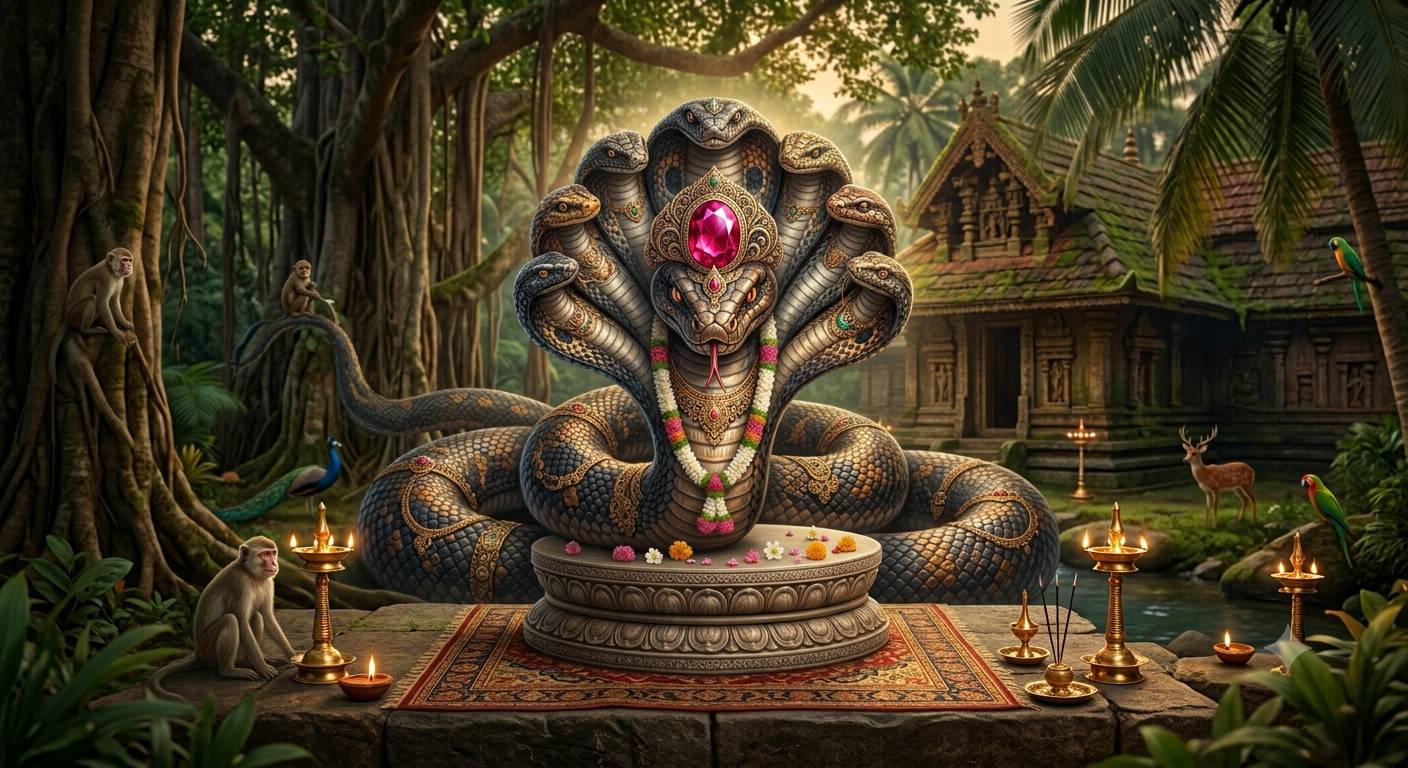
Vasuki is the king of the Nagas (serpent beings) who lives in Patala (the underworld). He is most famous for his role as the rope during the Samudra Manthan — the churning of the cosmic ocean. Shiva wears him coiled around his neck as an ornament, and Vasuki is considered one of Shiva's devotees. Also known as Nagadhiraja.
Symbols & Iconography
Birth & Origin
Born to the sage Kashyapa and Kadru, mother of all Nagas — one of her thousand serpent offspring.
Family
Father: Kashyapa. Mother: Kadru. Brothers: Shesha, Takshaka. Sister: Manasa (in some traditions).
Scriptures
Vasuki appears in the Mahabharata, Bhagavata Purana, and Vishnu Purana.
Worship & Legacy
Vasuki is worshipped during Naga Panchami alongside Shesha and other Naga deities. Nageshvara — one of the twelve Jyotirlingas — is associated with the Naga tradition of which Vasuki is a part.
Key Stories
1. The Churning of the Ocean
During the Samudra Manthan, Vasuki was used as the churning rope — wrapped around Mount Mandara, with the gods holding his tail and the demons holding his head. As the churning intensified, Vasuki's mouth breathed enormous quantities of smoke and venom — the demons, holding his head, were badly harmed by this, while the gods, holding his tail, were in a safer position.
2. Vasuki and Shiva
Vasuki is shown coiled around Shiva's neck in iconography — one of his most familiar ornaments. As a devotee of Shiva, he is worn as a mark of Shiva's mastery over serpents, death, and the underworld.
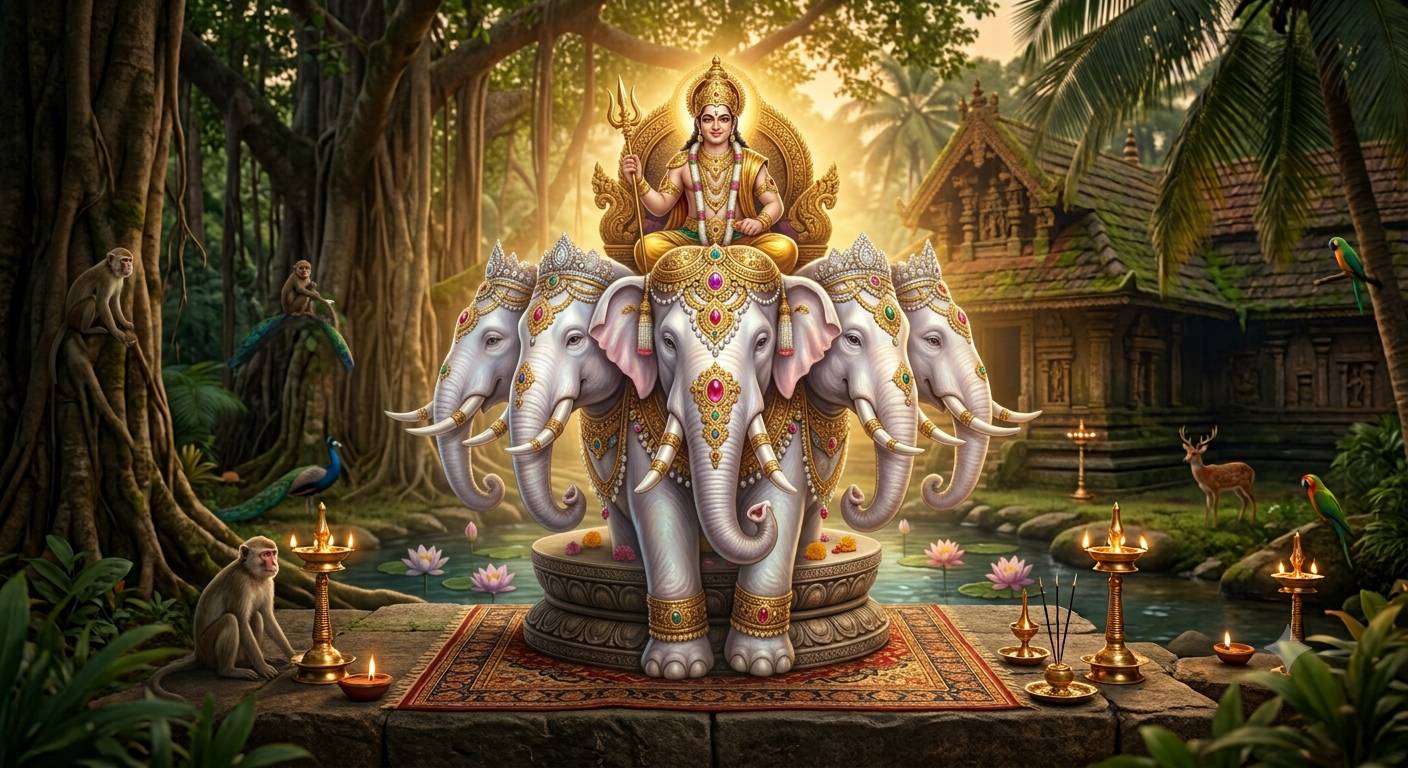
Airavata is the divine white elephant who emerged from the Samudra Manthan and became the vahana (mount) of Indra, king of the gods. He is the lord of all elephants and is associated with rain clouds — in the Vedic imagination, elephants were connected to clouds, and Airavata's white form was the divine cloud that brings rain. Also known as Ardha Matanga and Naga Malla.
Symbols & Iconography
Birth & Origin
Two distinct traditions describe Airavata's origin. In the Mahabharata and Bhagavata Purana, he emerged from the Samudra Manthan as one of its treasures and was claimed by Indra as his mount. In the Ramayana tradition, he is the son of Iravati and already exists as Indra's elephant — it is his trampling of Durvasa's garland that triggers the curse leading to the churning. The two accounts are reconciled in the Puranic doctrine that each cosmic age (Manvantara) has its own Indra, so the Airavata of one cycle differs from another. In the Ramayana he is also given the matronymic origin from which his name derives — "belonging to Iravati."
Scriptures
Airavata appears in the Bhagavata Purana, Vishnu Purana, Mahabharata, and Ramayana.
Worship & Legacy
Airavata has no independent temples but is present in virtually every temple that includes Indra as a directional guardian. The Erawan Shrine in Bangkok, Thailand — the most famous Hindu shrine in Southeast Asia — is dedicated to Brahma but features the four-faced Erawan elephant (the Thai form of Airavata) as its symbol. The Erawan Shrine is among the most visited religious sites in Southeast Asia.
Key Stories
1. Airavata and the Sage Durvasa
The conflict that precipitated the loss of the gods' power — and necessitated the Samudra Manthan — began with Airavata. The irascible sage Durvasa gave Indra a divine flower garland. Indra placed it on Airavata's head. Airavata threw it to the ground. Durvasa, furious at the disrespect, cursed Indra and all the gods to lose their power, prosperity, and glory. The gods weakened, the demons gained supremacy, and Vishnu advised the Samudra Manthan as the remedy.
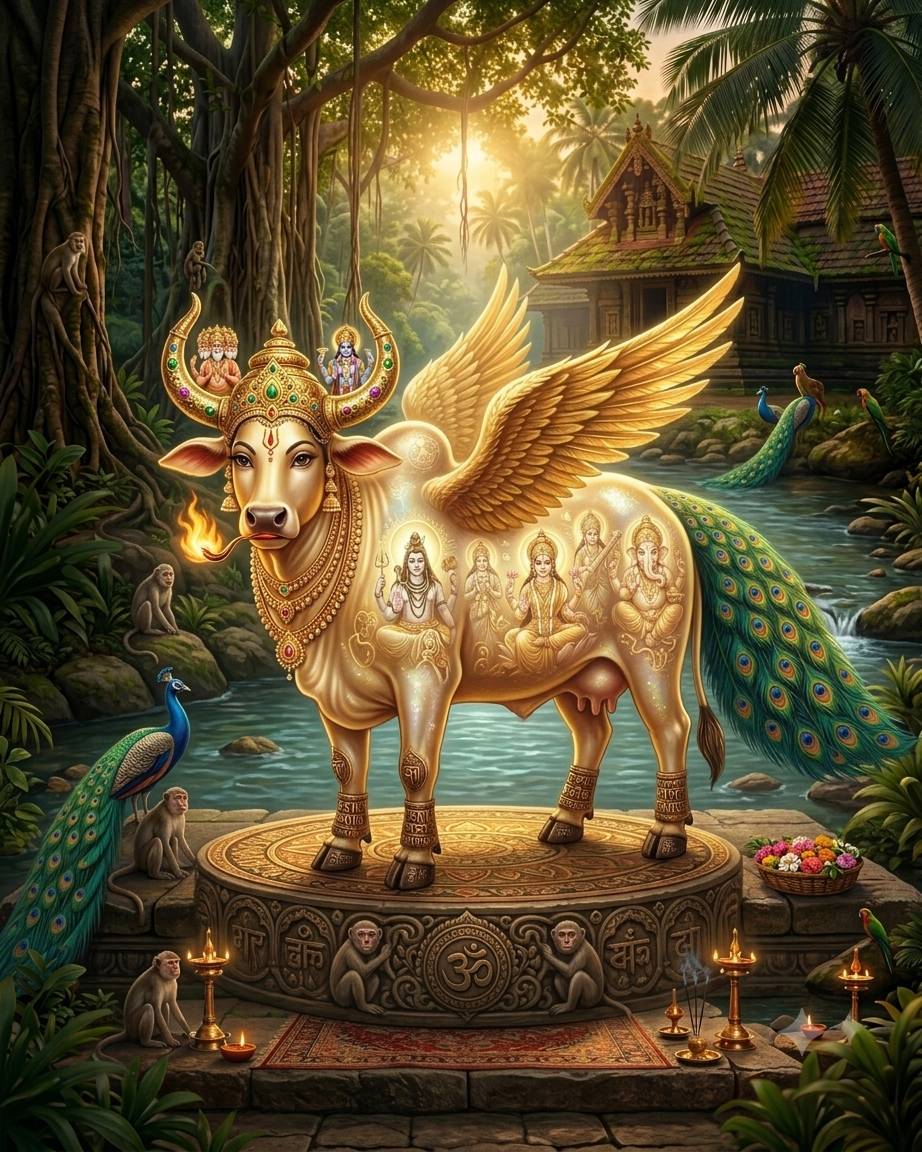
Kamadhenu is the wish-fulfilling cow of the gods — a divine bovine capable of producing whatever is needed by whoever possesses her. She is the mother of all cows and the source of all abundance. She is sometimes identified with Surabhi, the cow who also emerged from the Samudra Manthan. She is associated with Brahma, with the sage Vasishtha, and with the ashrams of great sages who kept her. Also known as Surabhi, Nandini (when in the form kept by Vasishtha), and Sabala.
Symbols & Iconography
Scriptures
Kamadhenu appears in the Mahabharata, Ramayana, Vishnu Purana, Bhagavata Purana, and Devi Bhagavata Purana.
Worship & Legacy
The cow in Hindu culture is considered sacred in part due to Kamadhenu's divine status as mother of all cows. The Panchagavya — the five products of the cow (milk, curd, ghee, urine, and dung) — are used in ritual purification. The protection of cows (Go Raksha) is a deeply embedded cultural value in Hindu tradition. No independent temples to Kamadhenu are standard, but her image appears in temples and she is invoked in rituals where abundance and wish-fulfillment are sought.
Key Stories
1. Vasishtha and Vishwamitra
The sage Vasishtha possessed Kamadhenu (here called Nandini or Sabala). The king Vishwamitra came to his hermitage with an army and demanded the cow. Vasishtha refused. Vishwamitra tried to take her by force. Nandini produced from her body an entire army — Pahlavas (Parthians), Shakas (Scythians), Kambojas, Yavanas (the Greeks, the word deriving from "Ionia"), and others including the Kiratas (Himalayan hill tribes), Cinas, Hunas (White Huns), and Sinhalas (of Sri Lanka) — that repelled Vishwamitra's forces. This conflict between the brahmin sage and the kshatriya king — over the sacred cow — is one of the foundational stories of Vishwamitra's transformation from king to sage. He eventually renounced his kingdom and performed austerities to become a brahmin himself, seeking to equal Vasishtha's power.
2. The Theft by Jamadagni's Visitor
The same conflict — a king attempting to take the sage's divine cow by force — is repeated in the story of Parashurama's father Jamadagni and the king Kartavirya Arjuna, with different and far bloodier consequences.
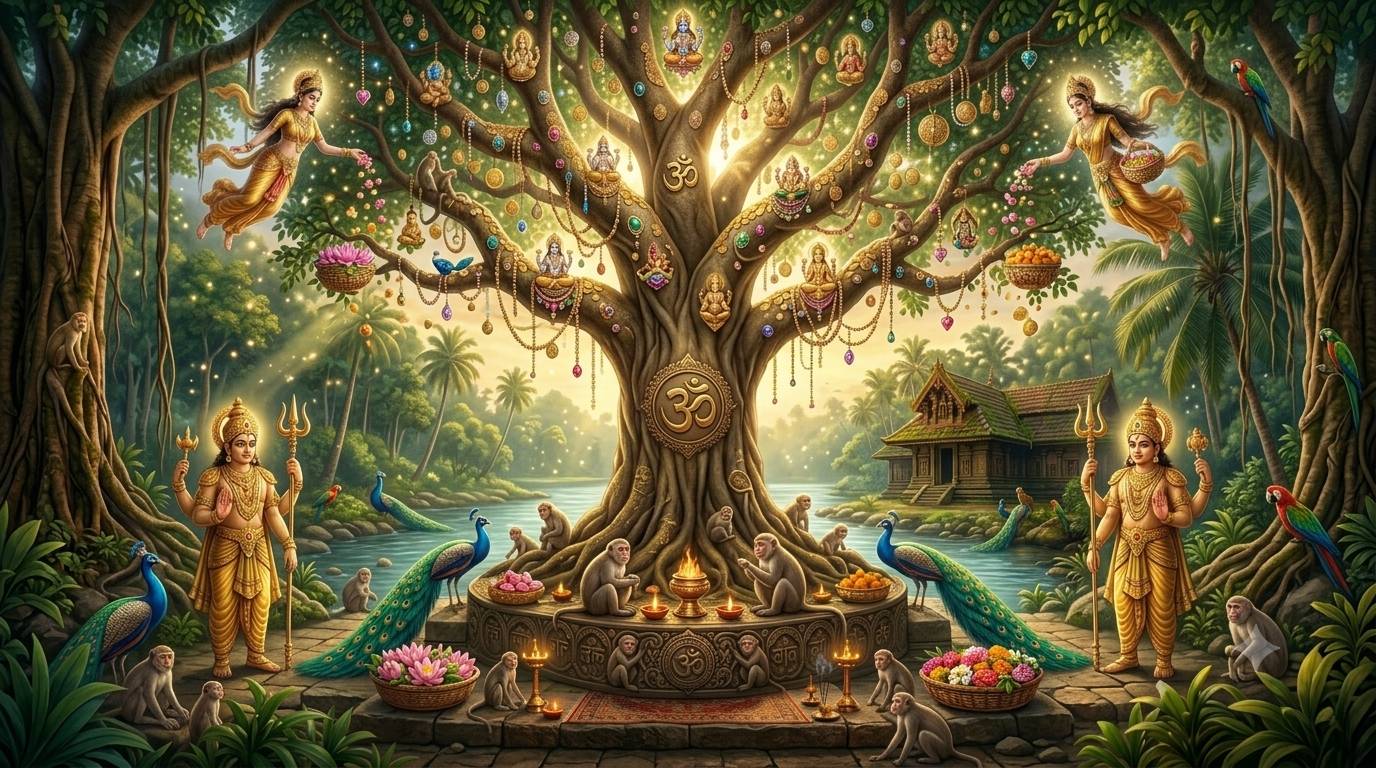
The Kalpavriksha (or Kalpa Vriksha) is the divine wish-fulfilling tree that grants any desire to those who stand beneath it. It is one of the five sacred trees of Indra's paradise (Svarga) — alongside the Mandara, Parijata, Santana, and Harichandana — and is considered the foremost among them. It is associated with abundance, generosity, and the fulfilment of desire. Also known as Kalpataru and Kalpadruma.
Symbols & Iconography
Birth & Origin
The Kalpavriksha emerged from the Samudra Manthan — the churning of the cosmic ocean — as one of its treasures. The gods, wary that such power might be misused if left on earth, carried it to Svarga and planted it in the Nandana garden, where it became the foremost of the five celestial trees.
Scriptures
The Kalpavriksha appears in the Bhagavata Purana, Mahabharata, and Vishnu Purana, and is named among the treasures of the Samudra Manthan.
Worship & Legacy
Several ancient trees across India are locally identified as Kalpavriksha — most notably at Prayagraj, where a tree near the Triveni Sangam is called by this name. The concept influenced temple tradition: the sthala vriksha (the sacred tree of a temple's grounds) in South Indian temples carries a comparable theological weight as a site of divine presence and wish-granting. The idea also passed into Jain and Buddhist cosmology, where wish-granting trees appear with related but distinct meanings.
Key Stories
1. The Parijata and Krishna
Krishna, at his wife Satyabhama's request, brought the Parijata tree — another of the five celestial trees — from Indra's heaven to earth. Indra objected and a battle ensued before Krishna succeeded in carrying it to his city of Dwarka. The Kalpavriksha itself remained in Svarga; only the Parijata was brought down.
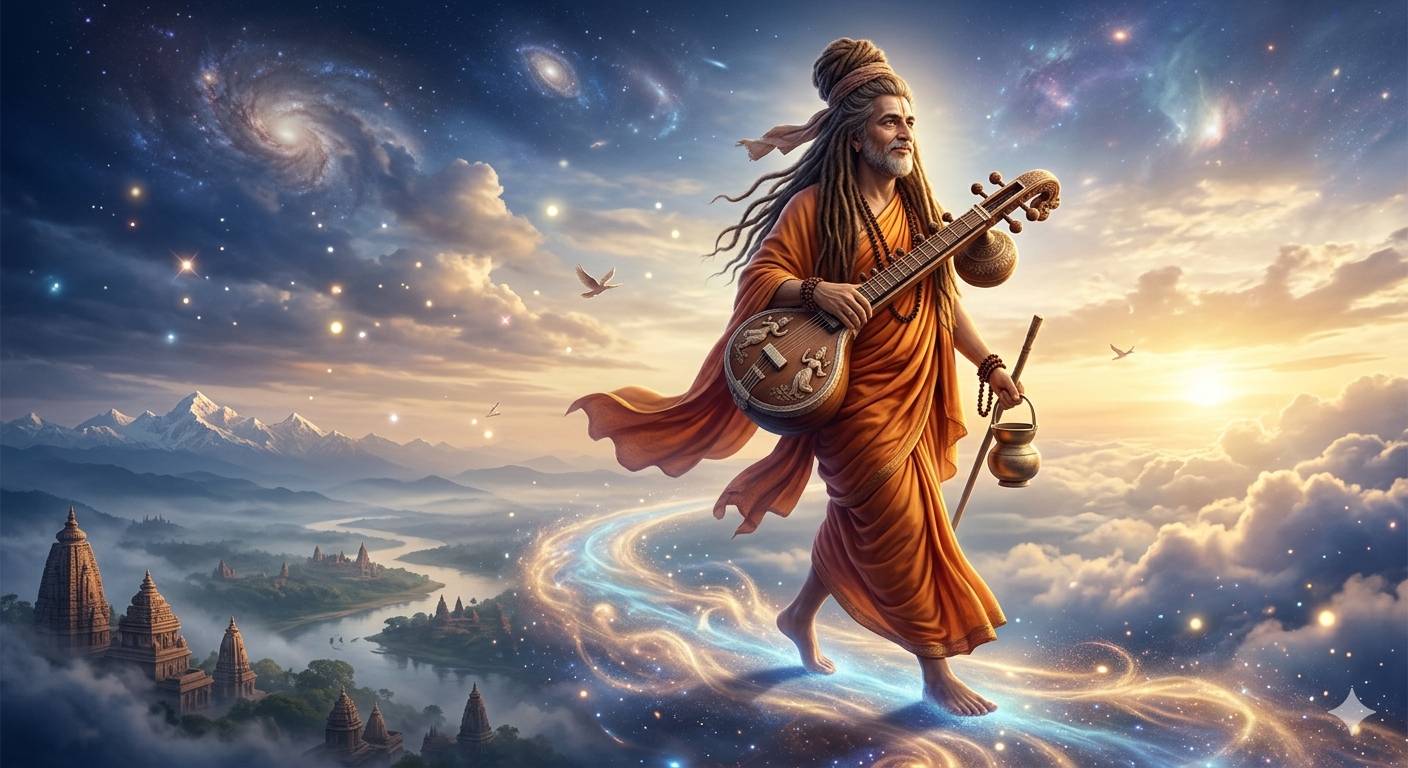
Narada is the divine sage and messenger who travels freely between all realms — the heavens of the gods, the earth, and the underworld — carrying news, precipitating events, and serving as a catalyst for many of the major stories in Hindu mythology. He is the son of Brahma and is considered the inventor of the vina (a stringed instrument). He is perpetually reciting the name of Vishnu — "Narayana, Narayana" — and is a beloved and mischievous figure in the entire Puranic tradition. Also known as Devarishi (divine sage), Brahmaputra, and Kalahamsa.
Symbols & Iconography
Birth & Origin
Son of Brahma — born from his lap or his thumb in different accounts. In the Bhagavata Purana, Narada tells his own story: he was born in a previous life as the son of a maidservant, became devoted to Vishnu through contact with wandering sages, and at death was granted rebirth as a divine sage with the freedom to travel all worlds.
Family
Father: Brahma. He is celibate — one of the eternal sages who does not marry or father children.
Scriptures
Narada appears throughout the Mahabharata, the Ramayana, the Bhagavata Purana, the Vishnu Purana, and virtually every other major Puranic text. The Narada Bhakti Sutras — aphorisms on devotion attributed to him — are a key text of the Bhakti (devotional) tradition.
Worship & Legacy
Narada has no major temples but is one of the most culturally present figures in the Hindu tradition — he appears in plays, films, television serials, and popular storytelling as the archetypal divine messenger who stirs the pot. Narada Jayanti is observed in some traditions. His name is sometimes used affectionately to describe someone who carries news between parties — though always ultimately in service of a larger divine purpose.
Key Stories
1. Narada the Catalyst
Narada's role in Hindu mythology is consistently that of a catalyst — he arrives in a story, delivers information or provokes a question, and sets major events in motion. He told Kamsa the prophecy that Krishna would kill him (leading Kamsa to imprison Devaki). He informed Valmiki of Rama's story, leading to the composition of the Ramayana. He advised the demon Hiranyakashipu's wife, indirectly shaping the devotion of Prahlada. He appears at the beginning of the Bhagavata Purana as the sage who sets the entire narrative chain in motion by asking Brahma the right questions. He is not a hero in his own stories — he makes everyone else's stories happen.
2. Narada and the Maya of Vishnu
In the Bhagavata Purana, Narada once asked Vishnu to show him Maya — the divine illusion that makes the world appear as it is. Vishnu agreed and asked Narada to fetch water from a nearby river. Narada went — and immediately forgot his errand. He entered a village, fell in love, married, had children, built a home, lived for years. Then a flood came and swept everything away — his wife, his children, his home. As he wept on a rock, Vishnu appeared beside him and asked: "Where is my water? You have been gone only a few moments." Narada understood. This story is the most celebrated illustration of Maya in the Puranas.
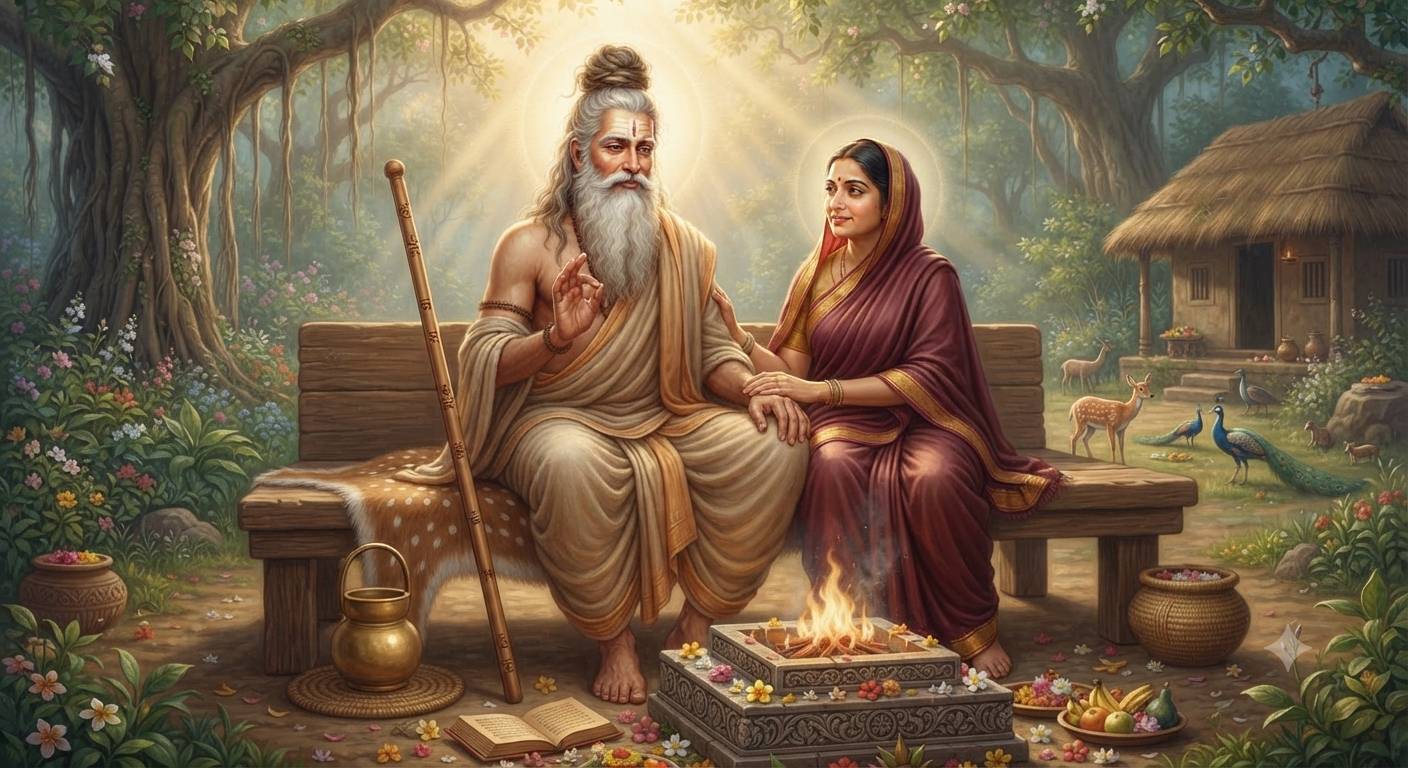
Vasishtha is the most exalted of the Saptarishi — the family priest (Kula Guru) of the solar dynasty of kings, which includes Rama and the entire Ikshvaku lineage. He is the author of the seventh Mandala of the Rigveda. He possesses Kamadhenu (the wish-fulfilling cow Nandini) and the divine lamp of knowledge. He is the greatest of the brahmin sages in prestige and the exemplar of spiritual power that surpasses military force. Also known as Vasishthamuni.
Symbols & Iconography
Birth & Origin
In the Rigveda, Vasishtha is said to be born from the seed of Mitra and Varuna when they saw the Apsara Urvashi. In the Puranas, he is born from Brahma's mind as one of the Prajapatis. He is the son-in-law of Daksha in some accounts.
Family
Consort: Arundhati — one of the most celebrated women in Hindu tradition for her virtue. Their steadfast fidelity is symbolized by the two stars Mizar and Alcor in Ursa Major, pointed out to brides during the wedding ceremony. Son: Shakti. Grandson: Parashara. Great-grandson: Vyasa.
Scriptures
Vasishtha is the primary author of Rigveda Book 7. He appears in the Mahabharata, Ramayana, and across the Puranas. The Yoga Vasishtha (also called the Maha Ramayana) is attributed to him and is one of the most philosophically sophisticated texts in the Sanskrit tradition.
Worship & Legacy
Vasishtha has no independent temples but is one of the most invoked sages in Vedic ritual — the Gotra (lineage) system of brahmin communities lists Vasishtha as the most common ancestral sage. Hundreds of millions of Hindus trace their Gotra to him. The Arundhati star (Alcor) — his wife — is pointed out to every Hindu bride during the wedding ceremony as a model of fidelity.
Key Stories
1. Vasishtha and Vishwamitra — The Great Enmity
The most celebrated story in Vasishtha's biography is his conflict with King Vishwamitra, who came to his hermitage and attempted to take his divine cow Nandini by force. Nandini repelled Vishwamitra's armies. Vishwamitra, humiliated, left his kingdom and performed intense austerities to become a brahmin sage equal to Vasishtha. Their conflict ran across many births and many generations and is the defining narrative of the brahmin-kshatriya tension in the Vedic tradition. It is fully told in the Mahabharata and the Ramayana.
2. Vasishtha as Guru of Rama
In the Ramayana, Vasishtha is the family priest and teacher of Rama. He conducted Rama's coronation ceremony, and his spiritual instruction appears in the Yoga Vasishtha — the most elaborate philosophical dialogue attributed to any Vedic sage — in which Vasishtha instructs the young Rama on the nature of consciousness, reality, and liberation.
3. The Curse of the Vasus
The eight Vasus stole Vasishtha's divine cow, leading to his curse that condemned them to human birth. This curse resulted in the birth of Bhishma as the eighth Vasu in the Mahabharata.
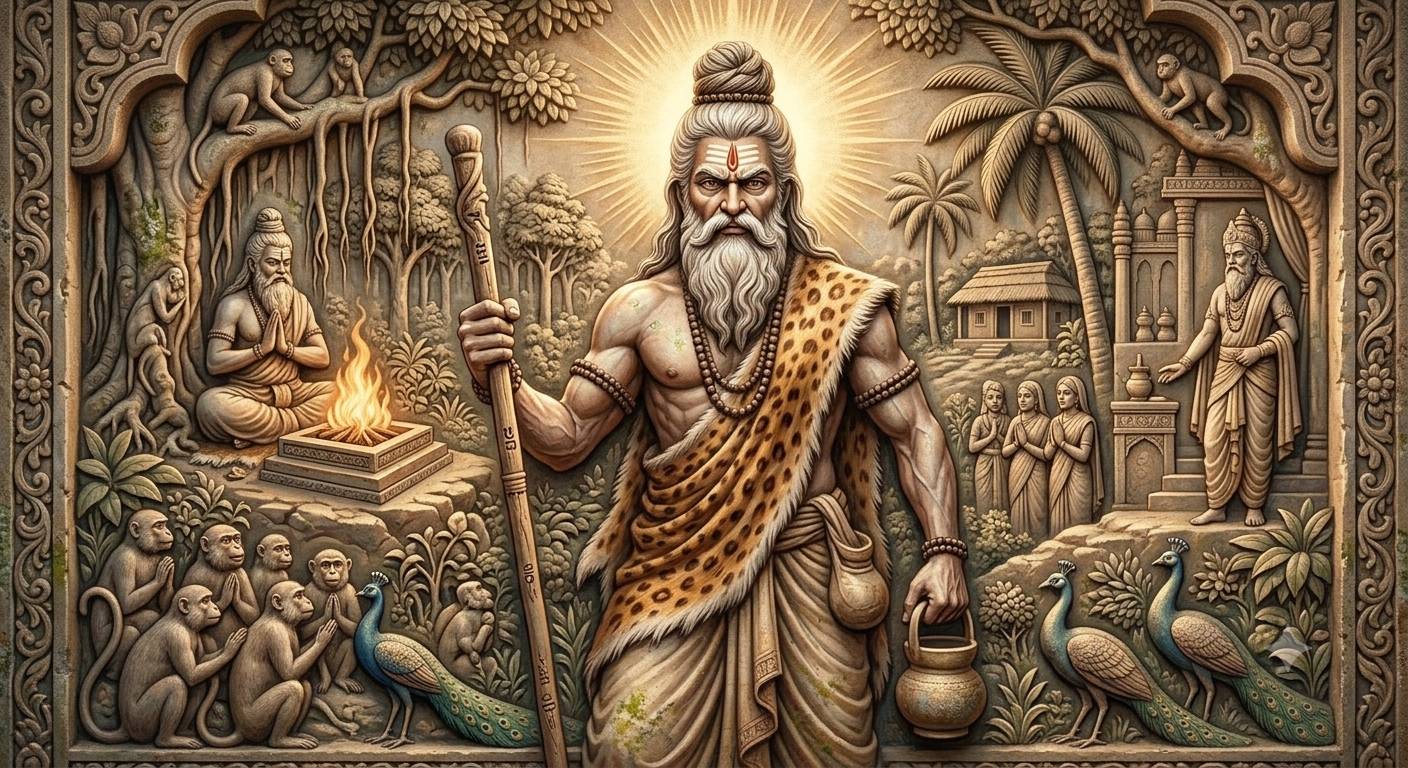
Vishwamitra is one of the Saptarishi and one of the most dramatic figures in the entire Vedic tradition. He began as a kshatriya king — Kaushika — and through immense austerities became a brahmarishi (the highest class of sage), overcoming his birth and transforming his very nature. He is a major composer of the Rigveda and the author of the Gayatri Mantra. He is also the sage who guided the young Rama and Lakshmana in their first adventures. Also known as Kaushika (his original name as a king) and Vishvamitra (friend of all worlds).
Scriptures
Vishwamitra is the primary author of Rigveda Book 3, including the Gayatri Mantra (3.62.10) — addressed to the illuminating power of the sun, asking it to inspire the intellect of all beings. He appears extensively in the Mahabharata and the Ramayana.
Worship & Legacy
No independent temples. His Gotra is carried by many brahmin communities.
Key Stories
1. The Quest to Equal Vasishtha
After Vasishtha's cow defeated his army, Vishwamitra gave up his kingdom and performed austerities. He was recognized successively as a Rajarishi (royal sage), Maharishi (great sage), and finally — after defeating every temptation including Menaka the Apsara — as a Brahmarishi. When even Vasishtha acknowledged him as Brahmarishi, the journey was complete. This transformation is one of the foundational narratives of the possibility of spiritual achievement across birth, effort, and determination.
2. Vishwamitra and Shunashepa
King Harishchandra, having no sons, vowed to Varuna that if granted a son he would sacrifice the child to him. A son — Rohita — was born. Varuna came to collect his due. Harishchandra repeatedly delayed, and Varuna afflicted him with dropsy as punishment. The aging king eventually purchased a brahmin boy named Shunashepa from his desperate father Ajigarta as a substitute sacrifice. Shunashepa was bound to the sacrificial post. Knowing he was about to die, he prayed to the gods — Agni, Prajapati, the Adityas — with Rigvedic verses. The gods, pleased, loosed his bonds and released him. Vishwamitra, present as the officiating sage, was so moved by Shunashepa's courage and devotion that he offered to adopt him as his eldest son, placing him above his own biological children. Half of Vishwamitra's sons accepted; those who refused were cursed. Shunashepa took the name Devarata and became Vishwamitra's heir. The story is the Aitareya Brahmana's origin myth for the existence of frontier and outcaste peoples — the same literary device used in the Kamadhenu story to explain the Shakas, Yavanas, and Pahlavas.
3. Vishwamitra Guides Rama
In the Bala Kanda of the Ramayana, Vishwamitra came to King Dasharatha asking for Rama — still a very young prince — to protect his yajna from demons. Dasharatha was horrified but could not refuse the sage. Vishwamitra guided Rama and Lakshmana through the forest, teaching them divine weapons (Bala and Atibala), and eventually bringing Rama to Mithila for Sita's swayamvara.
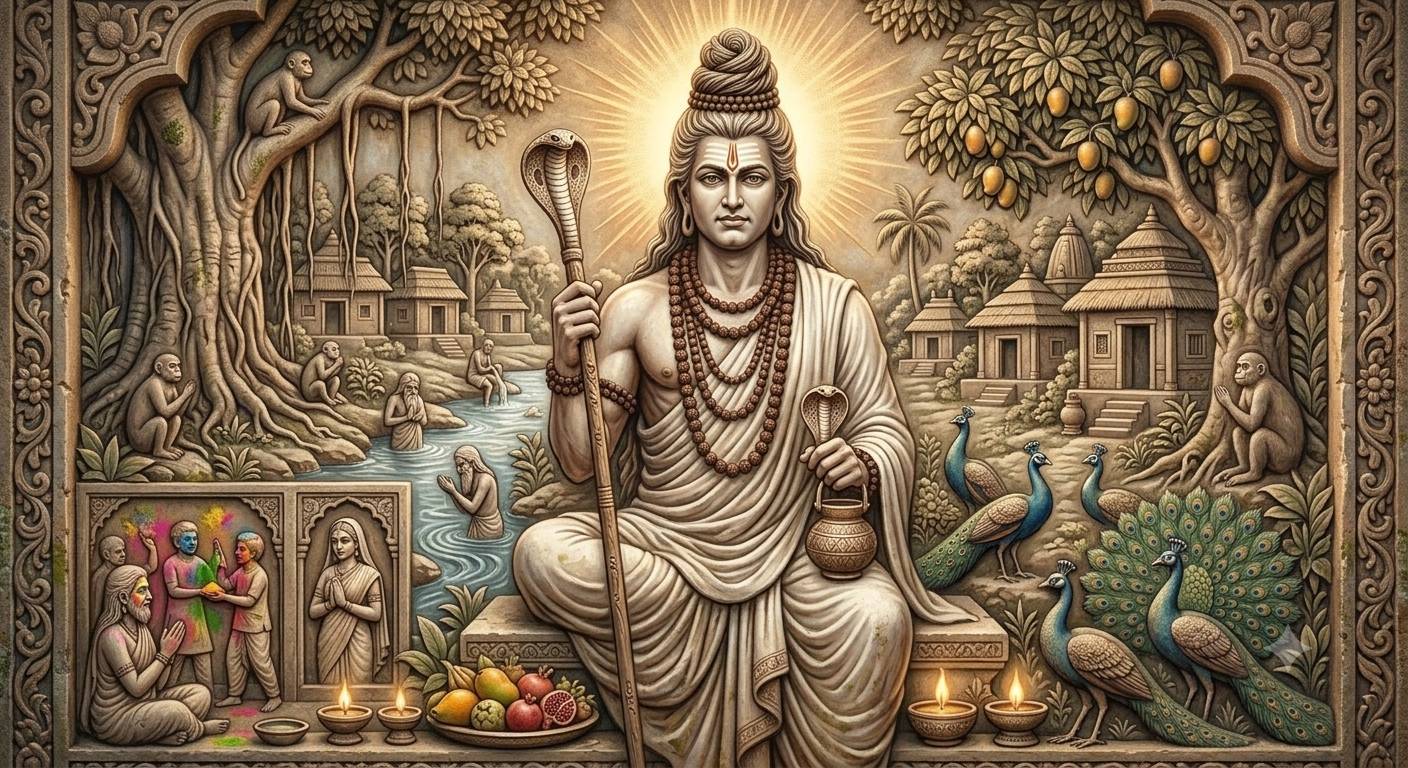
Gautama is one of the Saptarishi, a great sage associated with the Sama Veda and the Nyaya philosophical school. He is the husband of Ahalya and the father of a significant philosophical lineage. His ashram in the Dandaka forest is mentioned in the Ramayana.
Scriptures
Gautama appears in the Ramayana, Mahabharata, and Puranas. The Gautama Dharma Sutras are attributed to him. The Nyaya Sutras — foundational text of the Nyaya school of Indian philosophy — are attributed to a later Gautama.
Worship & Legacy
The Brahmagiri hill — source of the Godavari — and the Trimbakeshwar area are associated with Gautama. The Panchavati area near Nashik, where the Godavari flows, is called Gautami (of Gautama).
Key Stories
1. Ahalya and Indra's Deception
Gautama's wife Ahalya was approached by Indra disguised as Gautama. She acquiesced — in some versions knowing it was not her husband, in others deceived. When Gautama discovered the deception he cursed Ahalya to become stone (or in some versions, invisible ash) and cursed Indra to be covered with a thousand marks of shame. Ahalya remained in stone form until Rama's foot touched the earth of the ashram and released her — the dust of Rama's feet being the liberating force. This story appears in the Bala Kanda of the Ramayana.
2. Gautama and the River Godavari
Gautama is said to have performed austerities to bring a portion of the Ganga to the Deccan — the river that flows from his penance becoming the Godavari.
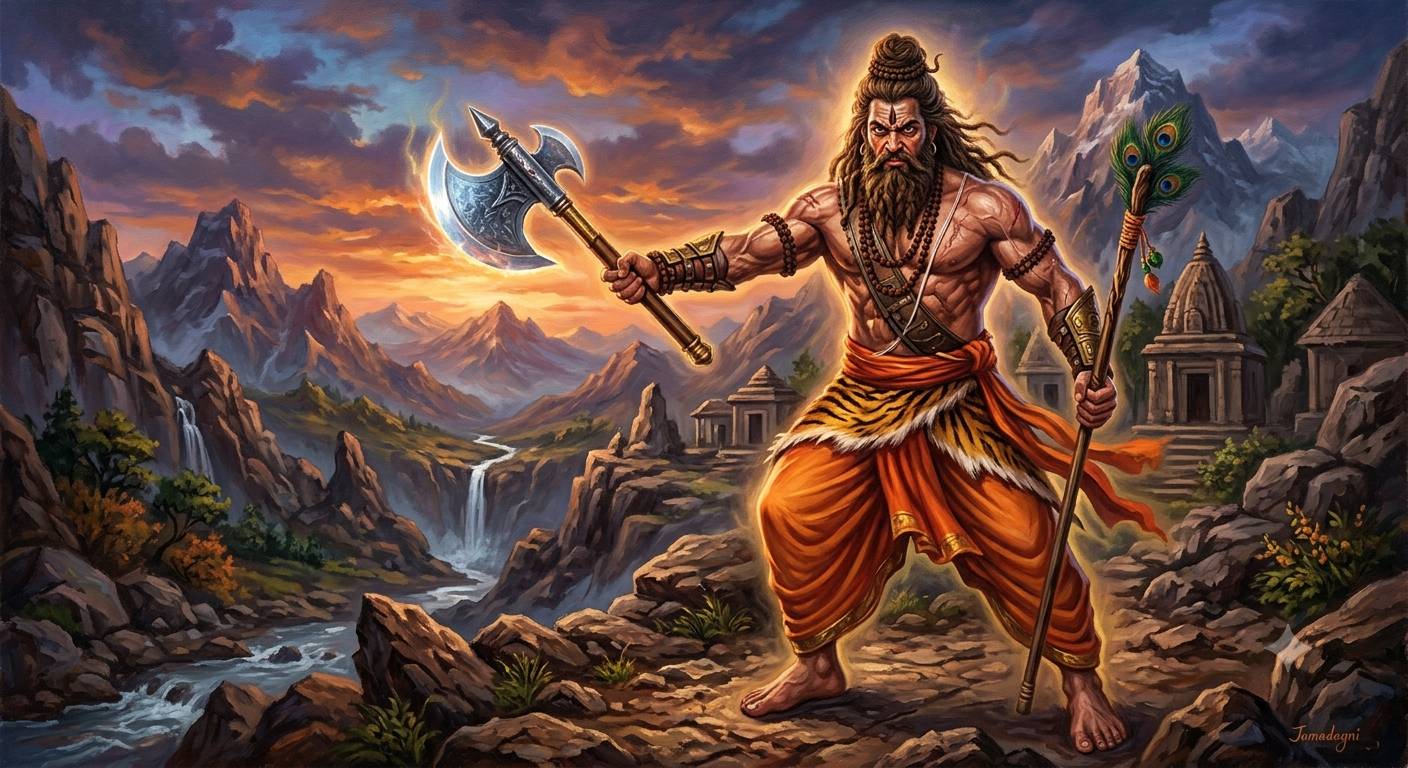
Jamadagni is one of the Saptarishi and the father of Parashurama — the warrior avatar of Vishnu. He is a sage of extreme spiritual power and equally extreme temper — the combination that makes him both a great rishi and the father of the most violent avatar.
Scriptures
Appears in the Mahabharata, Ramayana, and the Bhagavata Purana.
Worship & Legacy
Jamadagni's ashram is associated with sites in the Narmada region. He is invoked in the Jamadagni Gotra carried by some brahmin communities.
Key Stories
1. The Command to Kill Renuka
Jamadagni saw that his wife Renuka had momentarily experienced desire upon seeing a king bathing. He ordered each of his sons to kill her. One by one they refused and were cursed to become idiots. When Parashurama was ordered, he obeyed — and then asked as his boon for all his brothers to be restored and his mother brought back to life with no memory of what had happened. Jamadagni was satisfied and granted it all.
2. The Stealing of Kamadhenu and Jamadagni's Murder
King Kartavirya Arjuna visited Jamadagni's hermitage and, on departing, stole the sacred cow Kamadhenu. Parashurama tracked the king down and killed him. Kartavirya's sons retaliated by killing Jamadagni at his hermitage. This murder was the trigger for Parashurama's twenty-one rounds of exterminating the kshatriya class.
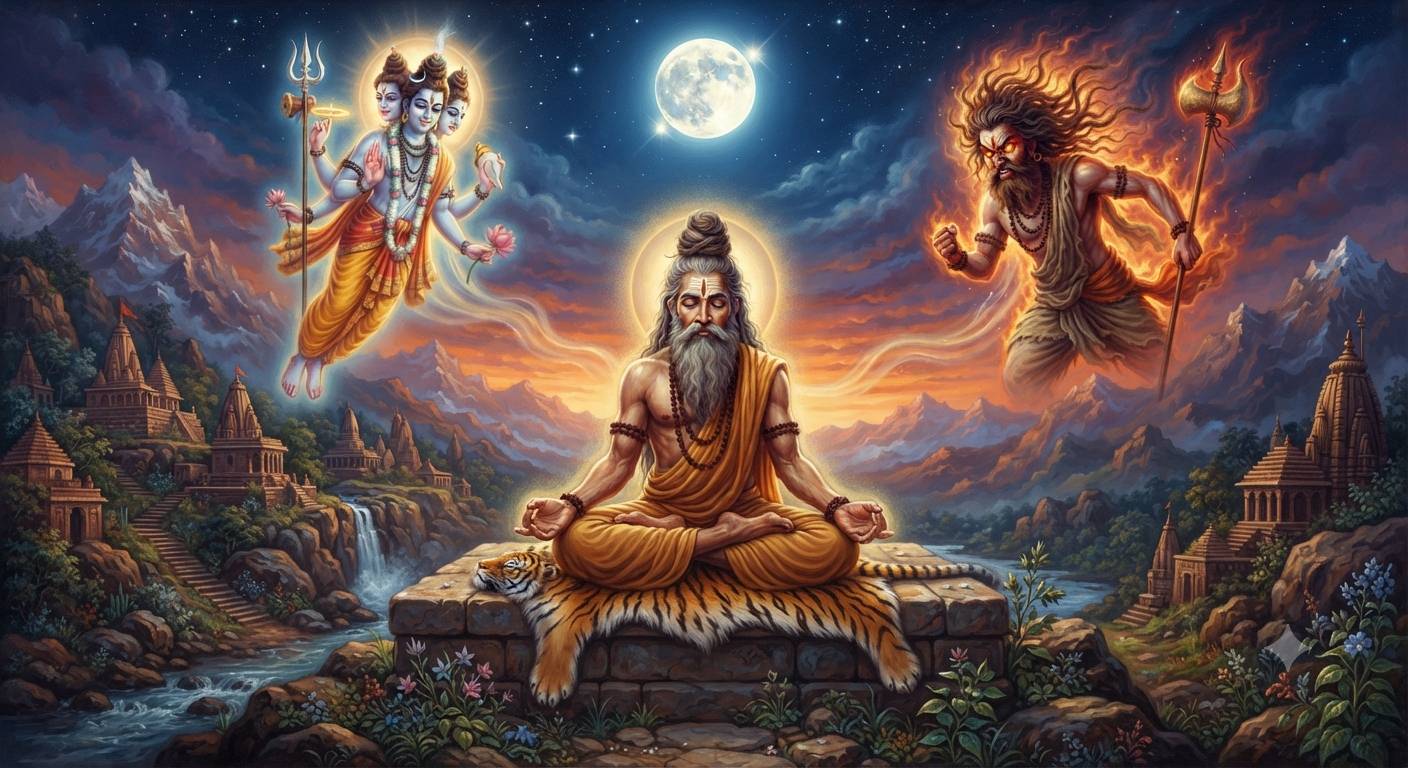
Atri is one of the Saptarishi and one of the most prolific composers of the Rigveda — the fifth Mandala contains many of his hymns. He is the husband of the supremely virtuous Anasuya and the father of three extraordinary sons: Dattatreya (the combined avatar of the Trimurti), Durvasa (known for his terrible curse-giving temper), and the moon god Chandra (in some accounts).
Scriptures
Atri composed primarily in Rigveda Book 5. He appears in the Mahabharata, Ramayana, and extensively in the Puranas.
Worship & Legacy
The Atri Gotra is carried by brahmin communities across India. Anasuya Devi temples in Andhra Pradesh and the site of Chitrakoot — where Atri and Anasuya's ashram is located — are pilgrimage sites associated with him.
Key Stories
1. Atri and Anasuya — The Birth of Dattatreya
The Trimurti tested Anasuya's legendary virtue and were transformed into infants at her touch. Their subsequent birth as Dattatreya (Vishnu's portion), Durvasa (Shiva's portion), and Chandra (Brahma's portion) from her womb made Atri the father of three of the most significant figures in the tradition.
2. The Rescue from the Burning Pit
The Rigveda references in multiple hymns (1.116, 1.117, 5.73–78) that Atri was thrown into a burning pit — a strait cleft in the earth filled with scorching heat — by the Dasyus, hostile beings who opposed the Vedic order. Trapped and burning, Atri prayed to the gods. The Ashvins arrived in their swift chariot and "made the fiery pit friendly for Atri's sake" — cooling the fire and freeing him. A related episode in Rigveda 5.40 describes Atri restoring the sun to the sky after the Asura Svarbhanu covered it with darkness. Through the power of his austerities and prayers, Atri forced Svarbhanu to release the sun. These episodes are preserved only as allusions in hymns rather than as full narratives.
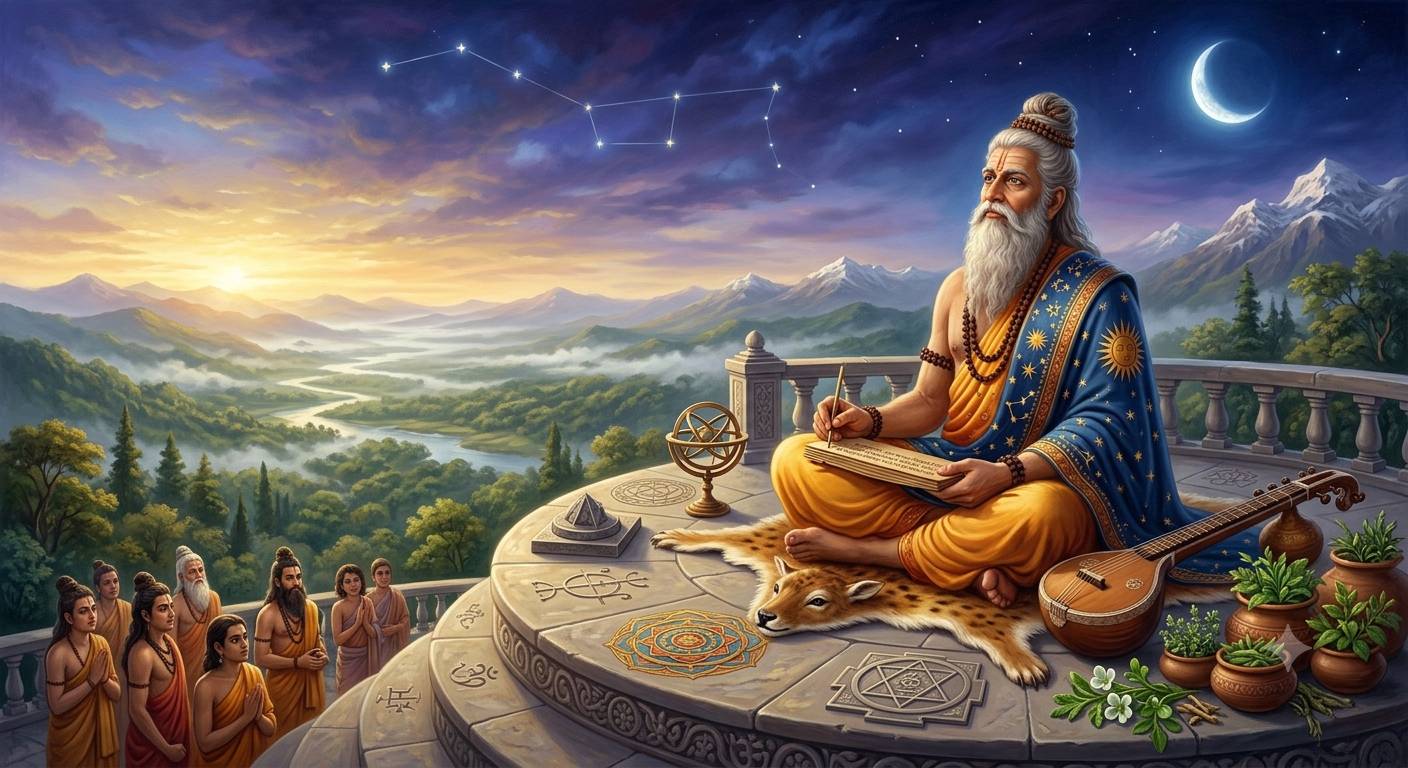
Bharadvaja is one of the Saptarishi and one of the most prolific composers of the Rigveda — the sixth Mandala contains his hymns. He is associated with medicine (he received knowledge of Ayurveda from Indra), the teaching of Drona (the greatest military teacher of the Mahabharata era was his son), and with the learning of the Vedic tradition generally.
Scriptures
Bharadvaja composed primarily in Rigveda Book 6. He appears in the Mahabharata and Ramayana.
Worship & Legacy
The Bharadvaja Gotra is one of the most widespread brahmin lineages in India. His ashram site at Prayagraj is a pilgrimage destination.
Key Stories
1. The Father of Drona
Bharadvaja's son Drona became the teacher of both the Pandavas and Kauravas in archery — the Dronacharya who taught Arjuna (making him the greatest archer in the world) and who was killed in the Mahabharata war. The birth of Drona is dramatic: Bharadvaja saw the Apsara Ghritachi bathing and his seed fell into a vessel (drona) — from which Drona was born without a mother.
2. Bharadvaja's Ashram in the Ramayana
During Rama's fourteen years of exile, he visited Bharadvaja's ashram at Prayagraj — the sage hosted him generously and directed him deeper into the forest. The ashram of Bharadvaja at the confluence of the Ganga and Yamuna is a sacred site in the Ramayana pilgrimage circuit.
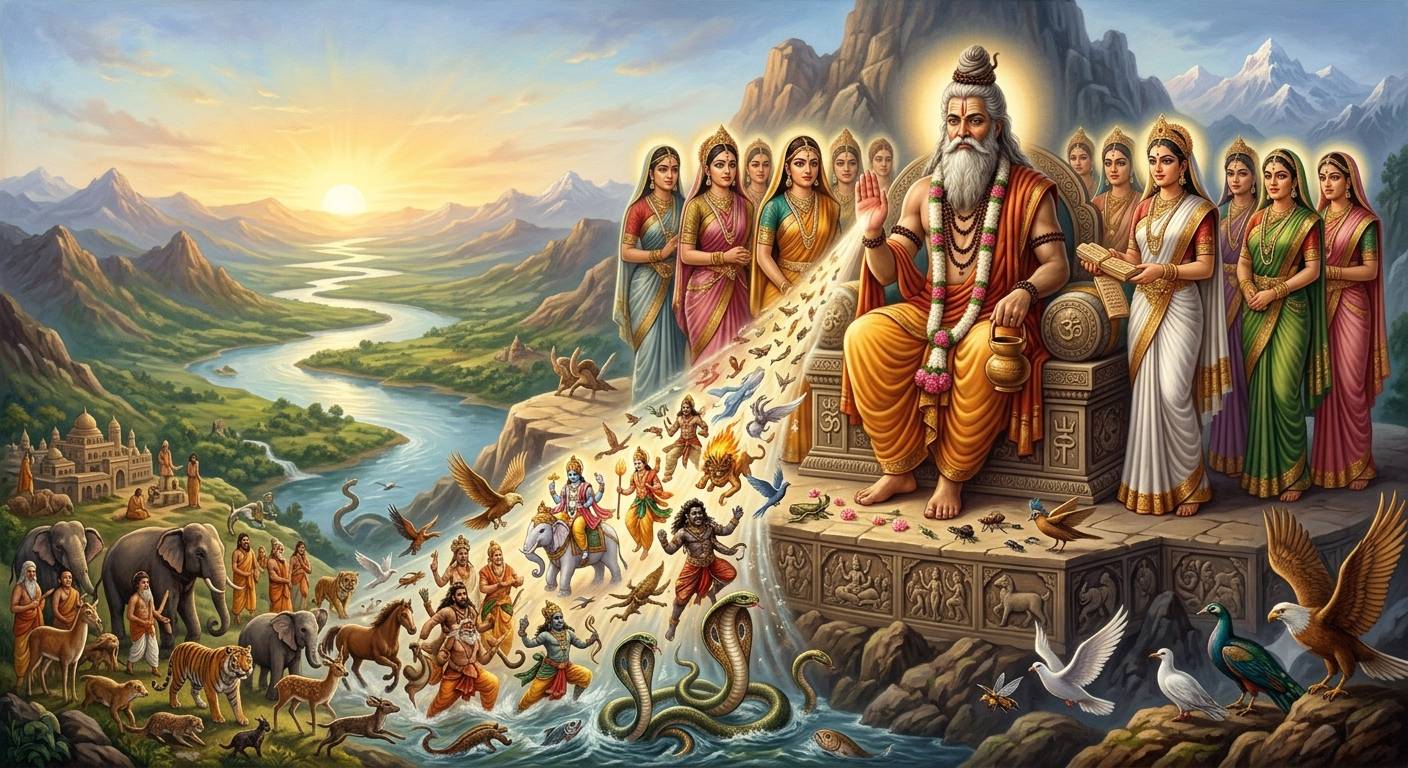
Kashyapa is one of the Saptarishi and the most cosmologically significant of them — he is the father of virtually all living beings in the Hindu tradition. His thirteen wives (daughters of Daksha) bore him the gods, demons, humans, nagas, birds, animals, and all other creatures. He is called Prajapati — the lord of creatures. Every major class of being in Hindu mythology traces its origin to one of Kashyapa's wives. Also known as Kashyapa Prajapati and Marichi-putra (son of the sage Marichi).
Birth & Origin
Son of the sage Marichi, who was one of the mind-born sons of Brahma.
Family
Wives: Aditi (mother of the Adityas/gods), Diti (mother of the Daityas/demons), Kadru (mother of the serpents/Nagas), Vinata (mother of Garuda and Aruna), Danu (mother of the Danavas), Surabhi (mother of cows), and others. His lineages include virtually every major deity and class of being in Hindu cosmology.
Scriptures
Kashyapa appears across the Rigveda, the Mahabharata, and all the major Puranas as the progenitor of all life.
Worship & Legacy
Kashyapa Gotra is one of the most widely carried brahmin lineages. The Kashmir Valley takes its name from him — Kashyapa-mira, or Kashyapa's lake, which he is said to have drained to create the valley's habitable land. The Dal Lake and the entire Kashmir Valley exist, mythologically, because Kashyapa released the water that previously filled the valley.
Key Stories
1. The Father of All
In the Puranic cosmology, Kashyapa's different wives bore him beings of completely different natures — the divine and the demonic, the serpent and the bird, the sacred cow and the demon races. This accounts for the eternal conflict between cosmic classes: the Adityas and Daityas are half-siblings through Kashyapa. Garuda and the Nagas are half-siblings through Kashyapa. The enmity between them is fraternal — from the same father, different mothers, different destinies.
2. Kashyapa and the Solar Line
Surya (the sun) is considered Kashyapa's son through Aditi — making Kashyapa the grandfather of Yama, Vaivasvata Manu, and the entire solar dynasty of kings.
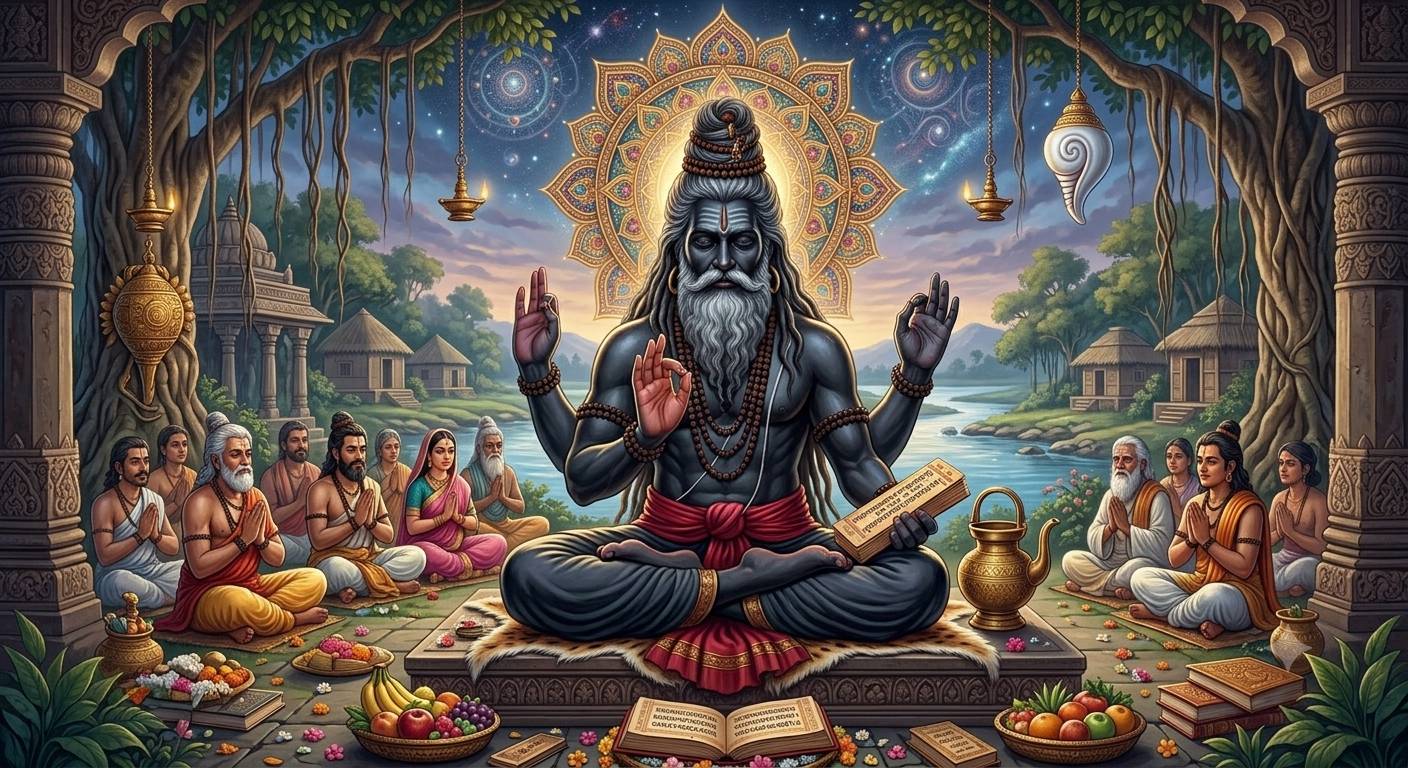
Vyasa — also called Veda Vyasa (the arranger of the Vedas) — is the most significant figure in the transmission of the entire body of Sanskrit sacred literature. He is said to have arranged the Vedas into their four divisions, composed the Mahabharata (the longest epic in the Sanskrit tradition), authored the Brahma Sutras, and composed or compiled the 18 Mahapuranas. He is a Chiranjivi — still alive. Also known as Krishna Dvaipayana (dark-complexioned, born on an island) and Badarayana.
Symbols & Iconography
Birth & Origin
Son of the sage Parashara and Satyavati — a fisherman's daughter. He was born on an island in the Yamuna and had a dark complexion, giving him his personal name. He went immediately into the forest to perform austerities after birth, promising to return whenever his mother called.
Family
Father: Parashara (grandson of Vasishtha). Mother: Satyavati. Sons: Dhritarashtra, Pandu, and Vidura — born to the widows of Vichitravirya by Niyoga (levirate union) — making him the grandfather of both the Pandavas and the Kauravas. The disciple who transcribed the Mahabharata: Ganesha.
Scriptures
Vyasa is considered the author or compiler of the Mahabharata, the 18 Mahapuranas (including the Bhagavata Purana), the Brahma Sutras (foundational text of Vedanta philosophy), and the arrangement of the four Vedas.
Worship & Legacy
Guru Purnima — the full moon of the month of Ashadha — is observed as Vyasa Purnima and is the most important festival honoring the teacher-student lineage in the Hindu tradition. All spiritual teachers across all traditions are honored on this day, with Vyasa as the first and greatest Guru. He is invoked at the beginning of every recitation of the Mahabharata and every Vedic study session.
Key Stories
1. The Composition of the Mahabharata
Vyasa conceived the Mahabharata and needed a scribe capable of writing at the speed he would dictate — without pause. Brahma suggested Ganesha. Ganesha agreed on one condition: Vyasa must never pause. Vyasa agreed but set his own counter-condition: Ganesha must understand every verse before writing it. When Vyasa needed a moment to compose a difficult passage, he composed a complex verse that took Ganesha time to decipher — using this pause to compose ahead. The Mahabharata contains approximately 100,000 couplets — the longest epic in human history.
2. The Arrangement of the Vedas
At the beginning of the Kali Yuga, Vyasa recognized that human life spans and capacity for learning were declining. He divided the single Veda into four — Rigveda, Samaveda, Yajurveda, and Atharvaveda — so that different groups of priests could specialize and the entire body of knowledge would be preserved collectively. He taught each of the four Vedas to a different principal disciple.
3. Vyasa and the Bhagavata Purana
After completing the Mahabharata, Vyasa felt incomplete despite having compiled all knowledge. The sage Narada told him that he had not yet adequately sung the glories of the divine. Vyasa then composed the Bhagavata Purana — the most beloved of all the 18 Mahapuranas, dedicated to the life and deeds of Krishna. After completing it, he felt peace.
4. The Three Sons by Niyoga
When King Vichitravirya of Hastinapura died without heirs, his mother Satyavati — also Vyasa's mother — called Vyasa from the forest and invoked the ancient practice of Niyoga: a male relative fathering children on behalf of a deceased man to continue the lineage. He was at this time a forest sage — dark-complexioned, wild-haired, matted, smelling of the forest and austerities. When the elder widow Ambika met Vyasa, she shut her eyes in fear; the child born was Dhritarashtra — blind. When the younger widow Ambalika met him, she went pale with dread; the child born was Pandu — "the pale one." Satyavati asked for a third child; Ambalika, unwilling to face Vyasa again, sent her maidservant in her place. The servant received him calmly, and the child born was Vidura — the wisest and most just of the three, but born of a servant woman and therefore ineligible for the throne.
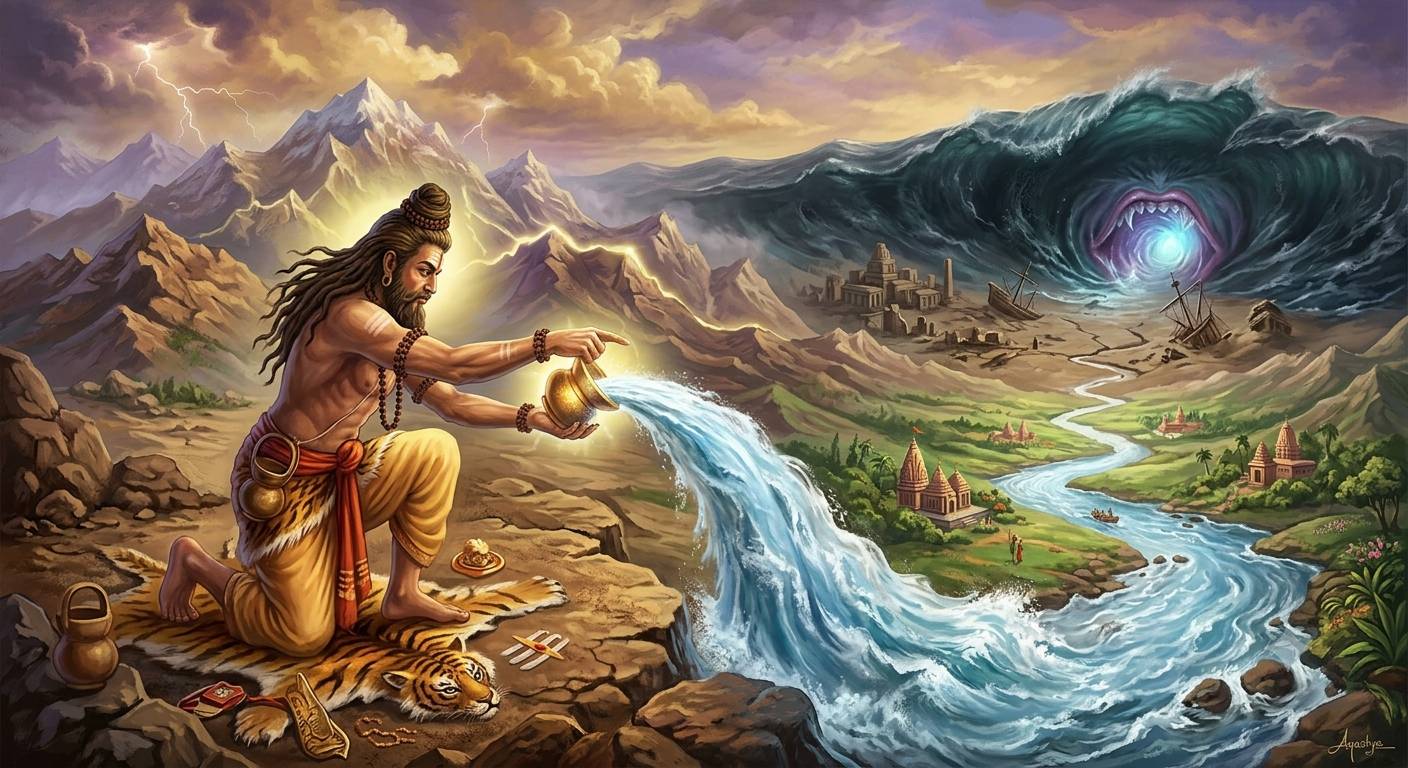
Agastya is one of the most significant sages in the Hindu tradition — his influence spans the Vedic north and the Dravidian south. He composed hymns in the Rigveda, is the founding sage of the Tamil language and Tamil Shaiva tradition, swallowed the ocean in a single draught, compressed the Vindhya mountains, and brought the Kaveri river to the south. He is a Chiranjivi — still alive. Also known as Kumbhayoni (born from a pot) and Pitasana.
Birth & Origin
Born (along with Vasishtha) from the seed of Mitra and Varuna shed when they saw the Apsara Urvashi — born from a pot (Kumbha) into which the seed fell.
Scriptures
Agastya appears in the Rigveda, Mahabharata, Ramayana (his ashram in the Dandaka forest is visited by Rama), and across the Puranas. In Tamil literature he is the most foundational figure.
Worship & Legacy
Agastya is worshipped at the Agastyarkoodam peak in Kerala (the southernmost sacred peak of the Sahyadri range). His association with the star Canopus (the second brightest star, called Agastya in Sanskrit) links him to the southern celestial hemisphere. He is revered equally in Sanskrit and Tamil traditions — a rare bridge figure between the two great streams of Indian civilization.
Key Stories
1. The Compression of the Vindhyas
The Vindhya mountains, jealous of Mount Meru, began growing so tall they threatened to block the sun's path. Agastya, traveling south, asked the Vindhyas to bow low and remain so until he returned from the south. He never returned — so the Vindhyas have remained bowed ever since. This story is told in the Mahabharata and Puranas and explains the relatively low elevation of the Vindhya range.
2. The Swallowing of the Ocean
When the demons Kalakeya hid in the ocean after being defeated by Indra, threatening to emerge and destroy the world, the gods asked Agastya to drain the ocean so the demons could be found. He drank the entire ocean in a single draught and held it until Vishnu restored the waters in the next cycle.
3. Agastya and the Tamil Language
In the Tamil tradition, Agastya is the father of Tamil grammar and literature. Shiva is said to have asked him to bring Tamil culture to the south. He composed the Agattiyam — the first Tamil grammar, now lost. He is revered in Tamil Nadu as the founder of the Siddha tradition of medicine and alchemy.
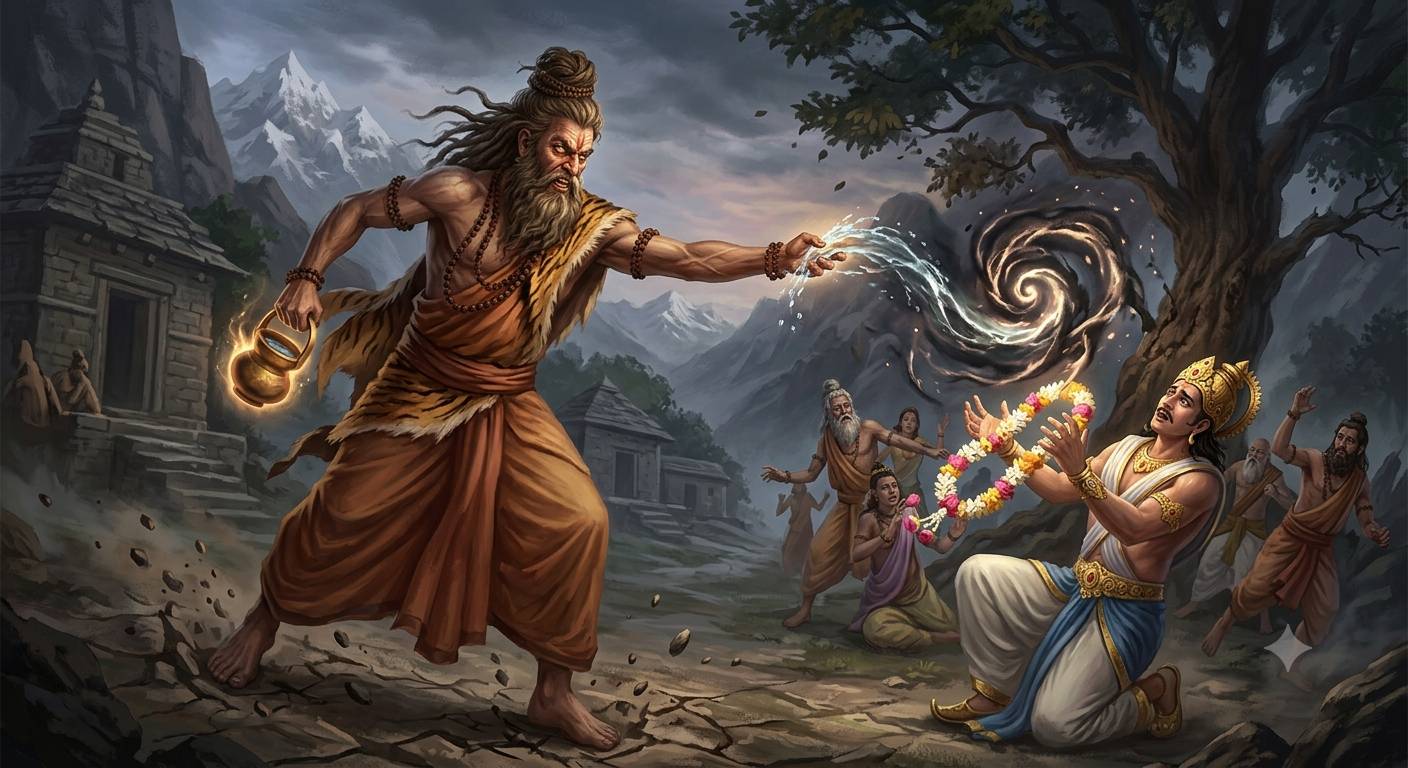
Durvasa is the son of Atri and Anasuya — born from Shiva's portion — and is the most notoriously short-tempered sage in Hindu mythology. His curses are swift, powerful, and often drive major narrative events. He is simultaneously a great sage of tremendous spiritual power and a figure whose anger has repeatedly disrupted the lives of heroes and gods.
Scriptures
Durvasa appears in the Mahabharata, Ramayana, Bhagavata Purana, and Vishnu Purana.
Worship & Legacy
No independent temples in modern India. His name has become a cultural shorthand for an extremely temperamental, easily offended person of great abilities. The Durvasa Ashram at Mathura is associated with him.
Key Stories
1. The Curse on Indra — Causing the Samudra Manthan
Durvasa gave Indra a divine flower garland. Indra placed it on Airavata's head; the elephant threw it to the ground. Durvasa's fury at this casual disrespect triggered his curse on the gods — stripping them of their power and glory. This led directly to the Samudra Manthan.
2. Durvasa and Kunti's Mantra
Durvasa was pleased with the hospitality of the young princess Kunti and taught her a mantra that could summon any god to father a child with her. Kunti, curious, tested it on the sun god Surya and accidentally invoked Karna — which changed the fate of the entire Mahabharata.
3. Durvasa and Krishna
Durvasa demanded Krishna feed him and his ten thousand disciples immediately — an impossible request. Krishna used the last grain of rice to serve him. Durvasa was satisfied but then asked Krishna to rub the rice over all his disciples' bodies. Krishna obeyed. Durvasa, satisfied, blessed Krishna with near-invulnerability — but left one spot (the sole of his foot, from the grain that didn't reach it) unprotected. This became the vulnerable point through which he was eventually killed.
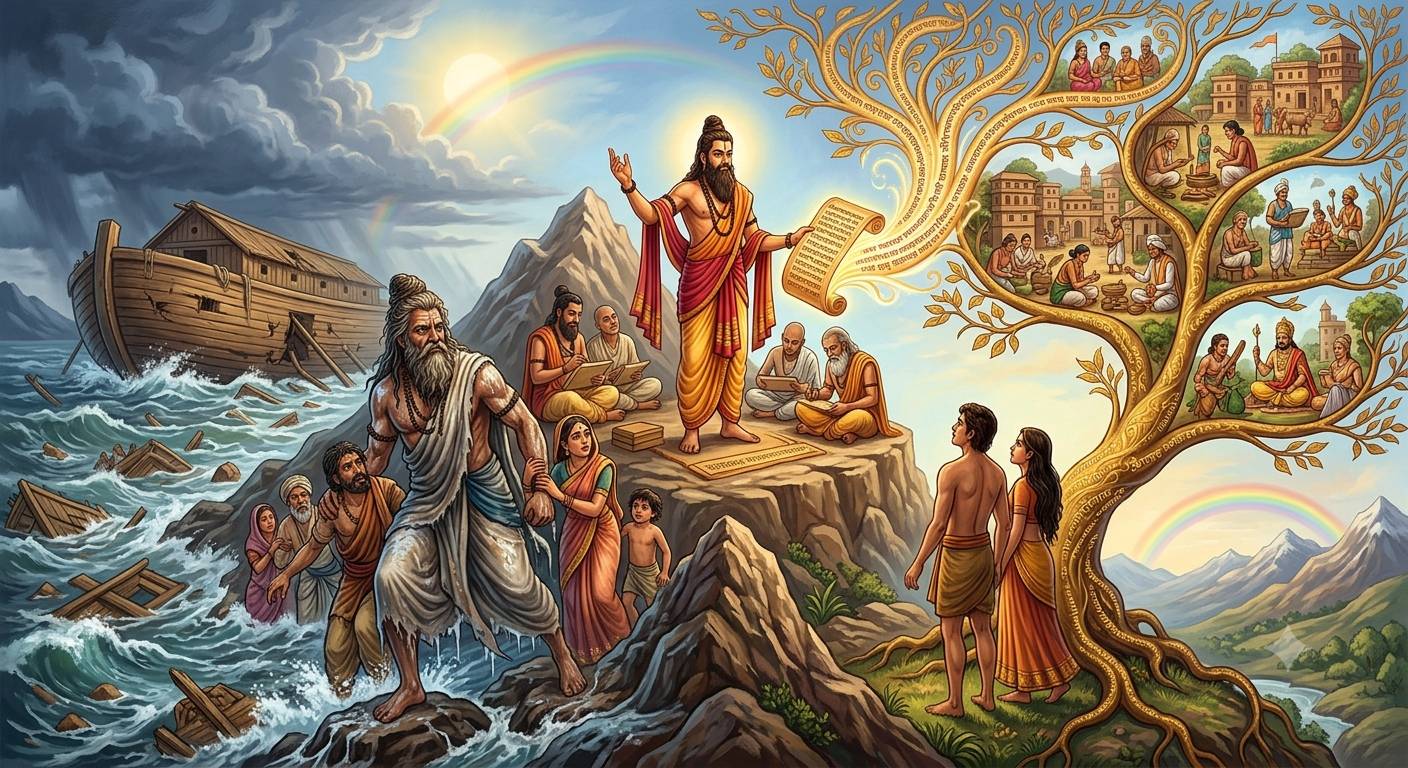
Manu is the progenitor of humanity — the first man, the survivor of the great flood, and the author of the Manusmriti (Laws of Manu), the most influential legal and social text in Sanskrit literature. There are fourteen Manus who rule in succession over the fourteen periods (Manvantaras) of each cosmic cycle. The current Manu is Vaivasvata Manu — son of Surya (Vivasvat).
Scriptures
Manu appears in the Shatapatha Brahmana, Mahabharata, Matsya Purana, and Bhagavata Purana. The Manusmriti is independently transmitted.
Worship & Legacy
No independent temples. His legacy is enormous in the domain of Indian law and social organization — the entire tradition of Dharmashastra (sacred legal literature) traces itself to Manu as the first lawgiver.
Key Stories
1. The Flood Survival
Vaivasvata Manu was warned of the coming flood by a fish (the Matsya avatar of Vishnu in later versions, or simply a divine fish in the Shatapatha Brahmana's original). He built a boat, was guided through the deluge by the fish, and landed on a northern mountain when the waters receded. From Manu, the current human race descends. The flood narrative appears across cultures — the Mesopotamian Utnapishtim, Noah, and Manu are parallel traditions.
2. The Manusmriti
The Manusmriti — attributed to Vaivasvata Manu — is the most comprehensive Sanskrit text on dharma, social organization, law, and ethics. It defined social structures, gender relations, caste obligations, and legal procedures across much of ancient India. It has been one of the most debated and contested texts in Indian history — praised by some as the foundation of Hindu social order, criticized by others (most notably B.R. Ambedkar) as the codification of caste oppression. Its burning by Ambedkar in 1927 was one of the most significant acts of protest in the Indian independence movement.
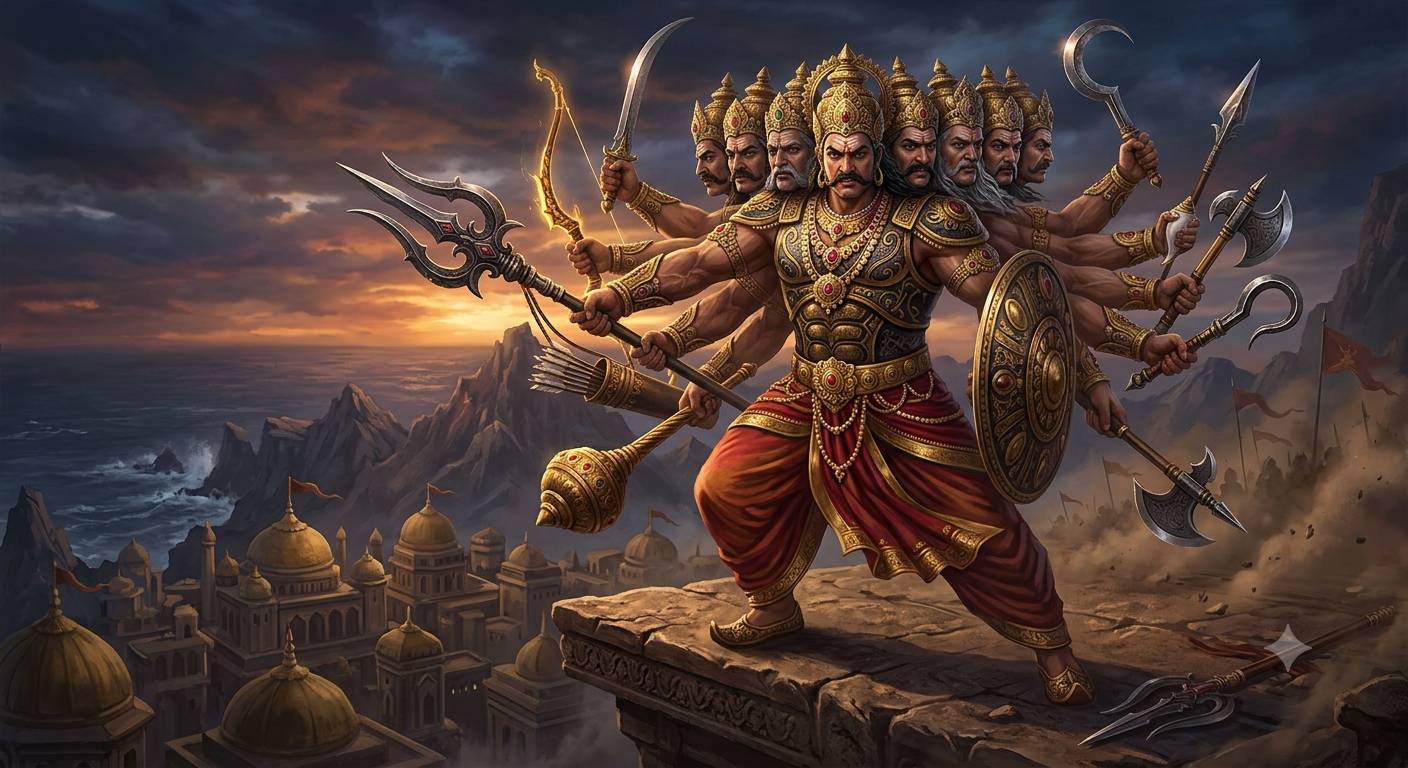
Ravana is the king of Lanka, the primary antagonist of the Ramayana, and one of the most complex figures in Hindu mythology. He is simultaneously a scholar of the Vedas, a devotee of Shiva, a composer of the Shiva Tandava Stotram, and a rakshasa (demon) king of immense power and ambition. His abduction of Sita is the central crime of the Ramayana, but his character contains contradictions that have made him a figure of fascination and occasional sympathy across multiple traditions. Also known as Dashagriva (ten-headed), Lankapati (lord of Lanka), and Lankadhisha.
Symbols & Iconography
Birth & Origin
The difference between Ravana and his half-brother Kubera is attributed to their conception — Kubera in brahmic serenity, Ravana at an inauspicious time.
Family
Father: Vishrava. Mother: Kaikesi. Brothers: Kumbhakarna and Vibhishana. Half-brother: Kubera. Sister: Shurpanakha. Son: Indrajit (Meghanada) — the greatest warrior in the war, who could only be killed by a being who had never slept. Consort: Mandodari — described as one of the five most chaste women (Panchakanyas) in the Hindu tradition, despite being married to Ravana.
Scriptures
Ravana is the central antagonist of the Valmiki Ramayana. He appears in the Mahabharata, the Shiva Purana (where his devotion to Shiva is prominent), the Skanda Purana, and the Adhyatma Ramayana.
Worship & Legacy
Ravana is worshipped as a deity in several communities — particularly in Sri Lanka, in parts of Rajasthan, Madhya Pradesh, and Andhra Pradesh where communities claim descent from him, and among some Shaiva communities who honor his devotion to Shiva. Dussehra — the festival marking Rama's victory over Ravana — is one of India's largest festivals, with the burning of Ravana's effigy in Mysuru, Varanasi, and Delhi drawing enormous crowds.
Key Stories
1. The Boon of Near-Invulnerability
Ravana performed ten thousand years of austerities to Brahma. At the end, he cut off each of his nine heads one by one as an offering. As he prepared to cut off the tenth, Brahma appeared and offered a boon. Ravana asked for invulnerability — to be unable to be killed by gods, demons, nagas, or any other divine or semi-divine being. He did not include humans or animals in his request, considering them beneath notice. This oversight — his own pride — created the opening through which Rama and his army of vanaras could kill him.
2. The Lifting of Kailash
Ravana once attempted to uproot Mount Kailash and carry it away — to install it in Lanka, or as a demonstration of his power. Shiva pressed the mountain down with his toe, trapping Ravana beneath. Ravana, in agony, composed the Shiva Tandava Stotram — a hymn of praise of extraordinary beauty — and sang it until Shiva, pleased, released him and granted him the name Ravana (he who makes the universe cry, or the great roarer).
3. The Abduction of Sita
In the Ramayana, Ravana abducted Sita by trickery — sending the demon Maricha disguised as a golden deer to lure Rama and Lakshmana away, then appearing disguised as a brahmin mendicant. He carried Sita through the sky to Lanka. Despite his immense power, he could not touch her during her captivity — his grandson Nalakuvera had cursed him that if he ever touched a woman without her consent, his heads would burst. His treatment of Sita — threatening but never forcibly touching — is the moral complexity that makes even this villain more than a simple monster.
4. The Death of Ravana
In the Ramayana's final battle, Rama killed every great champion of Lanka — Kumbhakarna, Indrajit, and finally Ravana himself. The killing of Ravana required a divine weapon (the Brahmastra given to Rama by Agastya) aimed at his navel — where his nectar of immortality was stored. His death is celebrated annually at Dussehra, when effigies of Ravana are burned across India.
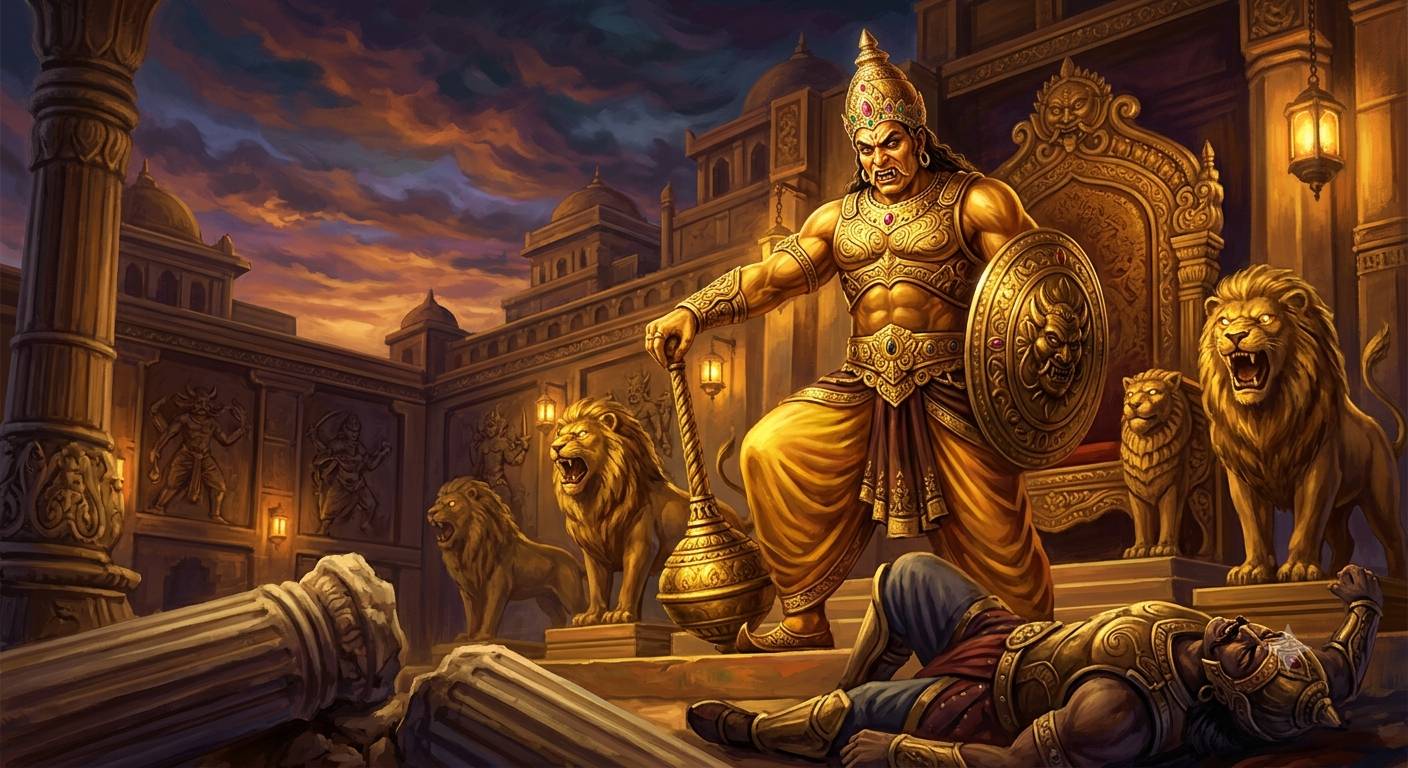
Hiranyakashipu is the most celebrated asura antagonist in the Bhagavata Purana — the demon-king who forbade worship of Vishnu in his kingdom and who persecuted his own son Prahlada for his devotion. His defeat by Narasimha is the mythological basis of Holi and the Narasimha Jayanti celebrations. His name means "golden bed" or one who loves gold and soft cushions.
Symbols & Iconography
Birth & Origin
Son of the sage Kashyapa and Diti. Twin brother of Hiranyaksha, who was killed by the Varaha avatar. Hiranyakashipu's rage at Vishnu began with the death of his brother. The Jaya-Vijaya tradition of the Bhagavata Purana holds that both Hiranyakashipu and Hiranyaksha were originally Vishnu's gatekeepers — Jaya and Vijaya — cursed by the four Kumaras to be born as demons for three lifetimes before returning to their divine positions.
Scriptures
Hiranyakashipu appears in the Vishnu Purana, Bhagavata Purana, and Narasimha Purana.
Worship & Legacy
His destruction by Narasimha is celebrated on Narasimha Jayanti. The burning of Holika (his sister) on the eve of Holi — which preceded Prahlada's miraculous survival — is the mythological basis of the Holika Dahan festival. Hiranyakashipu is invoked as the archetype of ego, power, and the denial of the divine within oneself.
Key Stories
1. The Boon and Its Conditions
Hiranyakashipu performed intense austerities and received from Brahma a boon of near-invulnerability: he could not be killed inside or outside, by day or by night, on the ground or in the air, by man or beast, by any god or demon, by any animate or inanimate weapon. He then conquered the three worlds and demanded worship of himself instead of the gods.
2. The Persecution of Prahlada and the Death at the Pillar
Hiranyakashipu's son Prahlada remained devoted to Vishnu despite his father's fury. He was thrown from a cliff, exposed to wild elephants, bitten by snakes, placed in fire, and submerged in the ocean — every attempt on his life failed because Vishnu's protection was with him. Finally, Hiranyakashipu demanded Prahlada show him where Vishnu was, since Prahlada claimed Vishnu was everywhere. He struck a pillar of the palace in contempt — and Narasimha burst from it. At twilight, on the threshold of the hall, holding Hiranyakashipu on his lap, Narasimha killed him with his own claws. Every condition of the boon was met.
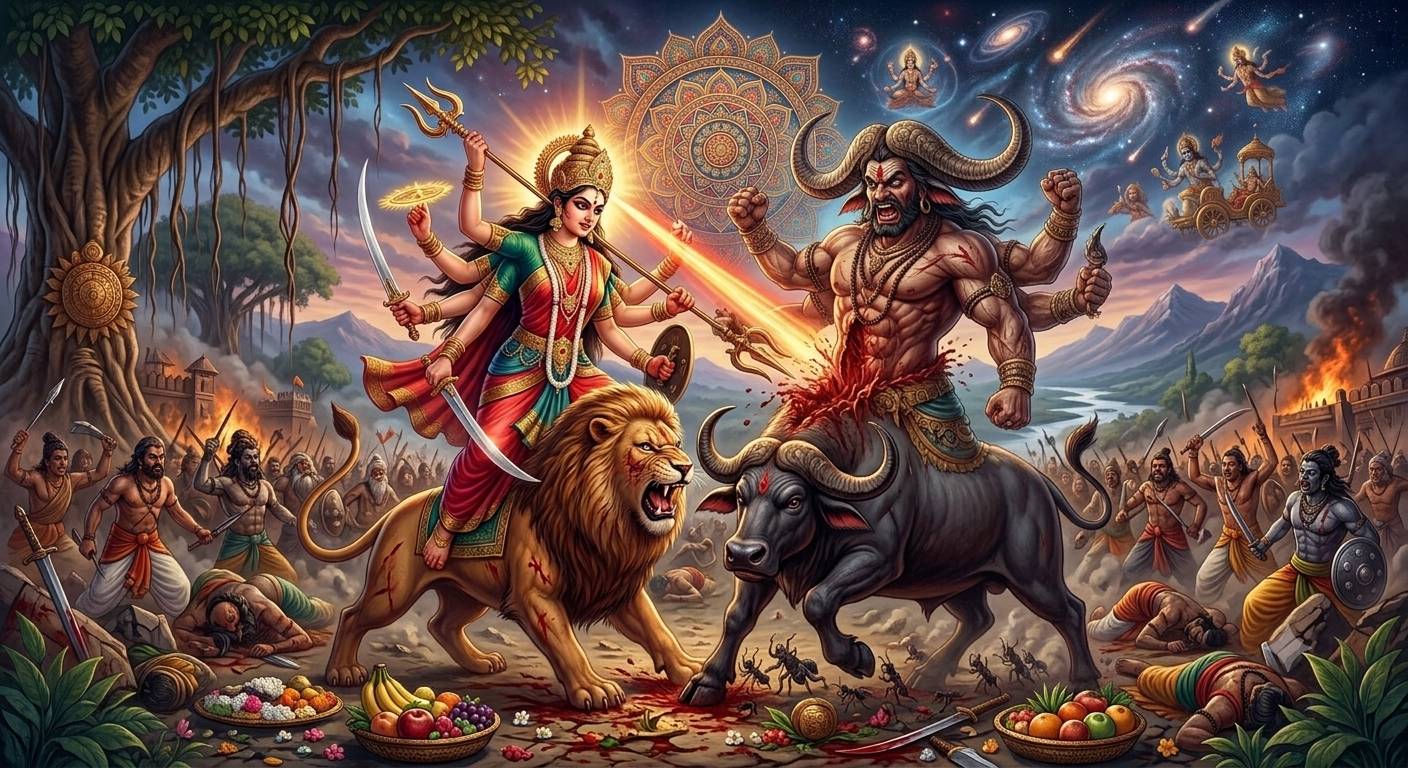
Mahishasura is the buffalo demon killed by Durga in the central battle of the Devi Mahatmya. His name means "great buffalo demon" (Mahisha = buffalo). He received a boon from Brahma that he could not be killed by any man or god — an oversight that the Goddess (who is neither) exploited.
Symbols & Iconography
Scriptures
The Devi Mahatmya (Markandeya Purana).
Worship & Legacy
Mahishasura is worshipped in Karnataka — particularly in Mysuru, which is named for him (Mahisuru/Mysuru = city of Mahisha). The Chamundeshwari Temple on Chamundi Hill at Mysuru depicts Durga killing him in an enormous murti. The annual Mysuru Dasara (Dussehra) festival — one of the most famous in India — celebrates Durga's victory over Mahishasura.
Key Stories
1. The Battle with Durga
Mahishasura conquered the three worlds and drove the gods from heaven. The gods combined their powers and created Durga. She fought his armies and his champions for nine days. Mahishasura himself kept transforming — from buffalo to lion to elephant to man — and she killed each form. In his final form, half-emerged from the neck of the slain buffalo, she pinned him with her lion's feet and drove her trident through him. The nine days of this battle are the theological basis of Navratri.
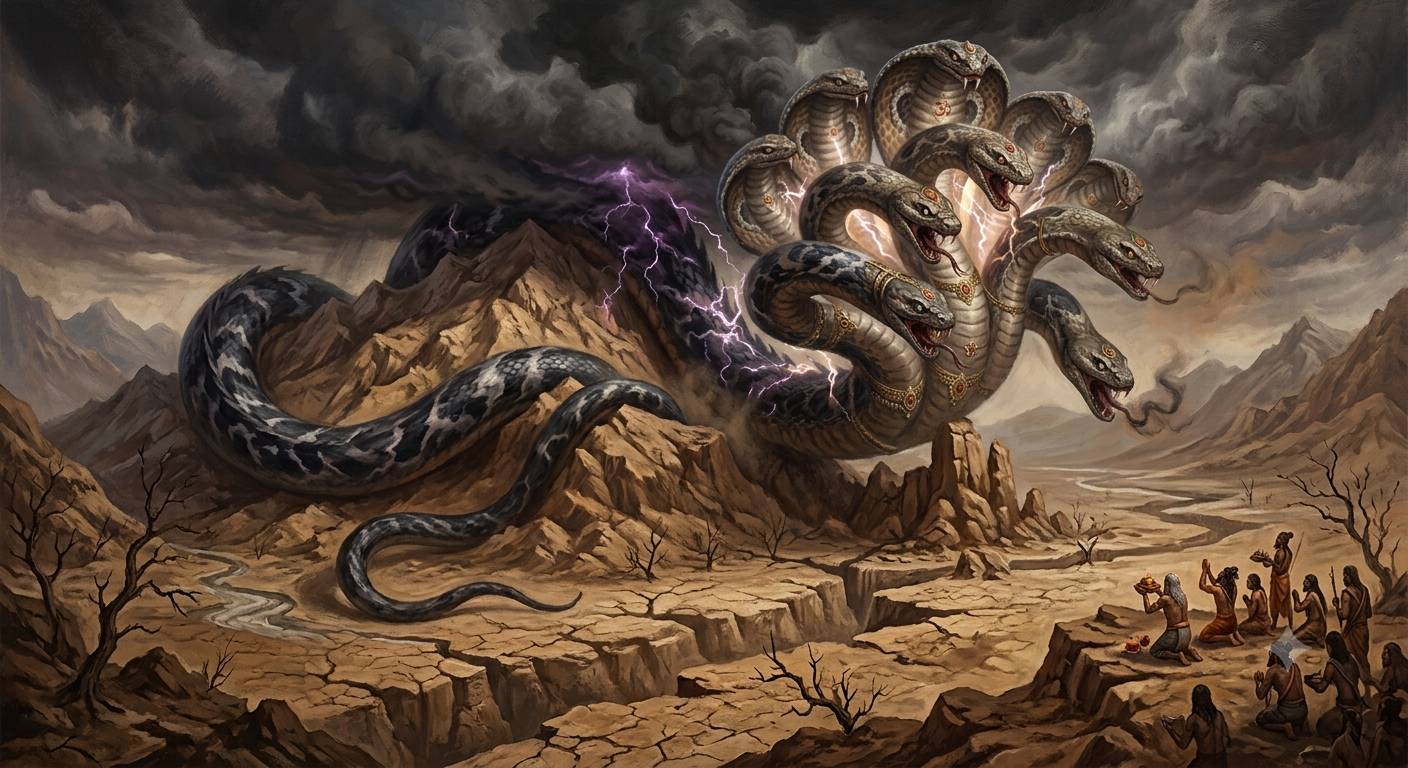
Vritra is the great cosmic serpent or dragon who blocked all the world's waters in the Rigveda — causing catastrophic drought until Indra slew him. He is the most mythologically significant asura of the Rigveda — the entire institution of Indra as the greatest god rests on his victory over Vritra. Also known as Ahi (the snake) and Namuchi (one who does not release).
Birth & Origin
In the Rigveda, Vritra is a primordial demon of chaos with no named origin — he simply exists as the force Indra defeats. In the Shatapatha Brahmana he is given a specific origin: deliberately created by the sage Tvashtr to avenge his son Vishvarupa, whom Indra had killed.
Scriptures
Vritra is the central figure of numerous Rigvedic hymns. He appears in the Shatapatha Brahmana, Mahabharata, Bhagavata Purana, and Vishnu Purana.
Worship & Legacy
Vritra is not worshipped. He is the defining adversary of the Rigvedic mythology — his defeat is the act that established both the divine order of the cosmos and the supremacy of Indra.
Key Stories
1. The Blocking of the Waters — Rigvedic
In the Rigveda, Vritra coiled around or swallowed the waters of the world, causing catastrophic drought. Indra, drinking Soma, took up his Vajra and attacked Vritra. He struck the serpent and split him open — the waters burst free and flowed across the earth. This myth is hymned more than any other in the Rigveda and is central to Indra's identity.
2. The Bones of Dadhichi
In the Puranic version, when Indra's Vajra proved insufficient against Vritra, the gods were told that only a weapon made from the bones of the sage Dadhichi could defeat him. Dadhichi voluntarily gave up his life so his skeleton could be used. Vishwakarma fashioned the Vajra from his spine. Indra used it to kill Vritra. This story overlays the Rigvedic account with a narrative of sacrifice and cosmic cooperation.
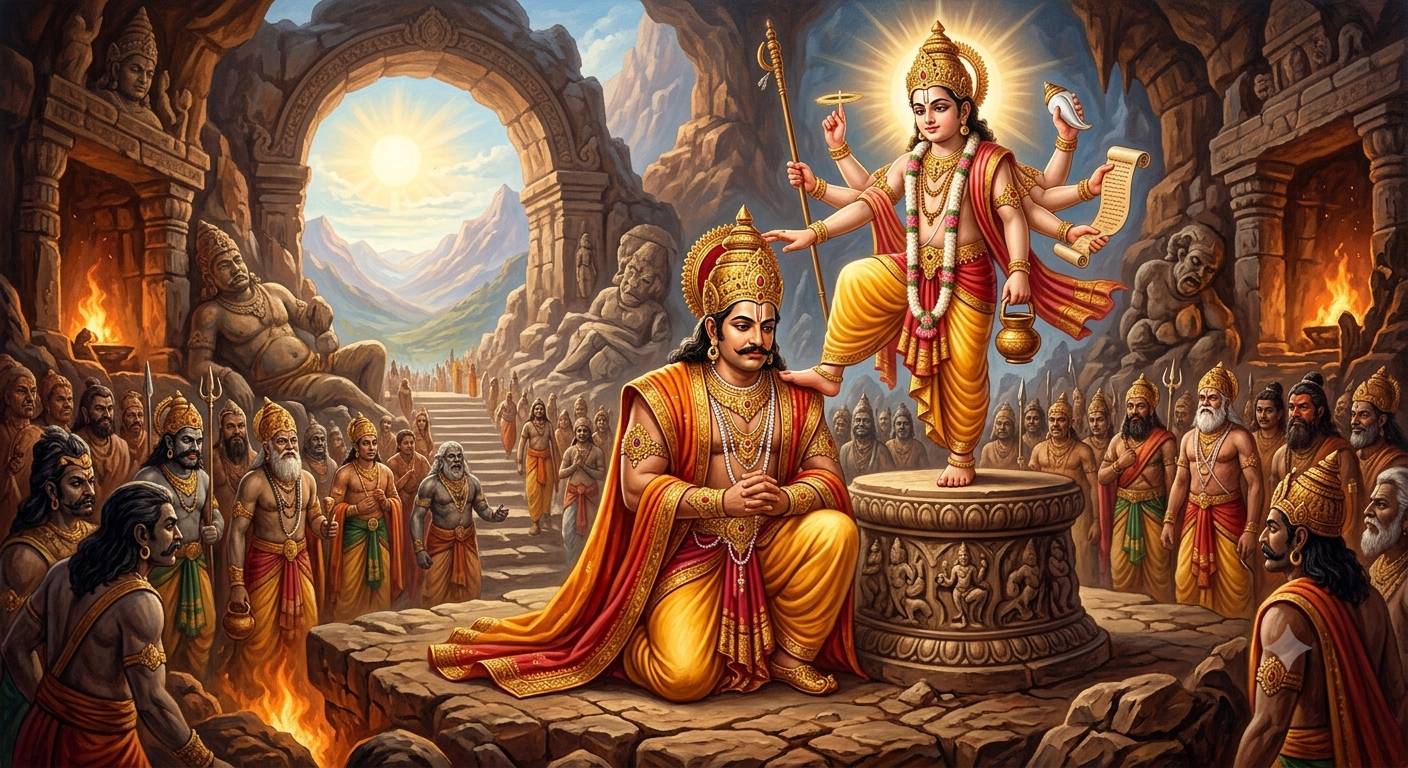
Bali (also called Mahabali) is the demon-king of the Bhagavata Purana whose story is the basis of the Vamana avatar and the festival of Onam. He is notable as an asura defined not by cruelty but by virtue — his generosity, his commitment to his word, and his humility in defeat make him one of the most sympathetically depicted asura-kings in the tradition.
Scriptures
Bali's story is in the Bhagavata Purana (eighth canto), Vishnu Purana, and Vamana Purana.
Worship & Legacy
Bali is worshipped in Kerala during Onam and in parts of coastal Karnataka and Goa. He is depicted in some traditions being held down by Vishnu's foot — but his face is serene, because he has accepted his defeat and found peace in his remaining kingdom.
Key Stories
1. The Three Strides of Vamana
Bali conquered the three worlds through austerity and dharmic conduct. Vishnu appeared as the dwarf Vamana and asked for three paces of land. Despite Shukracharya's warning, Bali granted the boon. Vamana grew cosmic — his first step covered the earth, his second the heavens. For the third, Bali offered his own head. Vishnu pressed him into the underworld with his foot — but honored Bali's virtue by granting him lordship there and making him Indra of the next age.
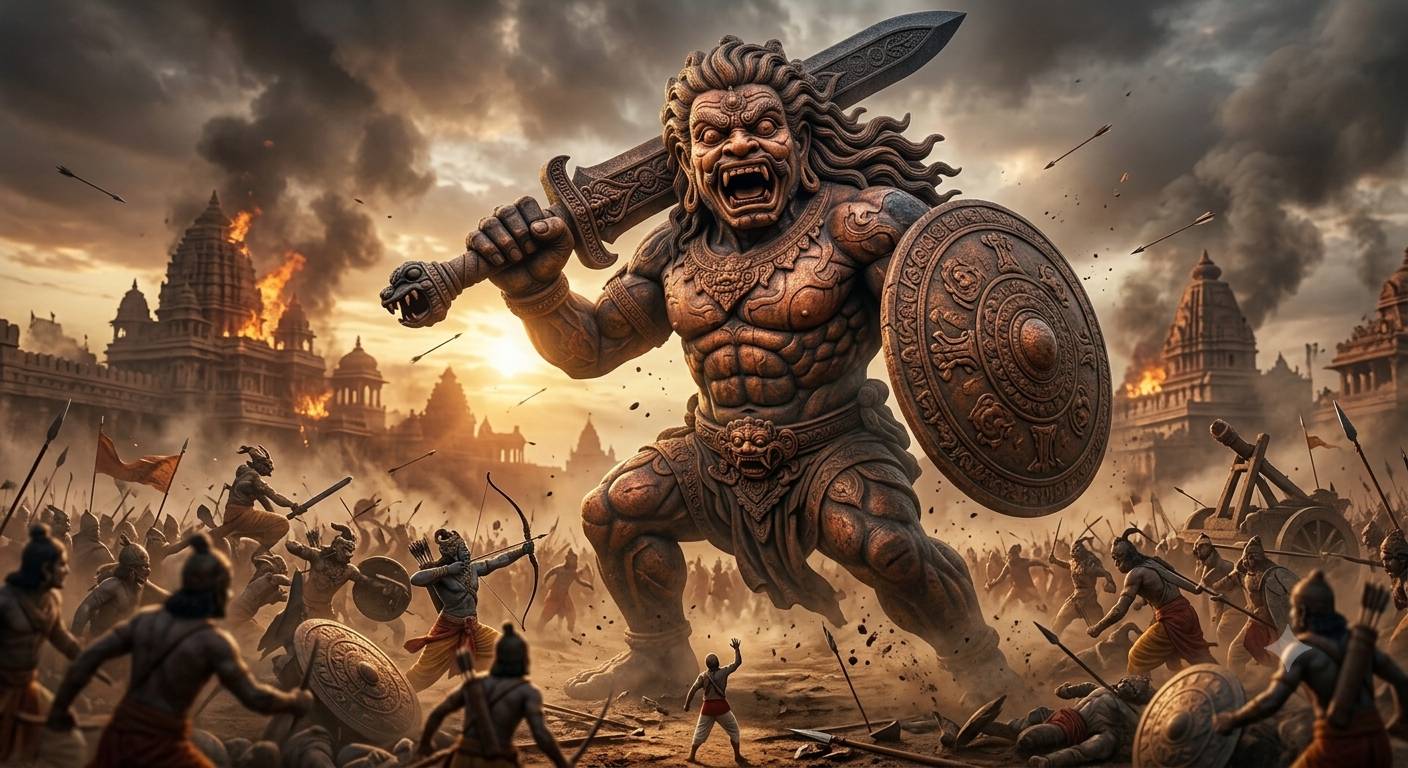
Kumbhakarna is Ravana's younger brother and the most physically powerful being in Lanka. He is cursed to sleep for months at a time — waking only to eat before sleeping again. He is the archetype of the loyal soldier who serves an unjust cause out of fraternal duty rather than conviction.
Symbols & Iconography
Scriptures
Kumbhakarna appears in the Valmiki Ramayana and the Ramcharitmanas.
Worship & Legacy
His name has become a cultural expression — "Kumbhakarna's sleep" is a Hindi idiom for extremely deep, long sleeping. No independent worship.
Key Stories
1. The Wrong Boon
Kumbhakarna performed great austerities and was offered a boon by Brahma. He intended to ask for Indrasana (Indra's throne) but Saraswati, at the gods' request, confused his tongue and he asked instead for Nidrasana (the bed of sleep). Brahma granted it. He slept for months at a time and was nearly impossible to wake. In some versions Vishnu or Indra also added to the curse's potency.
2. The Battle and Death
When woken for the war against Rama, Kumbhakarna told Ravana clearly that abducting another man's wife was wrong and that he would certainly lose. Nevertheless he fought — devastating Rama's army before being killed when Rama cut off his arms, then his legs, and finally his head with divine weapons.
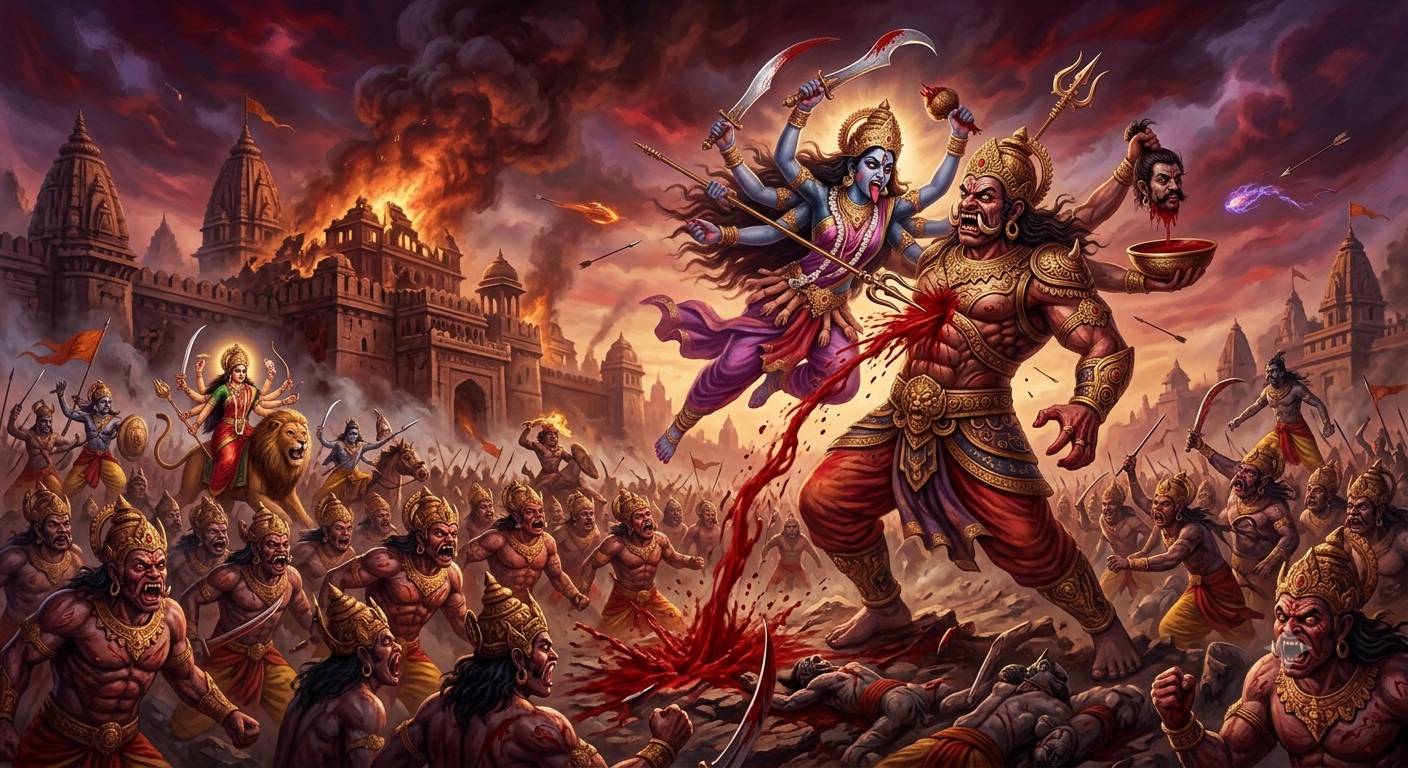
Raktabija is the asura whose blood, when it touched the ground, spawned a new demon identical to himself. He appears in the Devi Mahatmya as one of the champions of Shumbha and Nishumbha.
Scriptures
Devi Mahatmya (Markandeya Purana).
Worship & Legacy
Raktabija is not worshipped. His story is the theological basis for several Tantric practices involving the symbolic "drinking" of blood — consumption rather than rejection of the demonic as a path of mastery.
Key Stories
1. The Battlefield of Blood
As Durga's forces cut Raktabija with swords and arrows, every drop of blood that hit the earth spawned a new Raktabija — the battlefield filled with his replicas. Kali stretched her enormous tongue across the entire field and licked up every drop of blood as it fell, preventing new demons from forming. She then killed Raktabija himself.
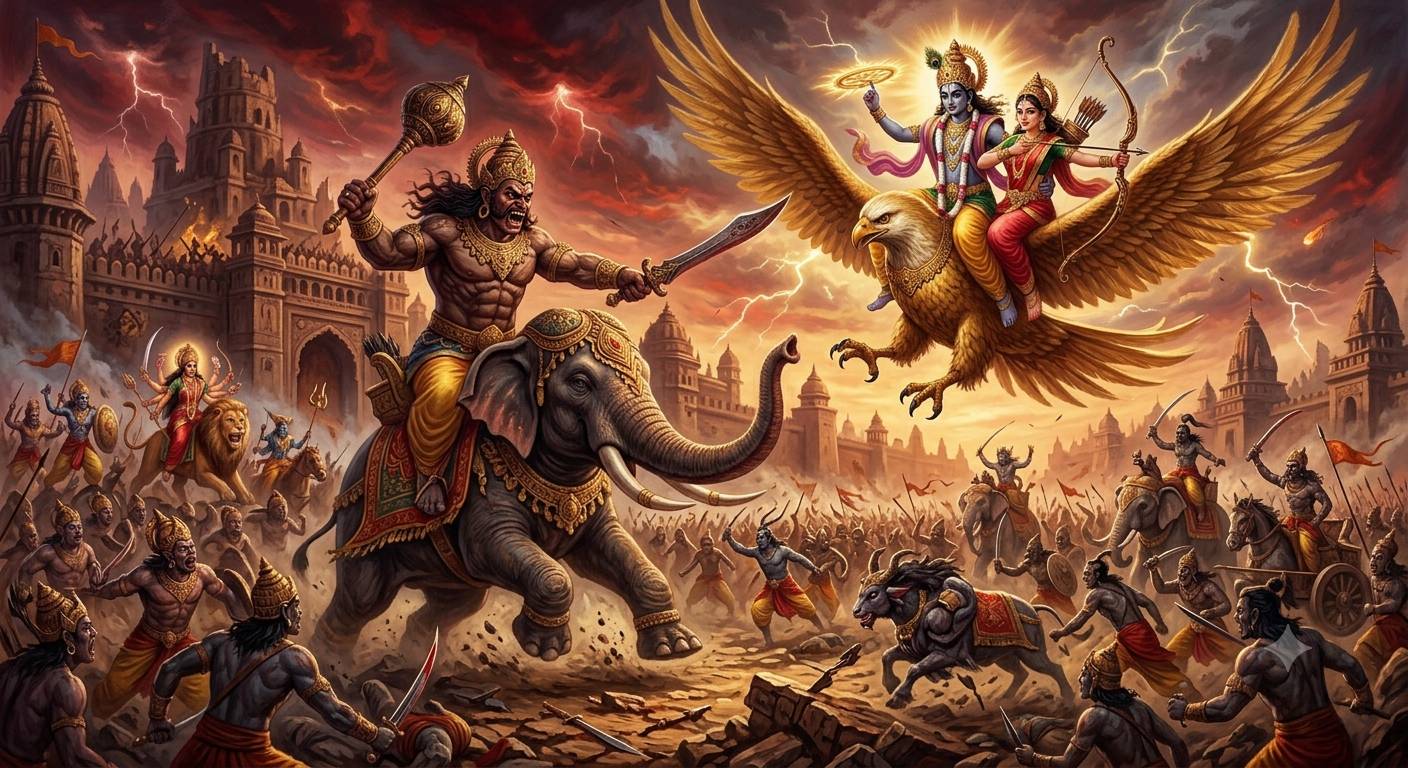
Narakasura is the demon son of Prithvi (the earth goddess) and Varaha (Vishnu's boar avatar). He conquered the three worlds and committed two symbolic acts of cosmic defiance — stealing Aditi's earrings (sacred symbols of divine motherhood) and Varuna's royal umbrella (the insignia of cosmic sovereignty). Also known as Bhauma (son of the earth).
Symbols & Iconography
Scriptures
Narakasura's story is in the Bhagavata Purana (tenth canto) and the Vishnu Purana.
Worship & Legacy
Naraka Chaturdashi — the day before the main Diwali night — celebrates Narakasura's defeat at Krishna's hands, tracing directly to his dying request that his death be marked with celebration rather than mourning. Oil baths at dawn on this day — washing off impurity as Narakasura was defeated — remain a living tradition in South India, where this day is often considered the primary Diwali observance rather than the following night.
Key Stories
1. The Death of Narakasura
Krishna and his wife Satyabhama (an avatar of Prithvi/Bhumi, Narakasura's own mother) attacked his fortress together. A prophecy said Narakasura would be killed by his mother. When Krishna was momentarily stunned in battle, Satyabhama took over his chariot and shot the arrow that killed Narakasura. Before dying, Narakasura asked that his death be celebrated with lights and joy rather than mourning — which became Naraka Chaturdashi (the second day of Diwali), also called Choti Diwali. Krishna then freed all 16,100 women held captive and, to protect their honor, married them all — the origin of the number 16,108 when added to his eight principal wives.
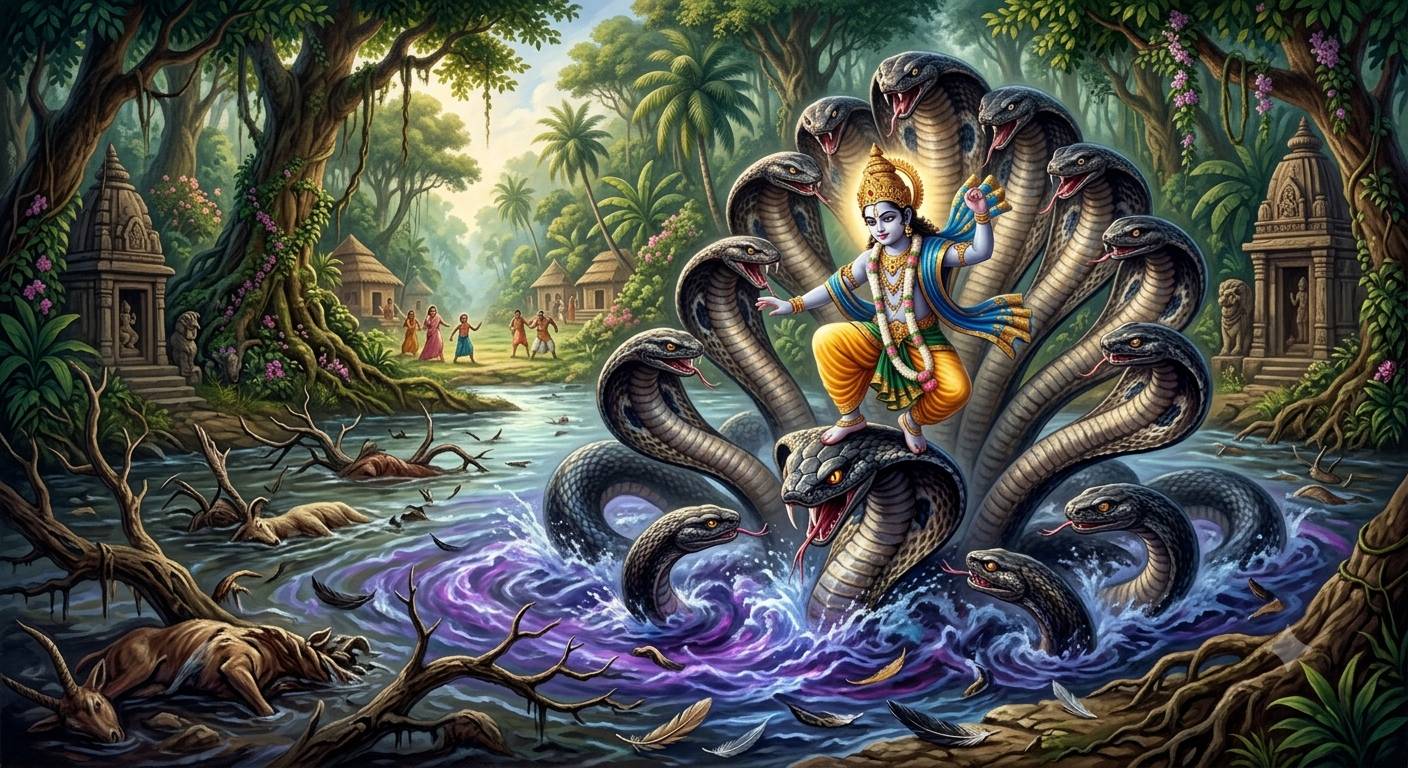
Kaliya is the multi-hooded serpent who poisoned the Yamuna river with his venom, killing the animals and birds along its banks and threatening the people of Vrindavan. He was defeated by the young Krishna in a beloved episode of Krishna's childhood.
Scriptures
Kaliya's story is in the Bhagavata Purana (tenth canto).
Worship & Legacy
The Kaliya Daman (defeat of Kaliya) is one of the most depicted scenes in Krishna devotional art — particularly the bronze tradition of South India and the paintings of Rajasthan. Krishna dancing on Kaliya's hoods is among the most recognized images of his childhood.
Key Stories
1. The Dance on Kaliya's Hoods
Krishna dove into the Yamuna's poisoned pool and battled Kaliya. Kaliya coiled around Krishna and seemed to crush him. Krishna expanded his body and broke free, then leaped onto Kaliya's hoods and began to dance — pressing the central hood down with his feet, forcing Kaliya to bow in surrender. Kaliya's wives pleaded for his life. Krishna spared him, on the condition that he leave the Yamuna and go to the ocean. The mark of Krishna's feet remained on Kaliya's hoods as protection, ensuring that Garuda would not attack him. The Yamuna was purified.
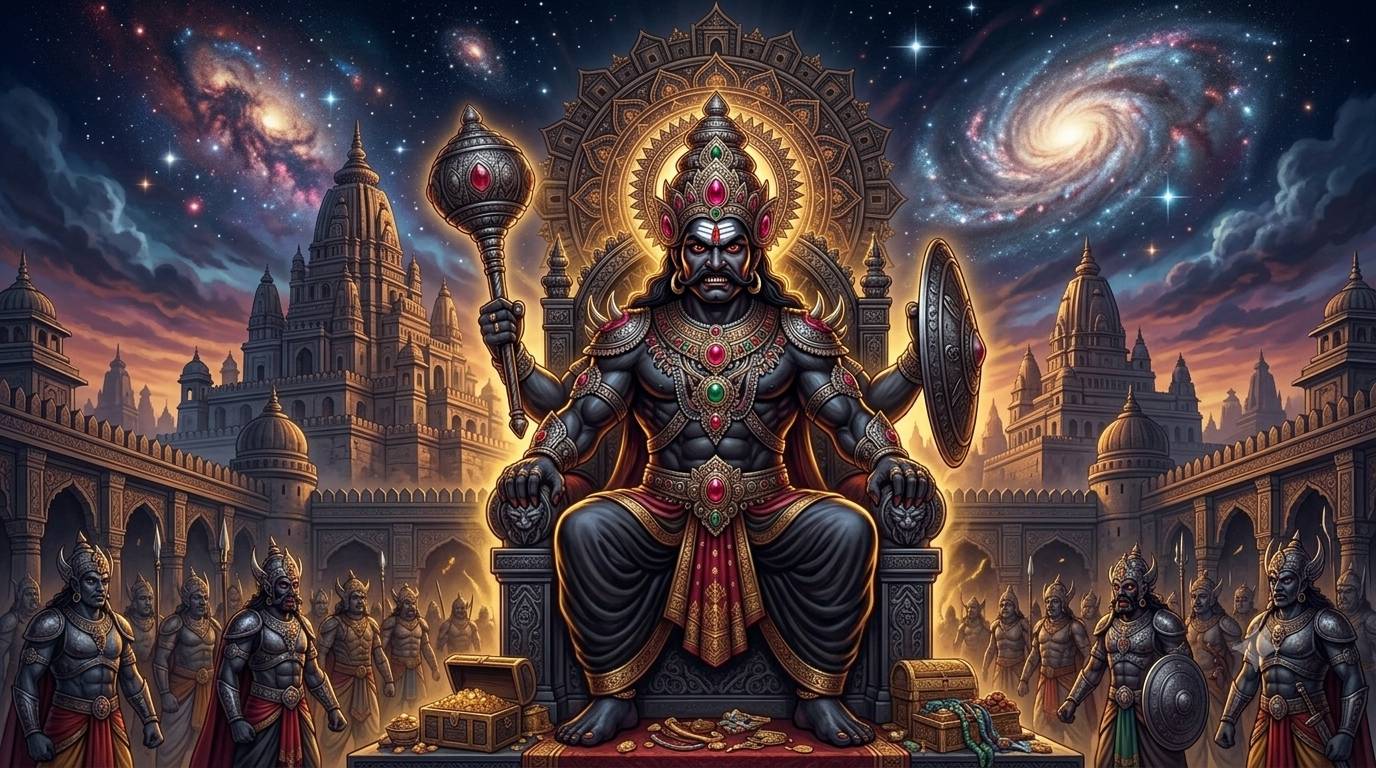
Tarakasura is the asura whose specific invulnerability — that only Shiva's son could kill him — drove the entire narrative of Kartikeya's birth and became the central crisis of Shaiva mythology. He is the archetype of the demon whose own cleverly worded boon becomes the instrument of his destruction. Also known as Taraka.
Symbols & Iconography
Birth & Origin
Performed intense austerities to Brahma and received a boon of near-invulnerability — specifying he could only be killed by Shiva's son. Since Shiva was in perpetual meditation after Sati's death with no prospect of fathering a child, Tarakasura considered himself permanently safe.
Family
No significant family is recorded in the texts. His significance is entirely as a narrative catalyst.
Scriptures
Tarakasura appears in the Shiva Purana, Skanda Purana, Mahabharata, and Bhagavata Purana.
Worship & Legacy
Not worshipped. His significance is entirely as the narrative catalyst for Kartikeya's birth — one of the most consequential events in Shaiva mythology.
Key Stories
1. The Conquest of the Three Worlds
Tarakasura drove the gods from heaven, occupied Indra's palace, disrupted all yajna (sacrifices), and imposed his will across all three worlds. His specific boon made him laugh at the gods' attempts to resist — none could harm him, and Shiva's celibacy seemed to make his protection permanent. The gods appealed to Vishnu and Brahma, who devised the plan to disturb Shiva's meditation and bring Kartikeya into existence.
2. Death at Kartikeya's Vel
Kartikeya led the gods' army against Tarakasura and killed him with his Vel. The battle is described in detail in the Skanda Purana — the enormous Purana dedicated to Kartikeya's life.
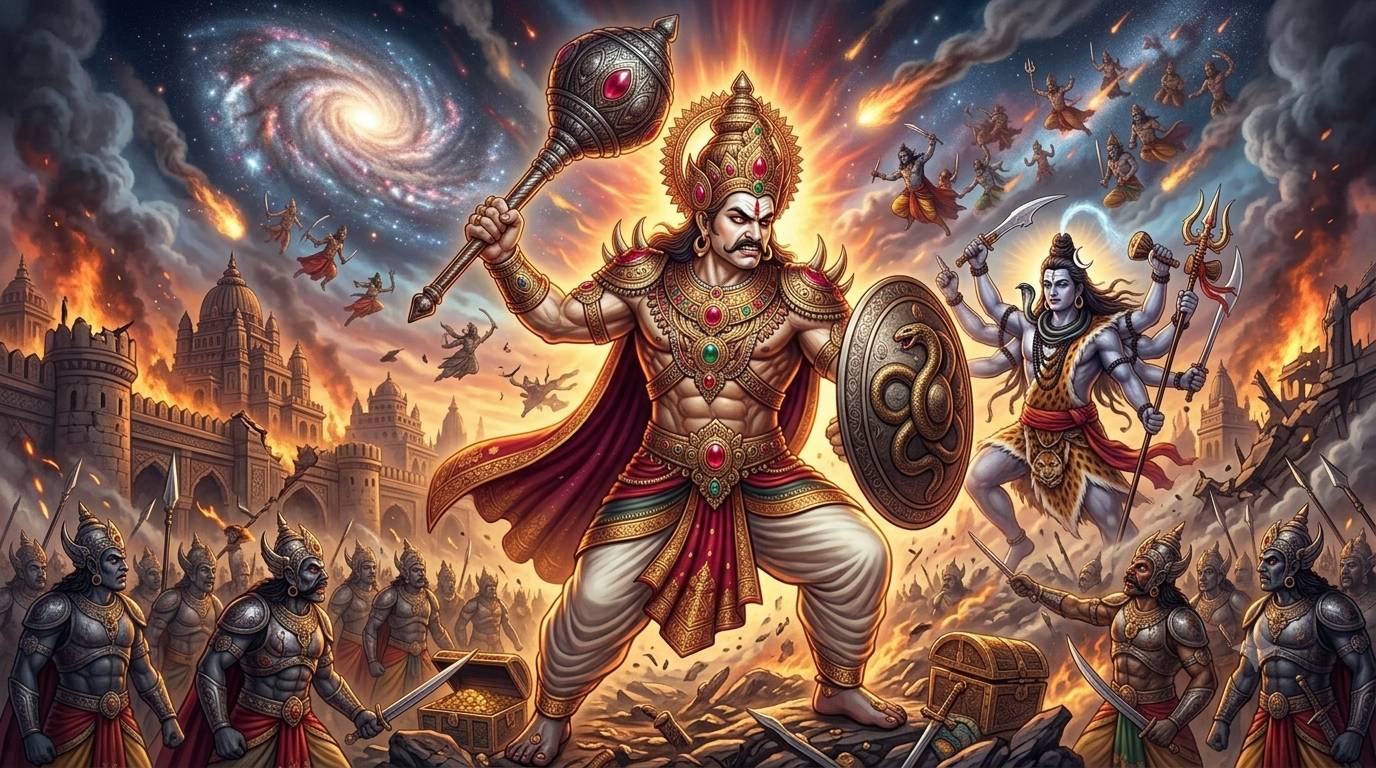
Jalandhara is an asura born from the collision of Shiva's divine fire with the ocean — making him, unusually, a demon of divine origin who inherited a portion of Shiva's own power. He is one of the few asuras to directly challenge Shiva in battle and nearly prevail. His story introduces one of the most ethically complex episodes in the Puranas. Also known as Shankha in some texts.
Symbols & Iconography
Birth & Origin
When Indra came to Kailash to meet Shiva and behaved arrogantly, Shiva's fury produced a flame of divine fire from his third eye. Brahma directed this fire into the ocean. From the ocean arose Jalandhara — a child of such power that the ocean itself raised him as a son. He was given the name Jalandhara (bearer of the waters) and grew into the most powerful asura of his age.
Family
Father: The ocean (adoptive). Wife: Vrinda — a woman of absolute fidelity and austerity, whose chastity was the source of Jalandhara's near-invulnerability.
Scriptures
Jalandhara appears in the Shiva Purana, Padma Purana, and Devi Bhagavata Purana.
Worship & Legacy
Not worshipped independently. His story is remembered primarily for its ethical complexity — a virtuous woman deceived, a demon killed through means that required a god to compromise his own integrity.
Key Stories
1. The Battle and Defeat Through Deception
Jalandhara conquered the three worlds and defeated the gods. When he challenged Shiva himself, the battle was nearly even — Shiva's weapons were countered at every turn. The gods discovered that Jalandhara's power was sustained by his wife Vrinda's absolute fidelity. Vishnu, to help Shiva, disguised himself as Jalandhara and went to Vrinda. She received him as her husband, breaking her chastity through deception. The moment her fidelity was broken, Jalandhara's protection failed and Shiva killed him. Vrinda, discovering the deception, cursed Vishnu to be separated from his consort — a curse fulfilled in the Rama avatar when Sita was abducted. The story appears in the Shiva Purana and is the Puranic tradition's most direct confrontation with the ethics of divine deception.
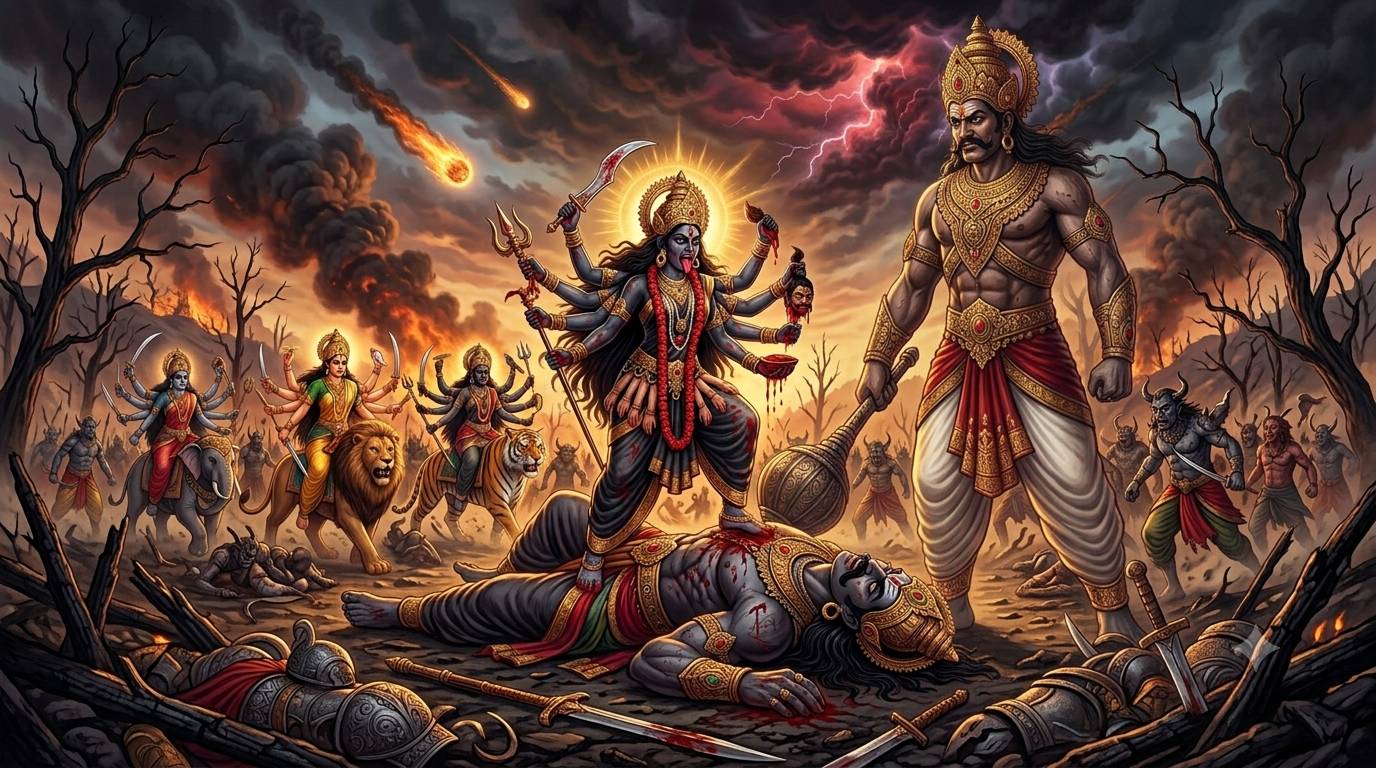
Shumbha and Nishumbha are the demon brothers whose defeat forms the third and climactic episode of the Devi Mahatmya — the most important text of the Goddess tradition. They had conquered the three worlds after Mahishasura's defeat, and their campaign against the Goddess culminated in the direct battle between Shumbha and the supreme Shakti herself.
Symbols & Iconography
Birth & Origin
No specific origin story is given in the Devi Mahatmya. They appear as rulers of the asuras who rose to power after Mahishasura's death, having performed austerities to receive their own boons of power.
Family
Brothers. Their army included the commanders Chanda, Munda, Raktabija, Dhumralochana, and a vast force of asuras.
Scriptures
Devi Mahatmya (Markandeya Purana), Chapters 8–10.
Worship & Legacy
Not worshipped. Their story is recited daily in temples and forms the third of the three great narratives of the Devi Mahatmya chanted across the nine nights of Navratri.
Key Stories
1. The Demand and the Final Battle
Shumbha, having conquered the universe, sent emissaries demanding the Goddess as his wife or submit to capture. She replied — with divine irony — that she had long ago vowed to marry only one who could defeat her in fair combat. Shumbha sent champion after champion — Dhumralochana, Chanda and Munda, Raktabija — each destroyed. Finally both brothers entered the field. Nishumbha was killed by Kali. When Shumbha confronted the Goddess and accused her of fighting with help, she absorbed all her attending Shaktis back into her own body — fighting entirely alone — and killed Shumbha herself. Before dying, he acknowledged her supremacy. This narrative is the theological climax of the Devi Mahatmya.
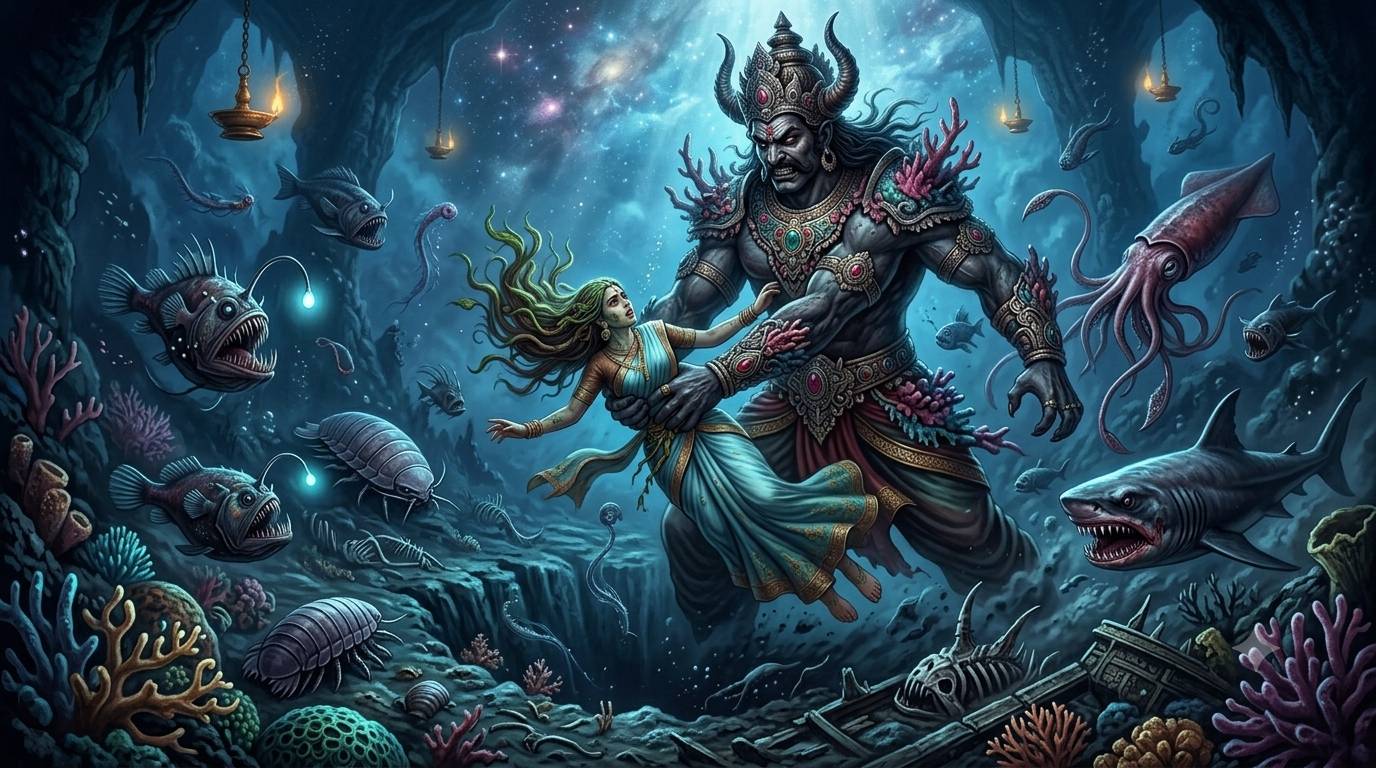
Hiranyaksha is the asura who seized the earth goddess Prithvi and dragged her to the bottom of the cosmic ocean — the act that necessitated Vishnu's Varaha avatar. He is the twin brother of Hiranyakashipu and, in the Jaya-Vijaya tradition, a previous birth of one of Vishnu's own gatekeepers. His name means "golden-eyed."
Symbols & Iconography
Birth & Origin
Son of the sage Kashyapa and Diti, born alongside his twin Hiranyakashipu. In the Jaya-Vijaya tradition of the Bhagavata Purana, both Hiranyaksha and Hiranyakashipu were originally Vishnu's gatekeepers, cursed by the four Kumaras to be born as demons for three lifetimes before returning to their divine posts.
Family
Father: Kashyapa. Mother: Diti. Twin brother: Hiranyakashipu.
Scriptures
Bhagavata Purana, Vishnu Purana, Valmiki Ramayana.
Worship & Legacy
Not worshipped. The Udayagiri cave reliefs in Madhya Pradesh — among the finest 5th-century CE sculptural masterpieces in India — depict his defeat as part of the Varaha composition.
Key Stories
1. The Dragging of the Earth and Death by Varaha
Hiranyaksha grew so powerful he challenged the gods and seized the earth goddess Prithvi, dragging her to the floor of the cosmic ocean. Without the earth in place, creation could not function. Vishnu took the form of Varaha — a boar of cosmic size — dove into the primordial ocean, fought Hiranyaksha for a thousand divine years, and killed him. He then lifted the earth on his tusks and restored her to her place in the cosmos.
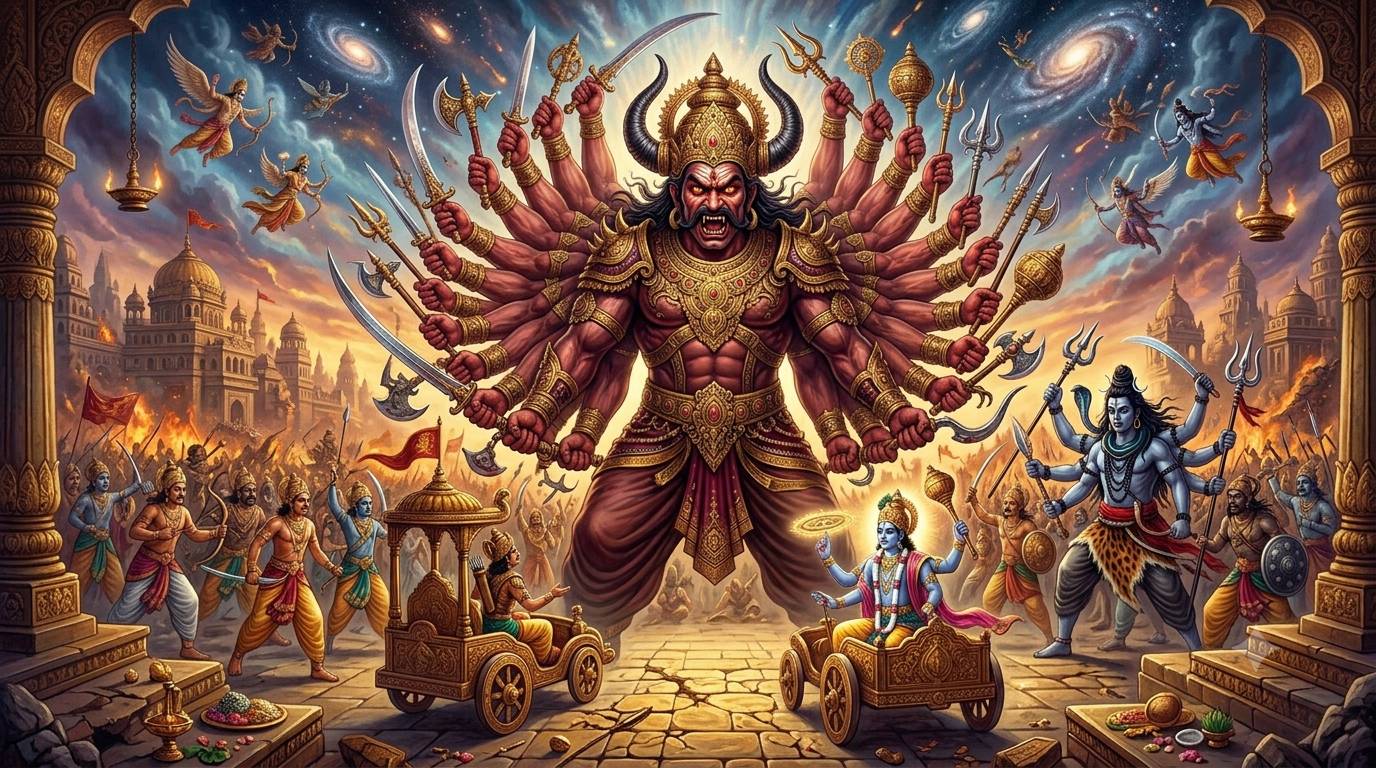
Banasura is a demon king with a thousand arms — a devotee of Shiva who received tremendous power through his worship. His story is one of the few in Hindu mythology in which Shiva and Krishna directly oppose each other in battle, making it a significant moment in the theological dialogue between Shaiva and Vaishnava traditions.
Symbols & Iconography
Birth & Origin
Son of the demon king Bali — the virtuous asura subdued by the Vamana avatar. Despite Bali's dharmic character, Banasura inherited the demonic nature of the Daitya lineage.
Family
Father: Bali. Daughter: Usha — whose love story with Aniruddha (Krishna's grandson) is the central narrative of his mythology.
Scriptures
Bhagavata Purana (tenth canto), Harivamsha.
Worship & Legacy
Banasura is associated with the Banashankari temple near Badami in Karnataka — named for the Goddess worshipped in his territory. The Usha-Aniruddha story is a subject of the Manipuri dance tradition. Some regional traditions in Assam identify his capital with sites in that region.
Key Stories
1. Usha, Aniruddha, and the War Between Krishna and Shiva
Banasura's daughter Usha fell in love with Aniruddha (Krishna's grandson) in a dream. Her companion Chitralekha located him astrally and brought him to Banasura's capital. When Banasura discovered them together he imprisoned Aniruddha. Krishna and Balarama came to rescue him. Shiva himself fought alongside Banasura out of loyalty to his devotee. Krishna countered Shiva's weapons one by one — the Pashupatastra with the Narayanastra, the fever weapon with cold, the yawn weapon with its equal. Shiva, recognising the contest was futile, asked Krishna to spare Banasura's life. Krishna agreed — but cut off all but four of his thousand arms and departed with Aniruddha and Usha. The story appears in the Bhagavata Purana and is the most direct confrontation between the two supreme deities.
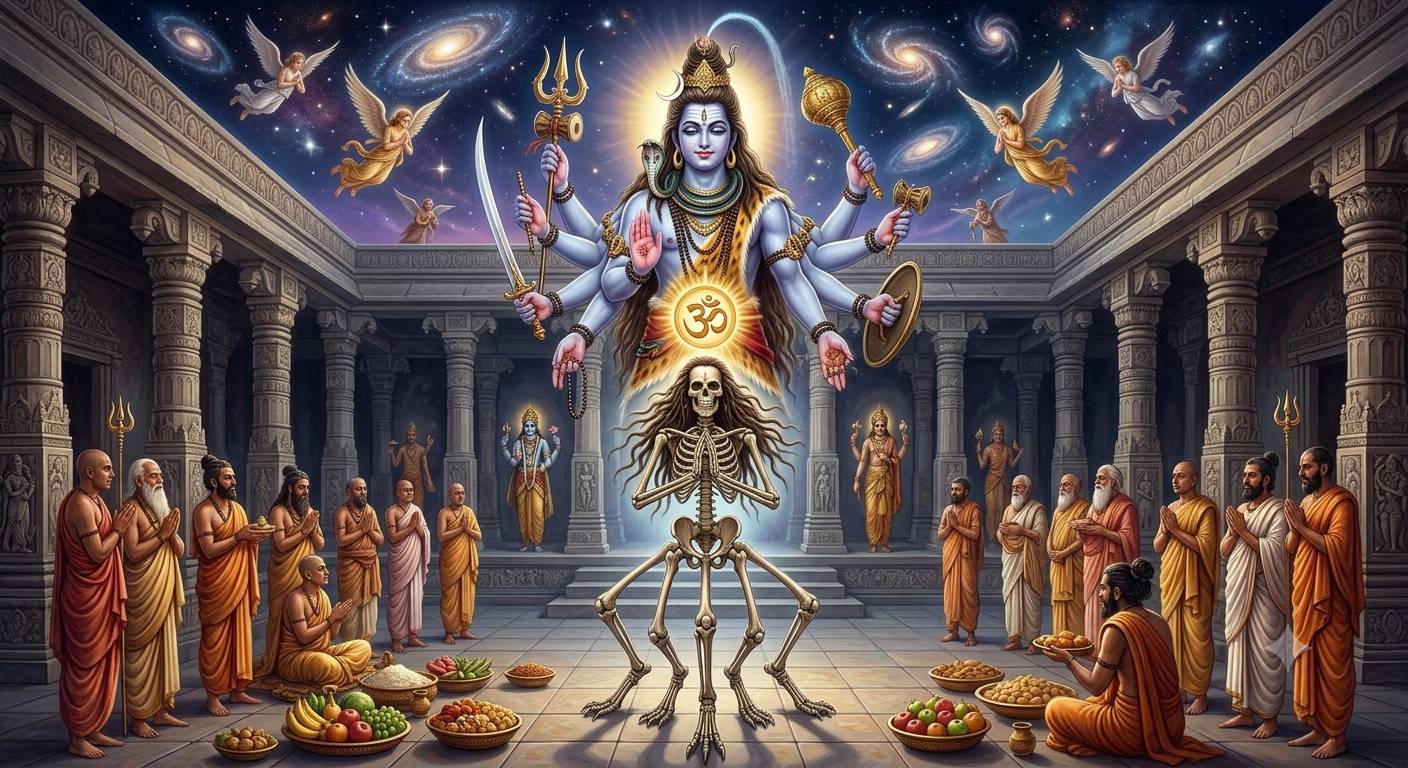
Andhaka is a demon of blindness and uncontrolled desire — unable to distinguish what is sacred from what is profane. He represents lust without discernment. His story ends in transformation rather than annihilation, making him one of the more theologically interesting asuras in the Shaiva tradition.
Symbols & Iconography
Birth & Origin
Parvati, in a playful moment, covered Shiva's three eyes from behind. Total darkness fell — and from that darkness, generated by the heat of Shiva's own divine fire, a being was born: blind, dark-complexioned, and filled with uncontrolled desire. He was given to the demon Hiranyakashipu to raise as his own son.
Family
Born of Shiva's darkness with Parvati as the indirect cause. Raised by Hiranyakashipu.
Scriptures
Andhaka appears in the Matsya Purana, Shiva Purana, and Skanda Purana.
Worship & Legacy
Andhaka is not worshipped as a demon. As Bhringi he is present in virtually every major Shiva temple in South India as one of Shiva's divine Ganas — his skeletal three-legged form a permanent fixture of the divine court.
Key Stories
1. The Defeat and Transformation into Bhringi
Andhaka grew immensely powerful and in his blindness attempted to abduct Parvati — unable to recognise her as a goddess or as his own mother. Shiva impaled him on his trident and held him there while Andhaka's blood dripped down — every drop spawning a new demon, exactly as with Raktabija. Shiva held him aloft as the blood burned away in divine fire, consuming the new demons as they formed. When all his blood was gone and his impurity burned out, Andhaka's eyes were opened — he saw Shiva and Parvati clearly for the first time. Shiva, moved by his awakening, restored him as Bhringi — one of his divine Ganas.
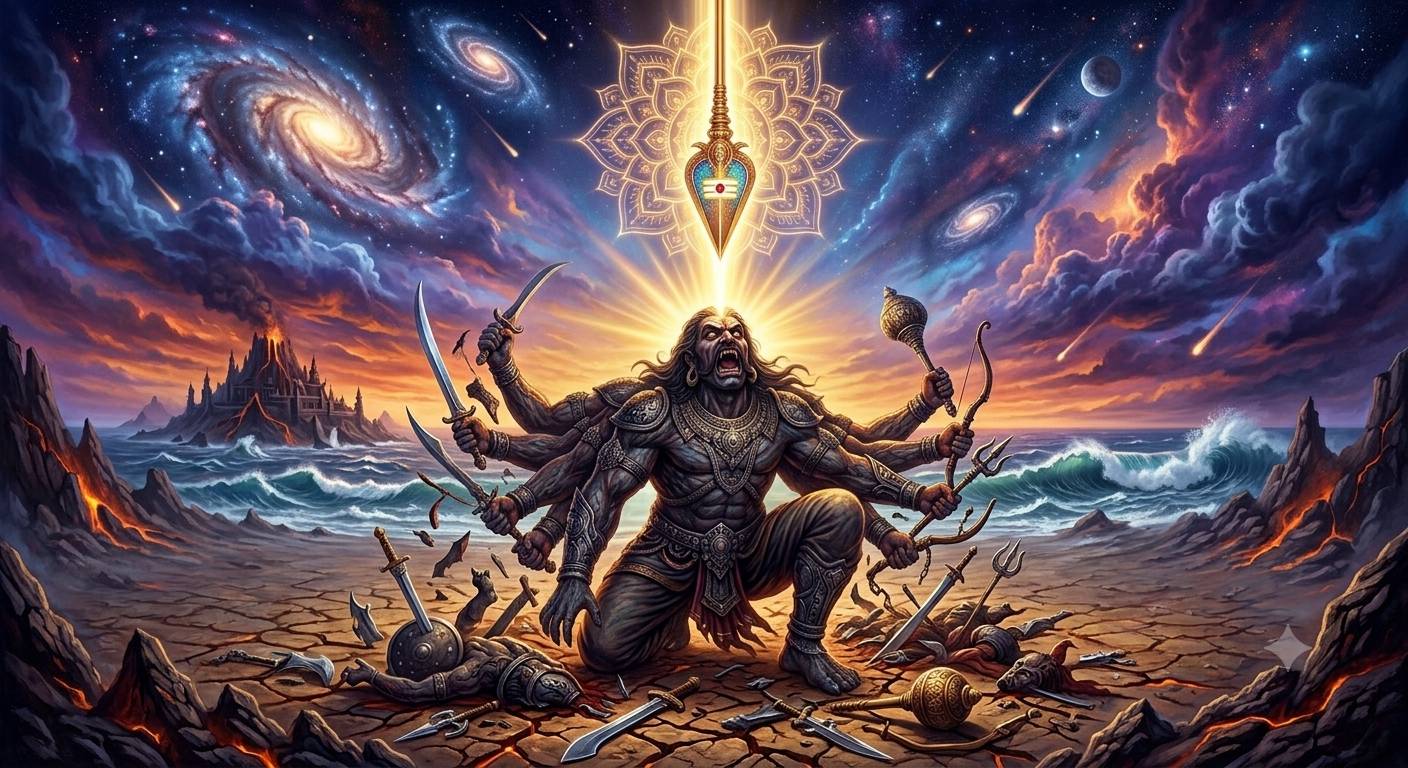
Surapadman is the supreme demon of Tamil Murugan mythology — the principal antagonist of the Kanda Puranam (Tamil Skanda Purana) whose defeat by Murugan's Vel forms the climax of the Tamil Shaiva narrative. He ruled the three worlds for millennia with absolute power and enslaved the gods themselves. His story ends not in mere defeat but in divine transformation — absorbed into Murugan's own iconography.
Symbols & Iconography
Birth & Origin
Son of the sage Kashyapa and Maya (an asura woman) — making him a demon of both divine and asura lineage. He performed intense austerities and received boons of immense power from Brahma and Shiva, making him effectively invulnerable to all existing beings.
Family
Father: Kashyapa. Mother: Maya. Brothers: Taraka (Tarakasura) and Simhamukha. All three were powerful asuras whose defeat by Murugan forms the central narrative of Tamil Shaiva mythology.
Scriptures
Kanda Puranam (Tamil Skanda Purana), composed by Kachiyappa Sivachariar (14th century CE). Surapadman does not appear in the Sanskrit Puranas — this is an entirely Tamil mythological tradition.
Worship & Legacy
The Surasamharam festival — the killing of Sura — is celebrated at Tiruchendur and other Murugan temples as a dramatic ritual reenactment of the final battle, enacted over six nights during Skanda Shashti. It is one of the most significant festivals in Tamil Shaivism. Surapadman's transformation into the peacock and rooster makes him present in Murugan's iconography in every Murugan temple — the defeated demon who became the god's eternal companion.
Key Stories
1. The Enslavement of the Gods and the Final Battle
Surapadman conquered and enslaved the gods — Indra and the Devas were imprisoned, the celestial order collapsed. The gods prayed to Shiva and Parvati, whose son Murugan was born specifically to defeat this demon. After defeating Surapadman's brothers and generals, Murugan finally faced Surapadman himself. Their battle was cosmic in scale and lasted six days — the six days of Skanda Shashti celebrated annually. On the sixth day, Surapadman transformed himself into a vast mango tree to escape the Vel. Murugan hurled the divine lance given by Parvati. It split the tree in two — one half transformed into Murugan's peacock vahana, the other into the rooster on his banner. Even in total defeat, Surapadman was granted a form of eternal service within Murugan's own divine identity — the peacock that carries the god and the rooster that announces his presence. This act of grace is the theological heart of the story.
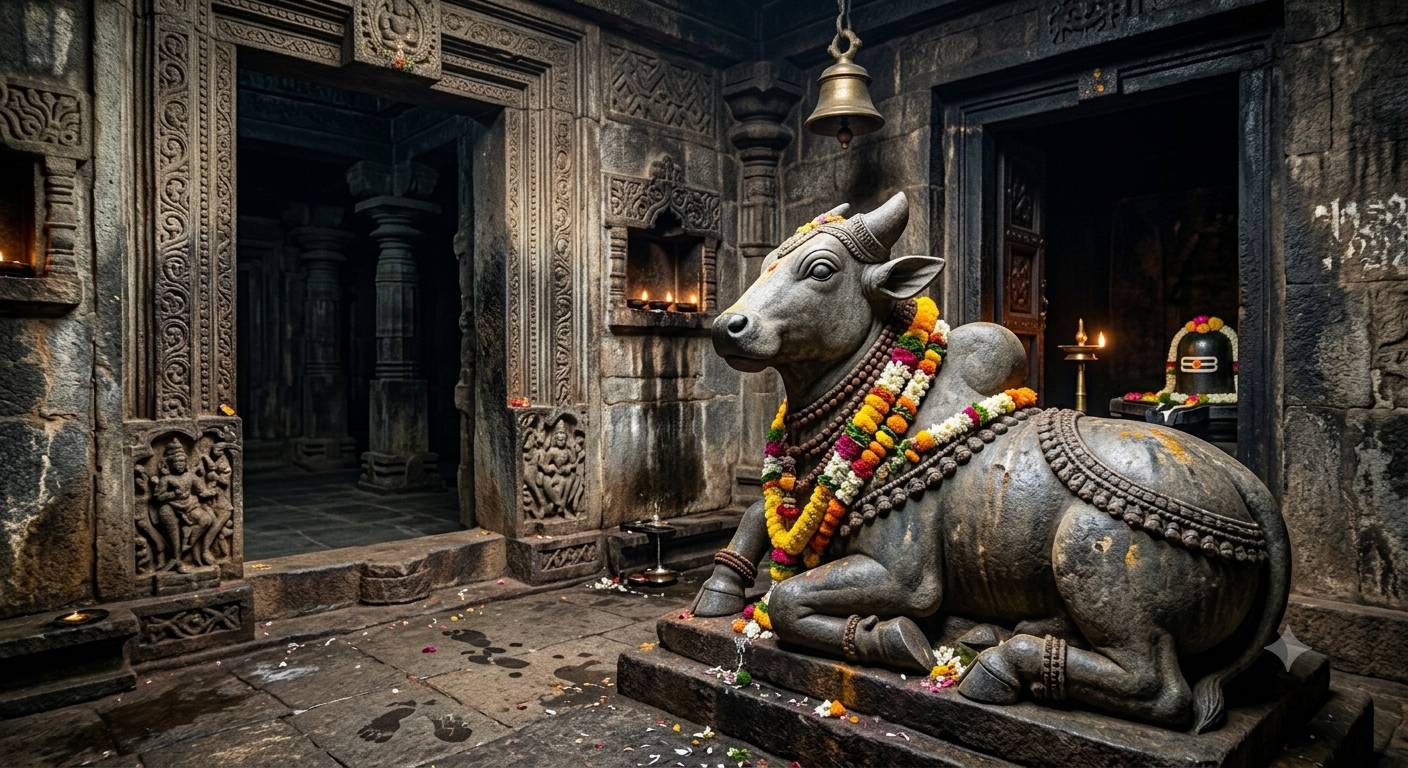
Nandi is the sacred bull of Shiva — his vahana (mount), his gatekeeper, and his most devoted servant. He sits at the entrance of every Shiva temple, facing the Shivalinga, eternally in meditation and devotion. He is also the lord of all Ganas (Shiva's divine attendants) and is considered the first teacher of music and dance — it is through Nandi that Shiva's arts descended to humanity. Also known as Nandikeshvara and Adhikara Nandi.
Symbols & Iconography
Birth & Origin
In the Shiva Purana, Nandi was born to the sage Shilada, who received him as a boon from Shiva after intense austerities. In another account he is the son of the divine bull Shalagrami and the cow Surabhi. Regardless of account, he was recognized by Shiva as his own son and made the lord of his Ganas.
Scriptures
Nandi appears in the Shiva Purana, Skanda Purana, and Linga Purana.
Worship & Legacy
Every Shiva temple in India has a Nandi facing the Shivalinga in the main hall (Nandi Mandapam). Touching Nandi's horns and looking between them toward the Shivalinga is a standard act of Shiva temple worship. The Nandi Hills near Bengaluru are named for him. Nandi Puja is performed in South Indian Shiva temples on the first day of each fortnight.
Key Stories
1. Nandi's Curse on Ravana
When Ravana came to Kailash to meet Shiva, Nandi blocked his entry, announcing Shiva and Parvati were together and not to be disturbed. Ravana mocked Nandi's bull face. Nandi cursed him — Lanka would one day be burned by monkeys. This curse was fulfilled by Hanuman.
2. Nandi as the Transmitter of Shaiva Knowledge
The Shaiva Agamas are attributed to Nandi — he received them from Shiva and transmitted them to the sages Sanaka, Sanandana, Sanatana, and Sanatkumara. All of Shaiva temple worship, ritual, and philosophy traces its transmission through Nandi.
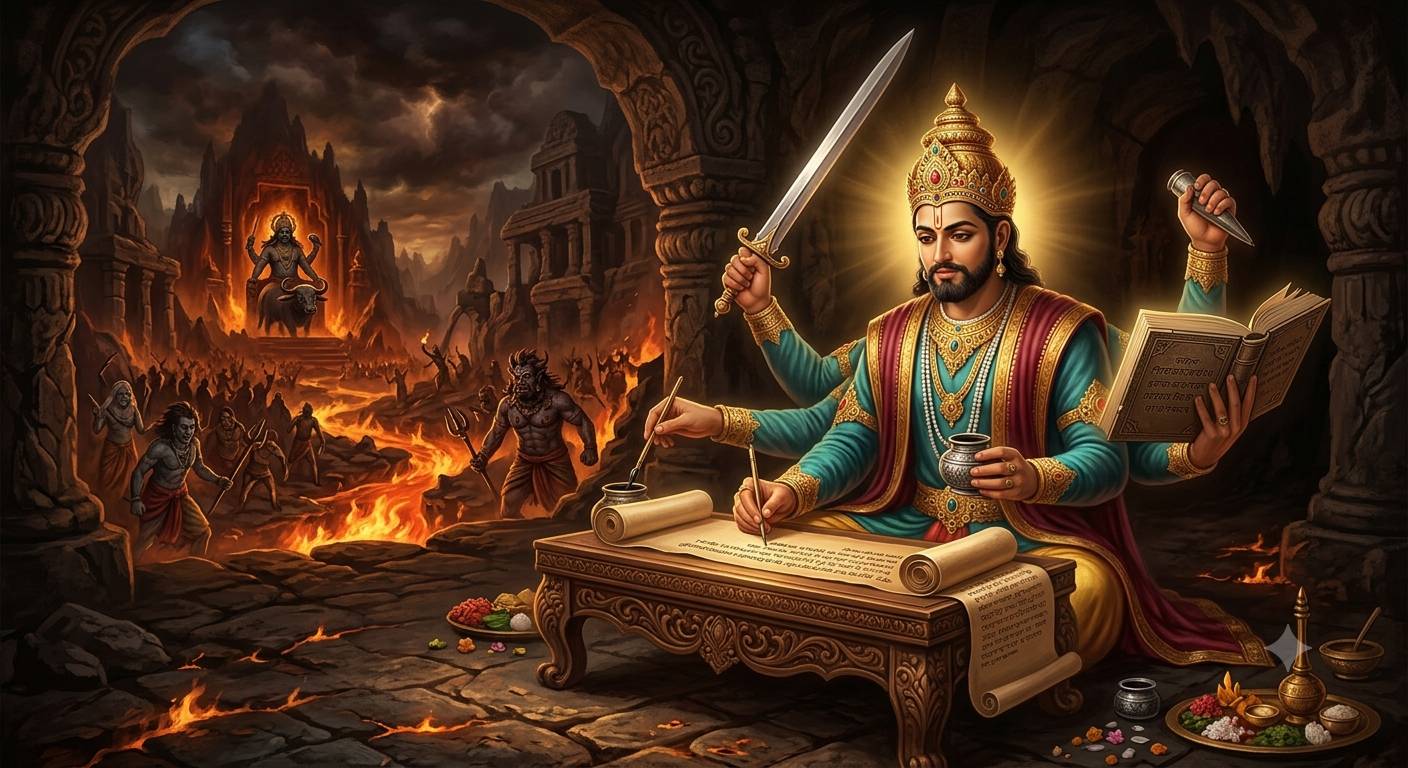
Chitragupta is the divine scribe who sits beside Yama in the court of the dead, recording the complete history of every soul's actions in life — every good deed, every harm, every word. When a soul arrives before Yama, Chitragupta reads from his register and the soul's fate is determined. He is the patron deity of writers and accountants, and is considered the ancestor of the Kayastha community of writers and administrators in northern India. Also known as Dharmaraj's assistant and Kayastha-dev.
Symbols & Iconography
Birth & Origin
In the Garuda Purana, when Yama complained to Brahma that he could not track all the souls arriving in his realm, Brahma meditated for 11,000 years. From this meditation Chitragupta emerged — already fully formed — from Brahma's body (Chitra = picture/complete, Gupta = hidden, suggesting he was hidden within Brahma). He is said to be the ancestor of the Kayastha community of writers and administrators in northern India.
Scriptures
Chitragupta appears in the Garuda Purana, Padma Purana, and Vishnu Purana.
Worship & Legacy
The Chitragupta Temple in Khajuraho (Madhya Pradesh) — built in the 9th–10th century CE — is one of the few temples dedicated primarily to him. His status as patron of writing makes him invoked by writers, accountants, and administrators. The Chitragupta Puja observed by Kayasthas on the second day after Diwali (Bhai Dooj) is a major community festival celebrating his role as their divine ancestor.
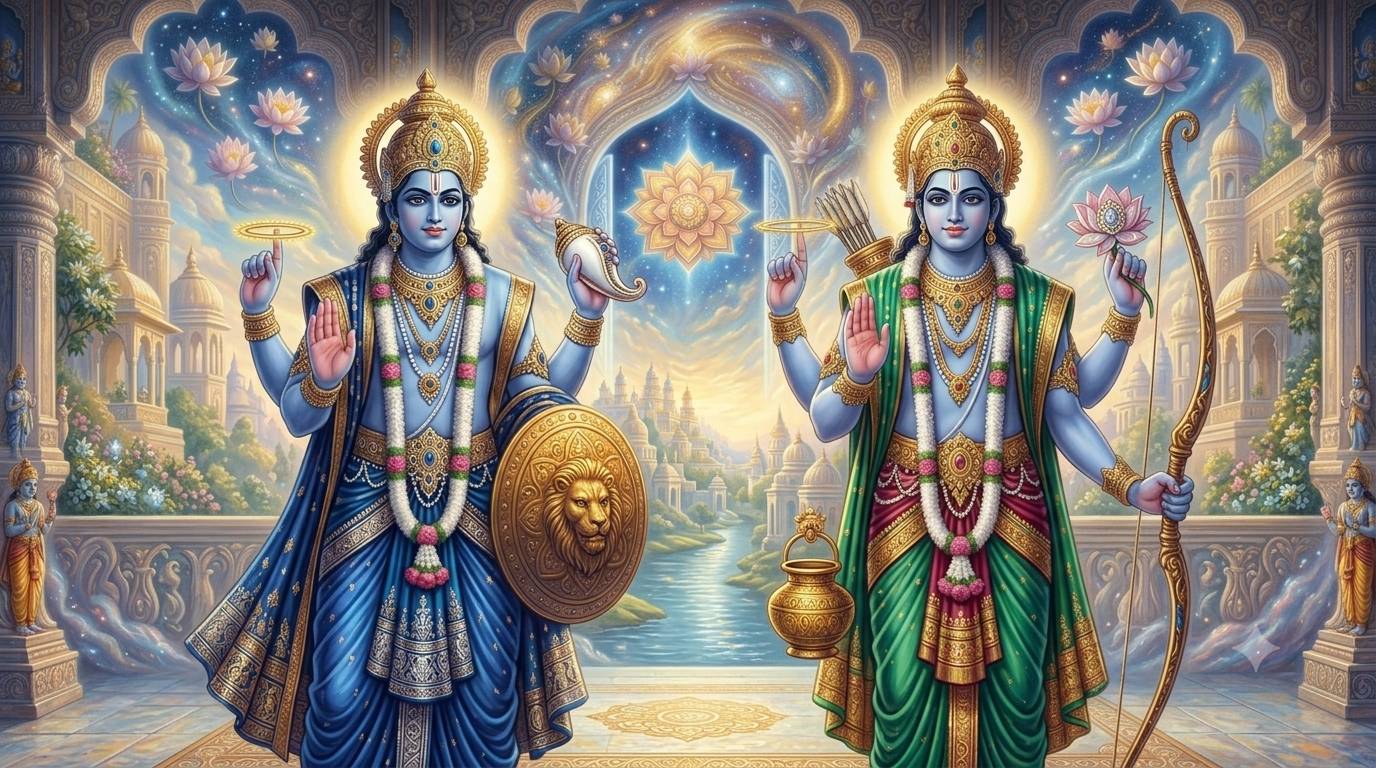
Jaya and Vijaya are the twin gatekeepers of Vaikuntha — Vishnu's celestial abode. Their story is the theological framework that explains the incarnation of major asuras in Puranic mythology: they were cursed to be born as demons in three consecutive lives before returning to their divine posts.
Scriptures
Jaya and Vijaya appear in the Bhagavata Purana (seventh canto) and the Vishnu Purana.
Worship & Legacy
The Dvarapalaka (divine gatekeeper) statues flanking the entrance to virtually every major Vaishnava temple are representations of Jaya and Vijaya. They are the theological basis for the concept that even the most fierce opposition to the divine can be understood as a form of divine service.
Key Stories
1. The Curse of the Four Kumaras
The four Kumaras — Brahma's celibate sage-sons — came to visit Vishnu in Vaikuntha. Jaya and Vijaya, not recognizing them in their childlike forms, blocked their entry. The Kumaras cursed both to be born as demons on earth. Vishnu appeared and tried to intercede, but the curse was already given. He offered them a choice: seven births as devotees of Vishnu, or three births as his enemies (returning sooner, after shorter lives of intense divine contact through combat). They chose three births. Their three pairs of births were: Hiranyaksha and Hiranyakashipu (killed by Varaha and Narasimha), Ravana and Kumbhakarna (killed by Rama), and Shishupala and Dantavakra (killed by Krishna). After the third birth they returned to Vaikuntha.
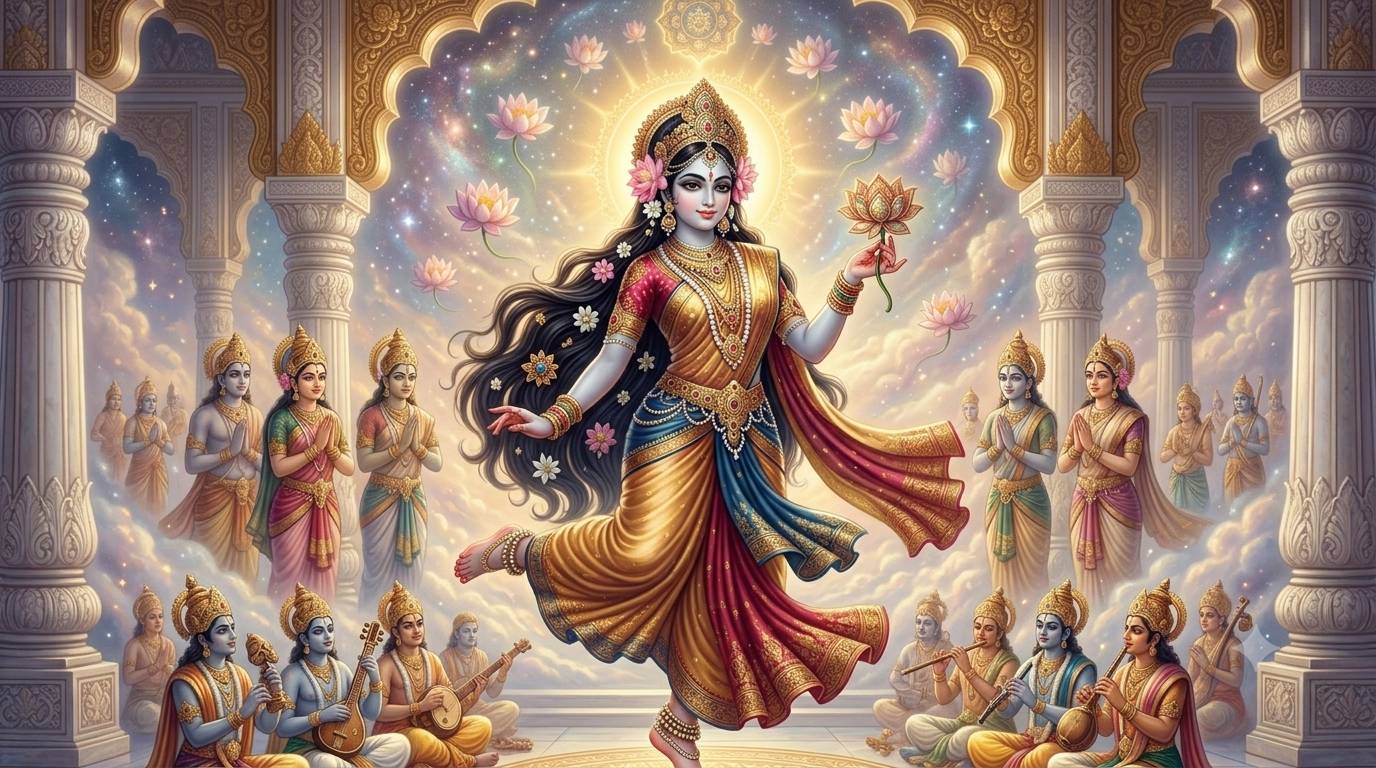
Urvashi is the most celebrated of all the Apsaras — the divine celestial dancers who inhabit Indra's heaven. She is associated with beauty, desire, and the intersection of divine and human love.
Symbols & Iconography
Birth & Origin
The sages Nara and Narayana were performing intense austerities at Badarikashrama (Badrinath). Indra, fearing their growing power, sent his finest Apsaras to disrupt their meditation. The sages were unmoved. Narayana, angered by their vanity, slapped his thigh and from it manifested a woman of such surpassing beauty that the assembled Apsaras stopped their dancing in shame. She was named Urvashi — from Uru, the Sanskrit word for thigh. The sages blessed her and sent her to Indra's court, where she became the foremost of all the Apsaras. This story is told in the Mahabharata (Adi Parva) and the Devi Bhagavata Purana.
Scriptures
Urvashi appears in the Rigveda, Vishnu Purana, Mahabharata, and Bhagavata Purana. She is the subject of Kalidasa's play Vikramorvasiyam.
Worship & Legacy
No independent worship.
Key Stories
1. Urvashi and Pururavas — Rigvedic
The dialogue of Urvashi and Pururavas in Rigveda Book 10, Hymn 95 is one of the oldest dramatic dialogues in Sanskrit literature. Pururavas, a mortal king, had lived with Urvashi for years but violated the conditions she had set. She left. He searched for her in grief. Their reunion and separation is one of the foundational love stories of the Sanskrit tradition, elaborated in the Vishnu Purana and Kalidasa's play Vikramorvasiyam.
2. Urvashi's Curse on Arjuna
During Arjuna's year in Indra's heaven, Urvashi desired him. Arjuna respected her as a mother — Pururavas, her former lover, was his ancestor. He refused. She cursed him to live as a eunuch for a year. Indra consoled Arjuna that the curse would be useful — it served as his disguise during the thirteenth year of exile at Virata's court.
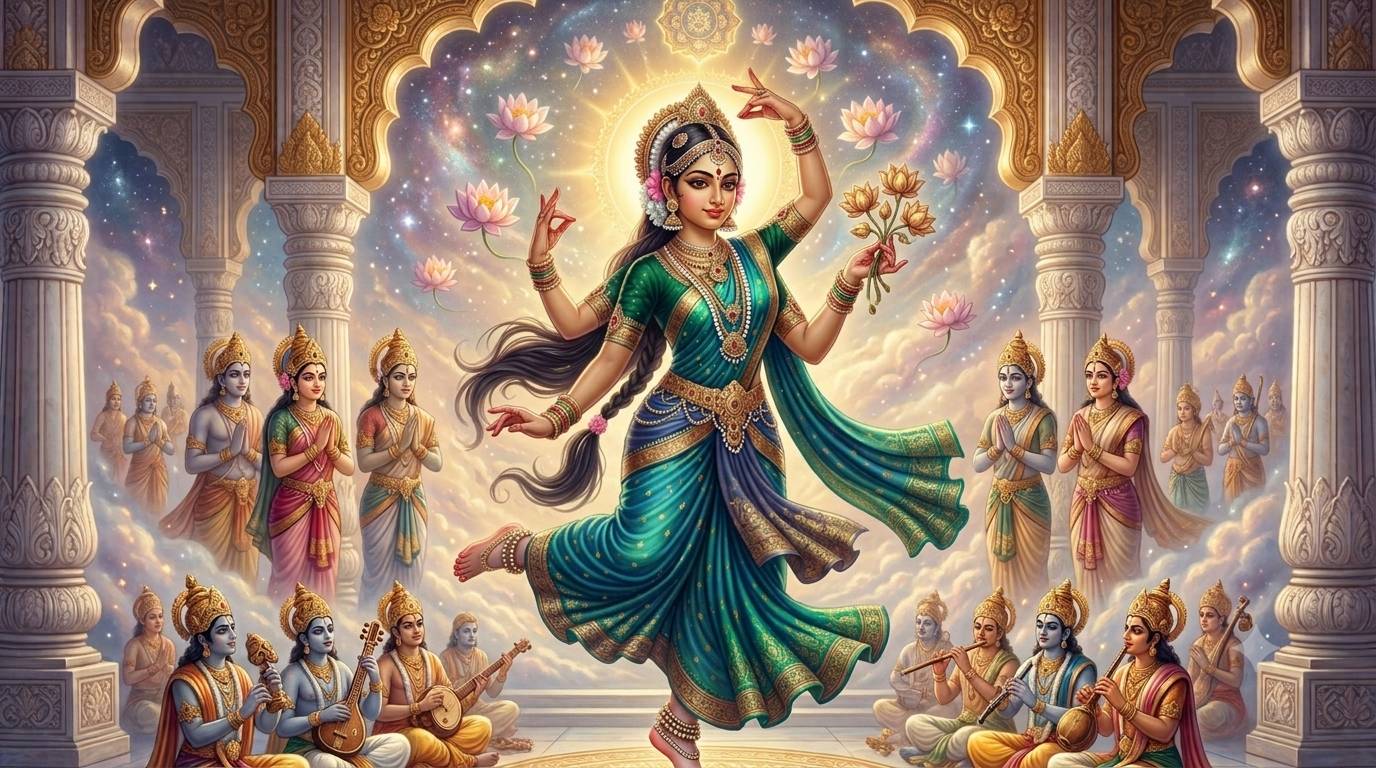
Menaka is an Apsara sent by Indra to break Vishwamitra's austerities — which were so powerful they threatened to destabilize the heavens. She is the mother of Shakuntala — the heroine of Kalidasa's most celebrated play.
Birth & Origin
Menaka's origin is given differently across texts — some place her among the Apsaras who emerged from the Samudra Manthan, others as a being created directly by Brahma. She is listed among the foremost Apsaras of Indra's court in the Mahabharata alongside Rambha, Urvashi, and Tilottama.
Family
Father: Brahma (in some accounts). Daughter: Shakuntala (by Vishwamitra). Shakuntala's son was Bharata — the legendary emperor from whom the name Bharatavarsha (India) derives.
Scriptures
Menaka appears in the Mahabharata and is the subject of Kalidasa's Abhijnanashakuntalam.
Worship & Legacy
No independent worship.
Key Stories
1. The Seduction of Vishwamitra
Indra sent Menaka to distract Vishwamitra from his meditation. She succeeded — Vishwamitra fell in love and they lived together for years. When he realized how much time had passed and how far he had fallen from his tapas, he dismissed Menaka gently (acknowledging it was not her fault) and returned to his austerities. Their daughter Shakuntala was born and left by Menaka in the forest, found and raised by the sage Kanva. Shakuntala later fell in love with King Dushyanta — their story is the subject of Kalidasa's Abhijnanashakuntalam, considered the finest Sanskrit play ever written.
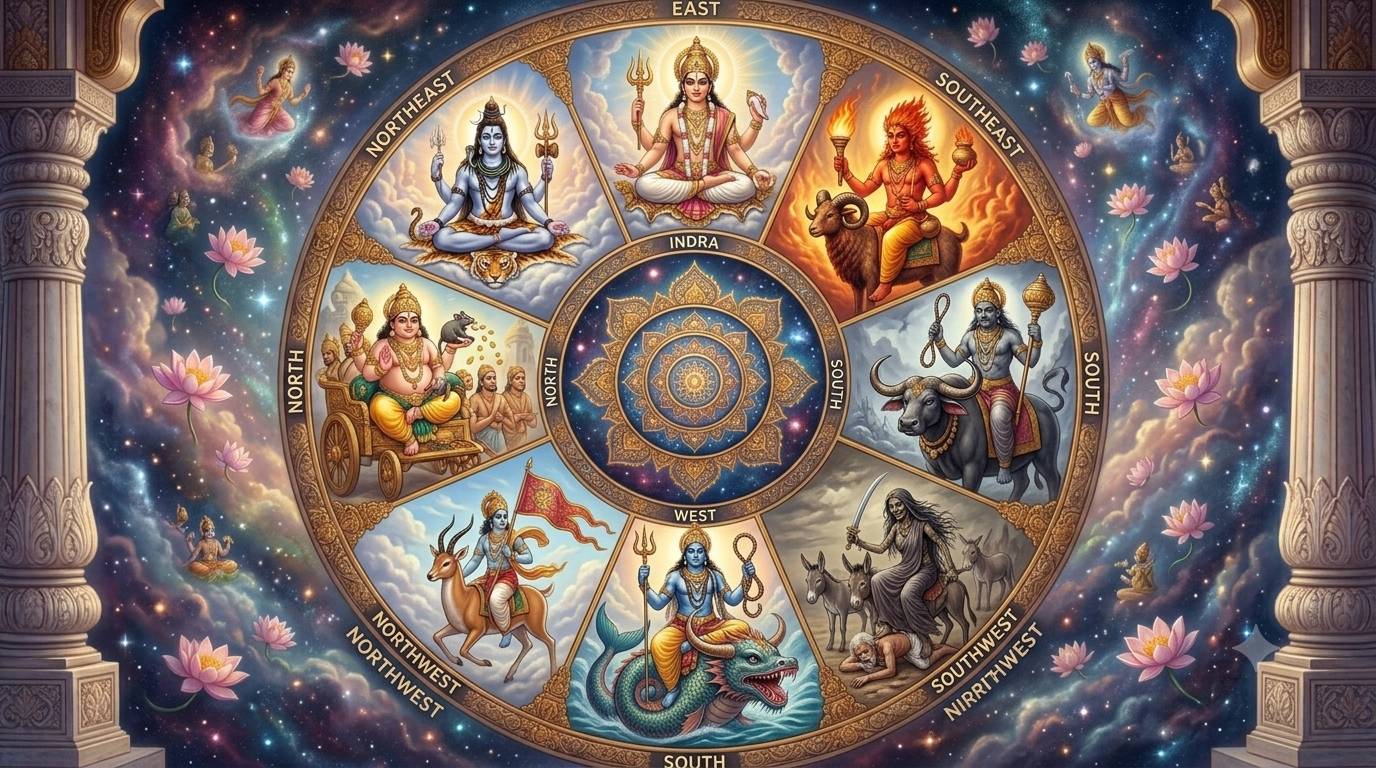
The Ashtadikpalas are the eight guardian deities of the eight cardinal and intercardinal directions. They are present in every major Hindu and Buddhist temple, protecting the space from all directions. Most of them are major deities in their own right; a consolidated reference to the eight is given here.
The Eight Guardians
- East — Indra: King of the gods, carrying the Vajra, riding Airavata.
- Southeast — Agni: God of fire, carrying a torch, riding a ram.
- South — Yama: God of death, carrying a noose and staff, riding a buffalo.
- Southwest — Nirrti (Nirriti): Goddess of decay, dissolution, and the southwest, associated with the forces of chaos and entropy. She carries a sword and rides a human being or a donkey. Among the older Vedic deities, appearing in the Rigveda as a personification of misfortune and death; she has no major temples but is propitiated in funeral rituals.
- West — Varuna: God of cosmic waters and moral order, carrying a noose, riding a Makara.
- Northwest — Vayu: God of wind, carrying a flag, riding an antelope or deer.
- North — Kubera: God of wealth, carrying a club and a mongoose, riding a man or a chariot.
- Northeast — Ishana (Shiva): Shiva as the lord of the northeast — the most auspicious direction in Vastu Shastra, governing wisdom and divine grace.
Worship & Legacy
The Ashtadikpalas are present in every major South Indian temple as directional protector sculptures on the outer walls or in dedicated shrines. The Vastu Purusha Mandala — the sacred diagram underlying traditional Indian architecture — is organized around their placement.
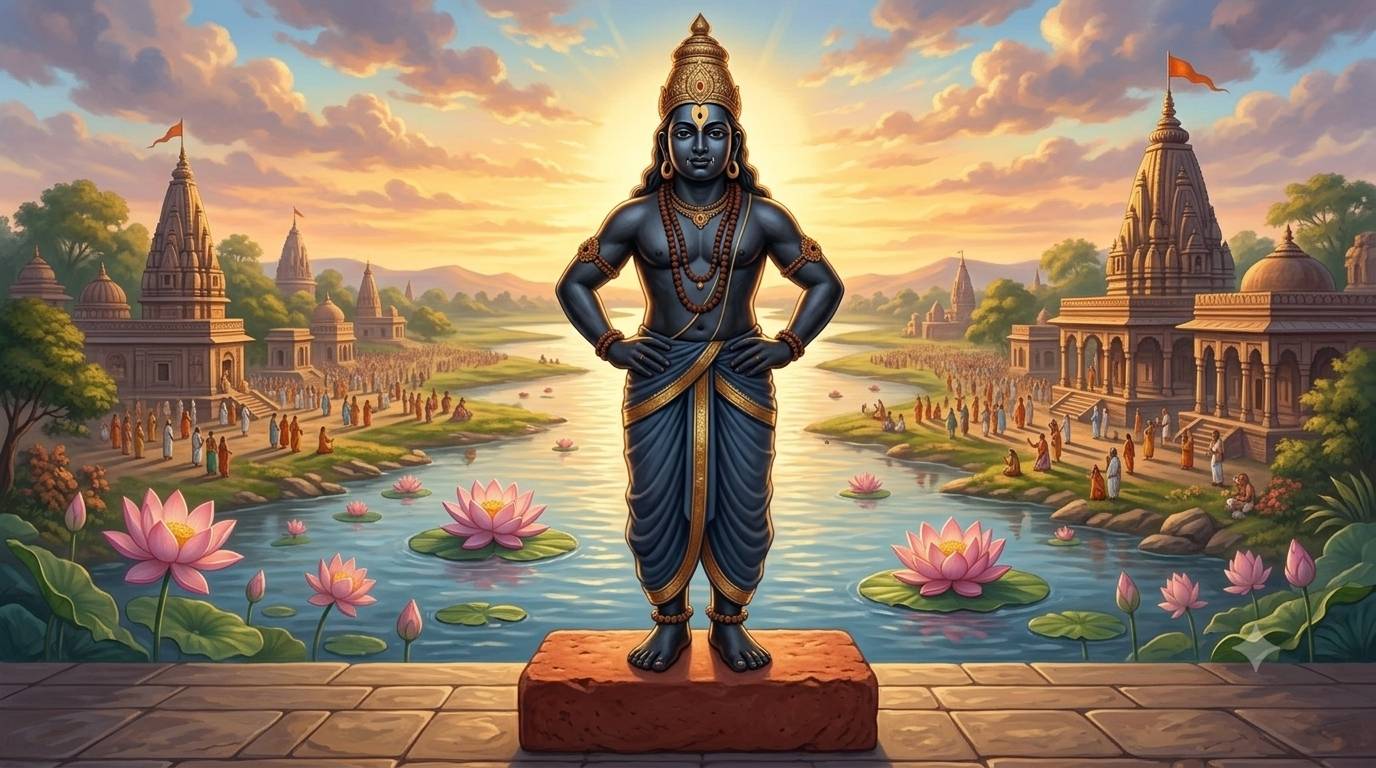
Vithoba is the presiding deity of the Pandharpur temple in Maharashtra — a beloved form of Vishnu/Krishna in the Varkari tradition. He is the god of patient love — the deity who waits for those who come to him. Also known as Vitthal and Pandurang (the fair one).
Symbols & Iconography
Scriptures
Vithoba is the subject of the extensive Varkari devotional literature in Marathi — the poetry of Dnyaneshwar, Namdev, Eknath, Tukaram, and hundreds of other saints.
Worship & Legacy
The Pandharpur Wari — the bi-annual pilgrimage to Pandharpur — draws between one and two million pilgrims walking in procession from across Maharashtra. The Varkari tradition is one of the most socially inclusive devotional movements in Indian history, emphasizing direct devotion over caste hierarchy. The Marathi devotional poetry (abhanga) of the Varkari saints — particularly Tukaram — is among the finest devotional literature in any Indian language.
Key Stories
1. Pundalik and the Brick
The story of Vithoba's temple at Pandharpur begins with the devotee Pundalik. Krishna himself came to visit Pundalik, but found him busy serving his aged parents. Pundalik threw a brick toward Krishna so he would have somewhere to stand and wait while Pundalik finished his duty. Krishna waited — and remained, eternally, on that brick. This story makes Vithoba the god of service to family alongside service to the divine.
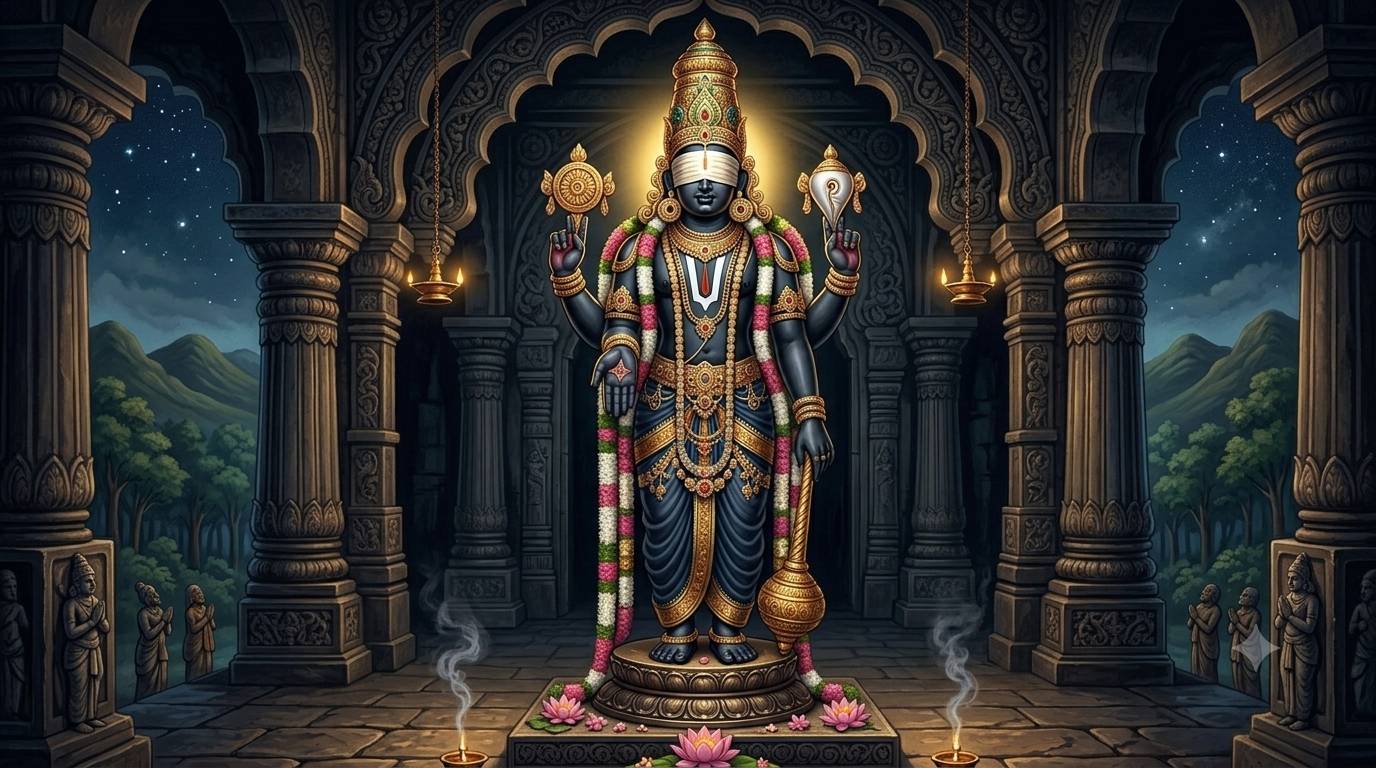
Venkateswara is the form of Vishnu worshipped at the Tirumala Venkateswara Temple in Tirupati, Andhra Pradesh — the most visited Hindu pilgrimage site in the world, receiving between 50,000 and 100,000 pilgrims daily. He is the lord of the Venkata hill and is considered by his devotees to be the most directly accessible form of the divine in the current Kali Yuga. Also known as Balaji (in North India), Srinivasa, Govinda, and Ezhumalaiyan (lord of the seven hills in Tamil). The Tirumala hill was a Buddhist site before its conversion to a Hindu shrine — a transition that occurred as Buddhism declined in South India between the 8th and 12th centuries CE.
Symbols & Iconography
Birth & Origin
The theological origin of the Tirumala form involves a story from the Bhavishyottara Purana and the Venkatachala Mahatmya: Vishnu descended to earth as Srinivasa and married the local princess Padmavathi. To pay the wedding debt owed to Kubera for financing the wedding, he is said to still be repaying — the donations of pilgrims going toward this cosmic debt, which will be fully repaid at the end of the Kali Yuga.
Worship & Legacy
The Tirumala temple receives approximately ₹600–700 crore (roughly $75–85 million USD) in annual donations — making it the wealthiest religious institution in the world. The hair-tonsuring tradition — in which devotees shave their heads and offer their hair as a vow — generates approximately 800 tons of hair annually, sold internationally for wig manufacturing. The Brahmotsavam festival at Tirupati is one of the largest annual religious festivals in India. The Tirumala Tirupati Devasthanams (TTD) runs hospitals, schools, and charitable institutions funded by temple donations.
Key Stories
1. The Son-in-Law of a Muslim General
A living tradition among Muslim communities of Rayalaseema holds that Venkateswara married Bibi Nancharamma, the daughter of a Muslim general, in 1311 CE, after she protected the deity's image from raiders. Her idol is present in the Tirumala temple precincts, and Muslim devotees from across Rayalaseema make an annual pilgrimage to the temple, treating Venkateswara as their son-in-law.
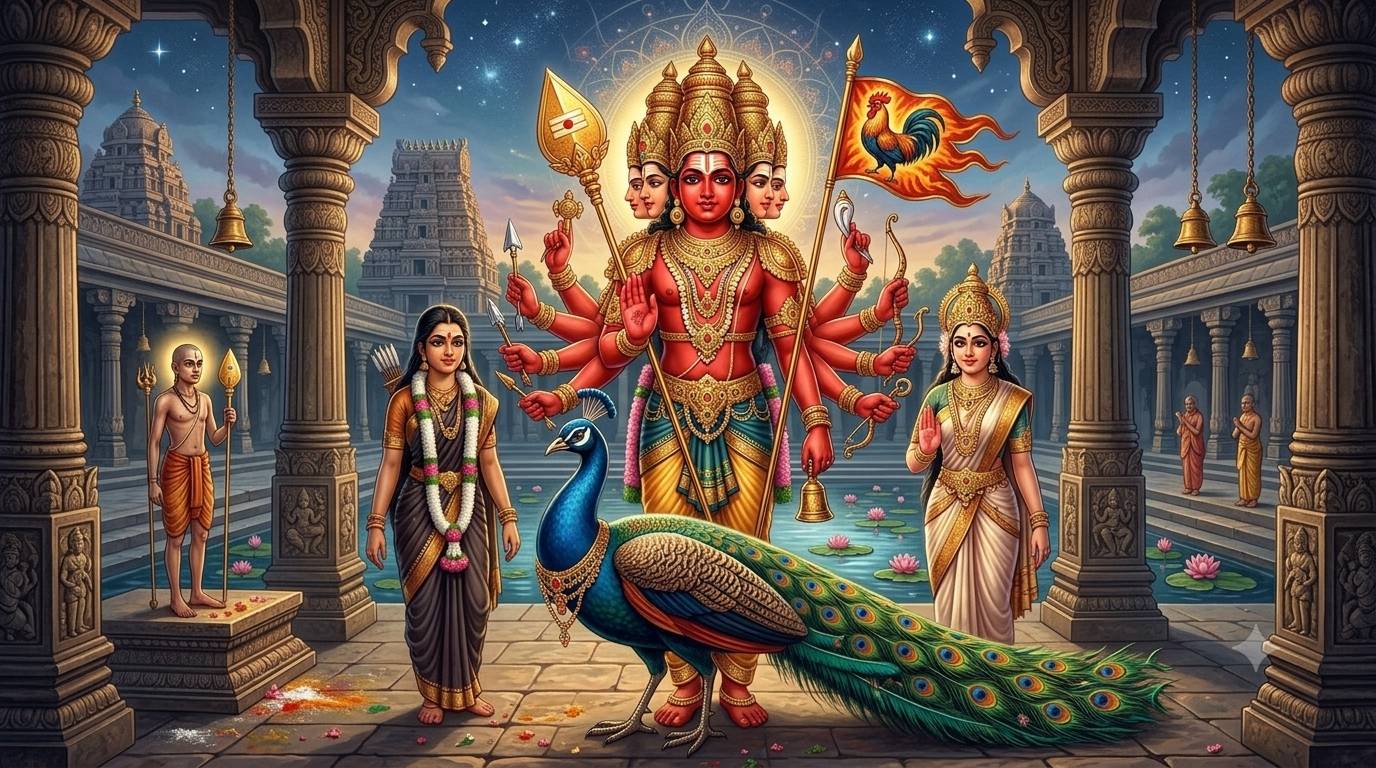
Murugan in the Tamil tradition is not merely the Sanskrit Kartikeya transplanted — he is one of the oldest and most deeply rooted deities of the Tamil people, with a continuous devotional tradition predating the Puranic period. In Sangam-era Tamil literature (c. 300 BCE – 300 CE) he is Murugan or Seyon — the red god of the hills and forests — worshipped in the Kurinji (hill) landscape. He is the patron of the Tamil language and of the Tamil people. Also known as Senthil, Saravana, and Kumaran.
Birth & Origin
Murugan's birth is told differently across texts. In the Mahabharata — the earliest elaborate account — he was born from Agni (fire) and Svaha, who impersonated six of the seven wives of the Saptarishi. The Atharva Veda describes him as a son of Agni. In the Skanda Purana and the Tamil Kanda Puranam — the dominant South Indian tradition — he is born from Shiva's third eye fire, carried by the Ganga, nurtured by the six Krittikas (the Pleiades), and is the son of Shiva and Parvati. Kalidasa's Kumarasambhava celebrates this birth in detail. In the Sangam Tamil tradition he is Seyon — the Red One — whose worship predates the Sanskrit Skanda mythology and was identified with it gradually from around the 4th century BCE onward.
Worship & Legacy
The six Arupadai Veedu (six battle abodes of Murugan) are the most sacred pilgrimage sites in Tamil Shaivism: Palani, Tiruchendur, Swamimalai, Thiruttani, Pazhamudircholai, and Thiruparankundram. Thaipusam — the most dramatic Hindu festival in the world, in which devotees carry Kavadi and pierce their bodies with skewers as acts of devotion — is celebrated by Tamil Hindus in India, Malaysia, Singapore, Mauritius, and South Africa. The Palani Dhandayuthapani Temple is among the wealthiest in South India.
Key Stories
1. Murugan and Valli — The Tamil Love Story
In the Tamil tradition, Murugan's pursuit and winning of the tribal girl Valli — who guards her family's millet fields on a hill — is the defining story of his character. He disguises himself, enlists Ganesha's help (as an elephant), and ultimately wins her. Their marriage represents the divine seeking the human soul across any boundary of culture, tribe, or background. This story has no full Sanskrit parallel and is distinctly Tamil.
2. Murugan Teaches Brahma — and Shiva
Brahma was unable to explain the meaning of the Pranava mantra (Om) to Murugan's satisfaction. Murugan imprisoned Brahma and took over the role of creator. Shiva had to intervene and ask Murugan to release Brahma. Shiva then asked Murugan to explain the meaning of Om — and Murugan whispered it into his own father's ear, becoming Shiva's guru. This is why Murugan is worshipped at Swamimalai as Swaminatha — the Lord who became his father's teacher.
3. The Defeat of Surapadman and the Peacock
Surapadman was the most powerful Asura of the age — his boon of near-immortality made him unconquerable. Murugan fought him for six days with his divine armies. On the sixth day — Skanda Shashti — Murugan hurled his Vel at Surapadman, who had transformed himself into a vast mango tree. The Vel split the tree in two. Murugan, in an act of grace, transformed the two halves — one became the peacock that is his vahana, the other the rooster on his flag. This is why the peacock and rooster are inseparable from Murugan's iconography.
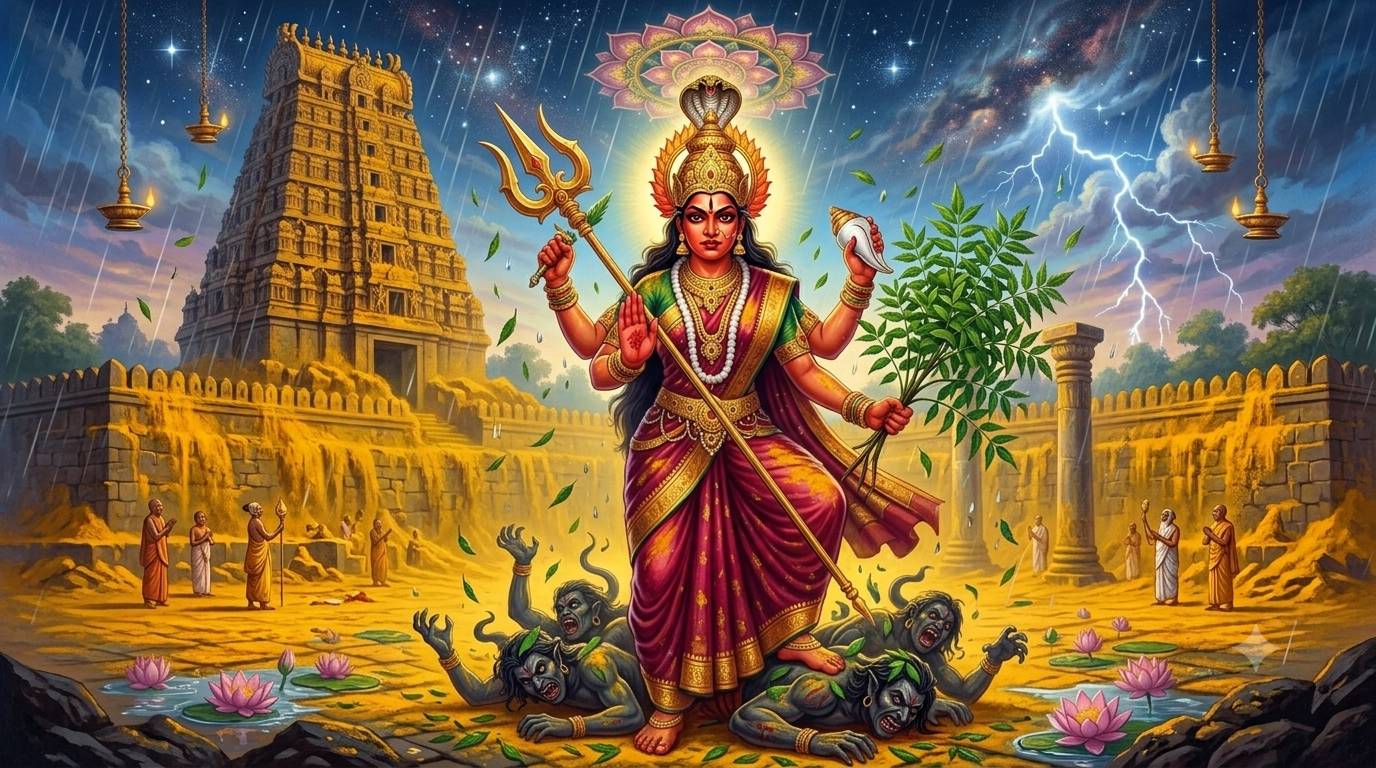
Mariamman is a fierce goddess of South India who governs smallpox, chickenpox, and other diseases, as well as rain, fertility, and village protection. She is not simply a healing goddess — she both sends and removes disease. Her visitation as pox is understood as her presence, her touch on the skin; cooling her anger through ritual removes the disease. She is identified by scholars as both an independent folk deity and a form of Parvati/Durga.
Symbols & Iconography
Worship & Legacy
Mariamman temples are the primary temples of many Tamil villages across Tamil Nadu and the Tamil diaspora worldwide, including Singapore, Malaysia, South Africa, and Mauritius. The Mariamman Temple in Samayapuram near Trichy is among the most visited temples in Tamil Nadu. The Mariamman Thiruvizha festival involves fire-walking as an act of devotion. Her worship predates Brahminic Hinduism and has existed alongside it continuously — one of the oldest living religious traditions in South India. In Karnataka and Andhra Pradesh she is known as Renuka Devi, and in some traditions as Yellamma — related but distinct regional forms with their own mythologies. Her worship extends across Tamil Nadu, Karnataka, Andhra Pradesh, and Sri Lanka.
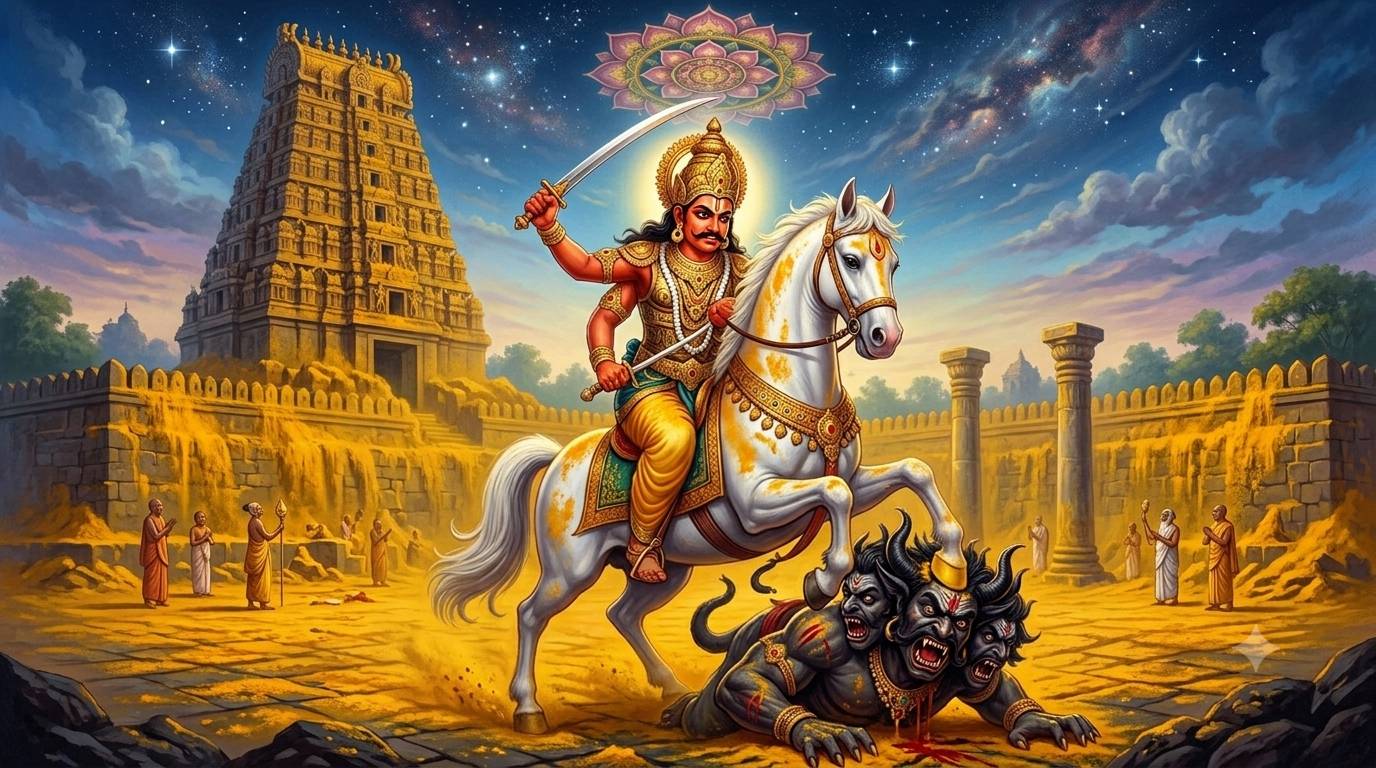
Khandoba is a warrior form of Shiva worshipped across Maharashtra, Karnataka, Goa, and Andhra Pradesh. He is the family deity (Kuladaivata) of large numbers of Maharashtrian families across agricultural, pastoral, and warrior communities. Also known as Martanda Bhairava, Mailara, Malhari, and Khanderaya.
Symbols & Iconography
Birth & Origin
A manifestation of Shiva, called forth to defeat the demons Mani and Malla who were terrorizing the world.
Family
Consorts: Mhalsa (the wife of the demon Mani, absorbed into his worship after his defeat) and Banai (a tribal woman who became his second consort). The defeated demons Mani and Malla became his gatekeepers.
Scriptures
Khandoba's mythology is preserved in the Malhari Mahatmya, a regional text specific to his tradition, and in the oral tradition of the Varkari and Dhangar communities.
Worship & Legacy
The Jejuri temple near Pune is the most significant Khandoba shrine in India, famous for the enormous quantities of turmeric powder thrown by devotees during Champashashthi. Swami Vivekananda's family deity was Khandoba. The Shinde, Patil, and Dhangar communities count him as their Kuladaivata.
Key Stories
1. The Defeat of Mani and Malla
Mani and Malla were demons terrorizing the three worlds. Shiva manifested as Khandoba and fought them. At the moment of their defeat, Mani and Malla begged to be incorporated into his worship rather than destroyed. Khandoba agreed — their wives became his consorts, and the demons themselves became his gatekeepers. The lemon carried by Khandoba in some depictions refers to this battle. This absorption of defeated enemies into divine service rather than their annihilation is a recurring feature of Maharashtra's folk deity traditions.
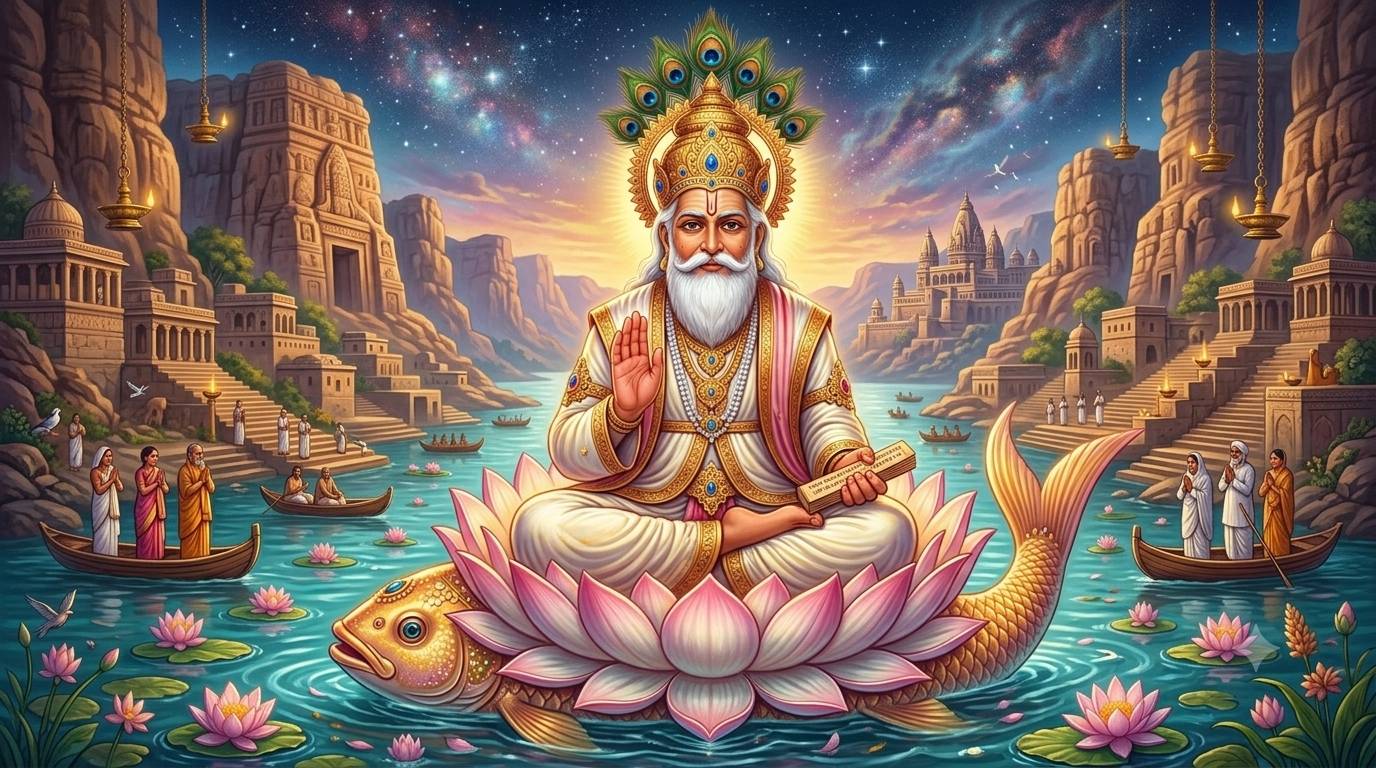
Jhulelal is the patron deity of the Sindhi people — the Hindu community whose homeland was the Sindh region (now Pakistan). He is considered an incarnation of Varuna (god of waters) and is associated with the Indus river. He is the protector of a minority community facing persecution — his story is a model of divine intervention in defense of religious freedom. Also known as Uderolal, Lal Sain, and Darya Lal (lord of the river).
Symbols & Iconography
Birth & Origin
When the Sindhi Hindu community faced religious persecution from the ruler Mirkhshah in the 10th century CE, they prayed to the Indus river for forty days. On the fortieth day a divine child was born to a pious couple in Nasarpur — named Uderolal. His cradle rocked on its own, giving him the name Jhulelal (the swinging one).
Scriptures
Jhulelal's story is preserved in the oral tradition of the Sindhi community and in regional texts including the Sindhi Granth. He is not found in Vedic or Puranic texts — his tradition is entirely regional and folk in origin.
Worship & Legacy
Cheti Chand — the Sindhi New Year, celebrated on the second day of Chaitra — is the primary Jhulelal festival, marking his birth. Since Partition (1947), the Sindhi diaspora scattered across India and worldwide has maintained his worship as a central marker of cultural identity. The joint Hindu-Muslim shrine at Udero Lal in Sindh (now Pakistan) — built in 1684 CE — remains a place of pilgrimage for both communities.
Key Stories
1. The Confrontation with Mirkhshah
Mirkhshah summoned the miraculous child. Jhulelal appeared before him simultaneously as an old man and a young boy — demonstrating his divine nature. He warned Mirkhshah to grant religious freedom or face divine wrath. Every attempt to kill him failed. Mirkhshah eventually relented and religious tolerance was restored in Sindh. At the site of their reconciliation a joint Hindu-Muslim shrine was built — still standing — where both communities worship together.
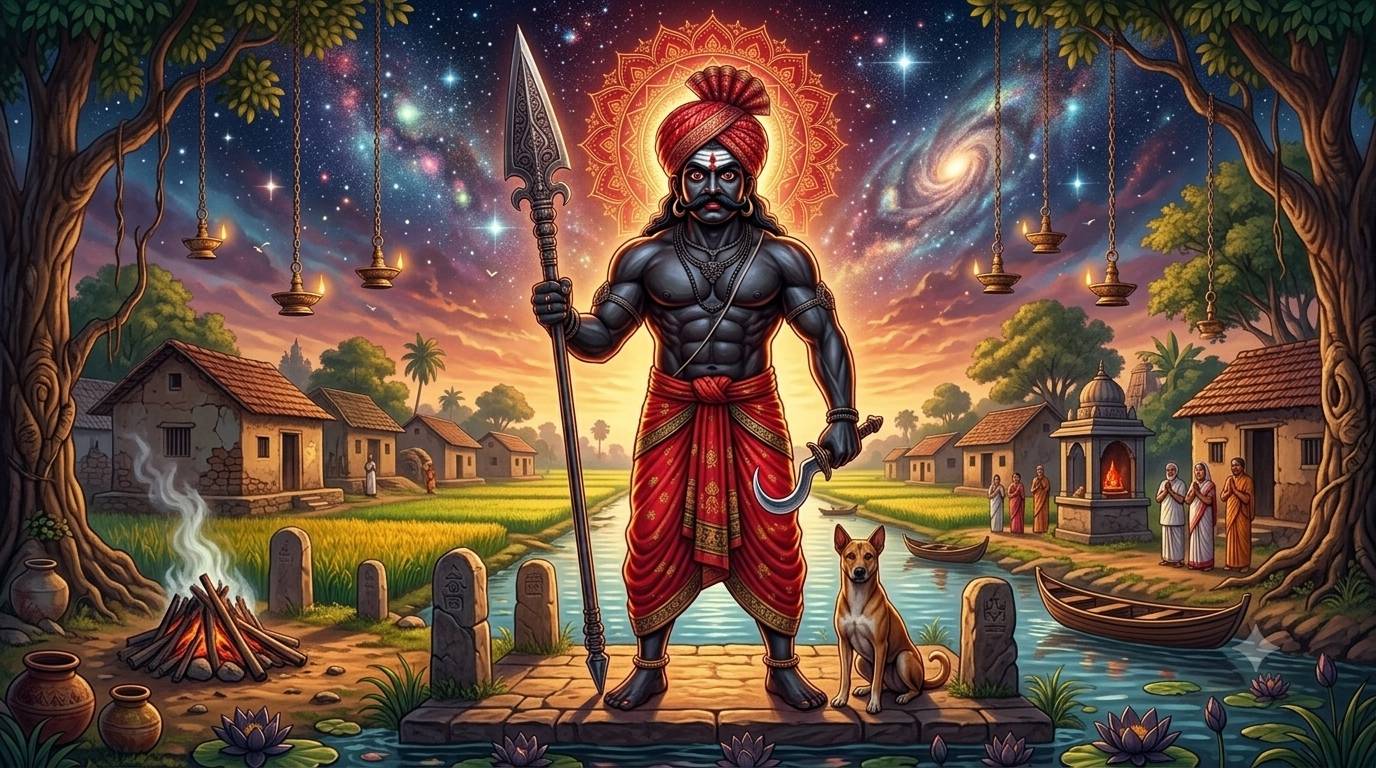
Karuppasamy (also spelled Karuppan, Karuppuswami) is one of the most widely worshipped folk deities of Tamil Nadu — a fierce, dark-complexioned guardian deity associated with village protection, agriculture, justice, and the punishment of wrongdoers. His name means "black god" (Karuppu = black). He is understood as a form of Shiva's Bhairava or as an independent folk deity who protects the boundaries of villages and punishes oath-breakers. Also known as Sudalai Madan (lord of the cremation ground) in some traditions.
Symbols & Iconography
Worship & Legacy
Karuppasamy is one of the most common folk deities in Tamil Nadu — nearly every village has a Karuppasamy shrine. He is worshipped with raw offerings, liquor (in some traditions), and animal sacrifices (in some communities, though this practice varies). He governs oaths — promises made in his name are considered absolutely binding. His worship spans agricultural communities, Dalit communities, and warrior castes across Tamil Nadu and the Tamil diaspora.